


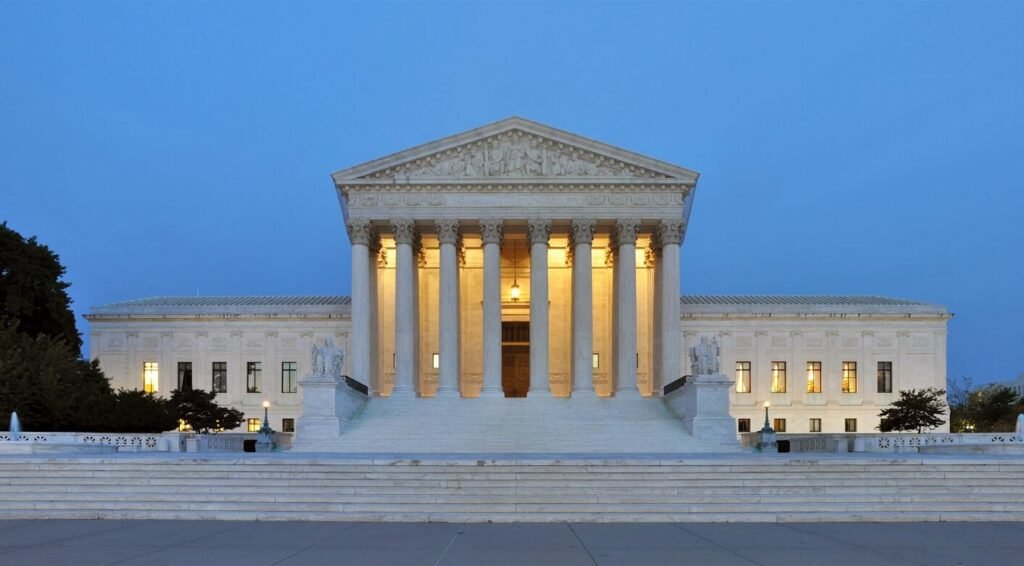
The Supreme Court on Monday (April 6) vacated a lower court ruling that ordered internet provider Grande Communications to pay $46.7 million in damages to a group of record labels for infringement in November 2022.


The highest court in the US wrote: “The petition for a writ of certiorari is granted. The judgment is vacated, and the case is remanded to the United States Court of Appeals for the Fifth Circuit for further consideration in light of Cox Communications, Inc. v. Sony Music Entertainment.”
The decision comes as the Supreme Court last month ruled unanimously in Cox v. Sony Music that internet service providers cannot be held liable for copyright infringement committed by their users, unless the provider actively induced the infringement or provided a service tailored to that infringement — meaning a service not capable of substantial noninfringing uses.
In 2019, a jury in Virginia found Cox guilty of indirect copyright infringement carried out by its users. It awarded damages of $99,830.29 for each of 10,017 infringed musical works, amounting to slightly over $1 billion.
However, in early 2024, the 4th Circuit Court of Appeals partially overturned that verdict, deciding that Cox couldn’t be held liable for “vicarious” copyright infringement, because it wasn’t proven that the company directly profited from its subscribers’ piracy.
Cox then filed a petition for certiorari with the Supreme Court in August 2024, and by June 2025, the Supreme Court agreed to hear the case.
“The petition for a writ of certiorari is granted. The judgment is vacated, and the case is remanded to the United States Court of Appeals for the Fifth Circuit for further consideration in light of Cox Communications, Inc. v. Sony Music Entertainment.”
Supreme Court
Following the landmark ruling on Cox v. Sony, handed down on March 25, Grande Communications, a Texas-based subsidiary of Astound Business Solutions, filed for its petition for certiorari, or a review of a lower court’s decision, after losing its copyright infringement case against a group of record labels in 2022.
When the ruling was handed down in 2022, the RIAA said the court found the company to be liable for “willful infringement of 1,403 copyrighted sound recordings.”
The RIAA noted in its press release at the time that under federal law, internet providers are not allowed to be “willfully blind to online piracy on their networks”.
However, in the latest ruling in favor of Cox in its Sony case, Justice Clarence Thomas wrote: “Under our precedents, a company is not liable as a copyright infringer for merely providing a service to the general public with knowledge that it will be used by some to infringe copyrights.”
In 2023, the trial court denied Grande’s motion and by October 2024, the Fifth Circuit Court of Appeals upheld the liability finding, prompting Grande to file for a petition for certiorari.
Grande was sued by the major labels in 2017, alleging it ignored years of infringement notices and took no meaningful action to discourage what they describe as “theft” of copyrights, according to the original complaint, which you can read here.
The Supreme Court’s latest order vacated the 2022 judgment and remanded the case to the Fifth Circuit for reconsideration in light of Cox v. Sony Music.
The Cox v. Sony ruling is expected to ripple beyond Grande. Elon Musk’s X Corp has already cited the decision to argue that music publishers’ long-running copyright infringement case against the platform should be thrown out.
In a court filing obtained by MBW, dated March 27 — just two days after the Cox decision was handed down — X’s lawyers told the Nashville federal court that “under Cox, the liability theories that survived X’s motion to dismiss fail as a matter of law.”
X has requested a status conference with the court and signaled its intention to file a motion for judgment on the pleadings, arguing that the Supreme Court’s new legal standard renders the publishers’ surviving claims defunct.
Aside from Grande, record labels Sony, Universal, Warner and ABKCO Music also filed a $2.6 billion lawsuit against Verizon in 2024 over similar allegations.
Elsewhere, Meta recently invoked the Cox ruling in its latest summary judgment filing against Epidemic Sound. Epidemic Sound filed a second copyright infringement lawsuit against the Facebook parent in December, alleging that the tech giant continues to infringe the music company’s catalog across Facebook, Instagram and WhatsApp.
Epidemic filed its first lawsuit against Meta in July 2022, which remains active before Judge Jacqueline Scott Corley in the same court. That case sought at least $142 million in damages.
Music Business Worldwide