


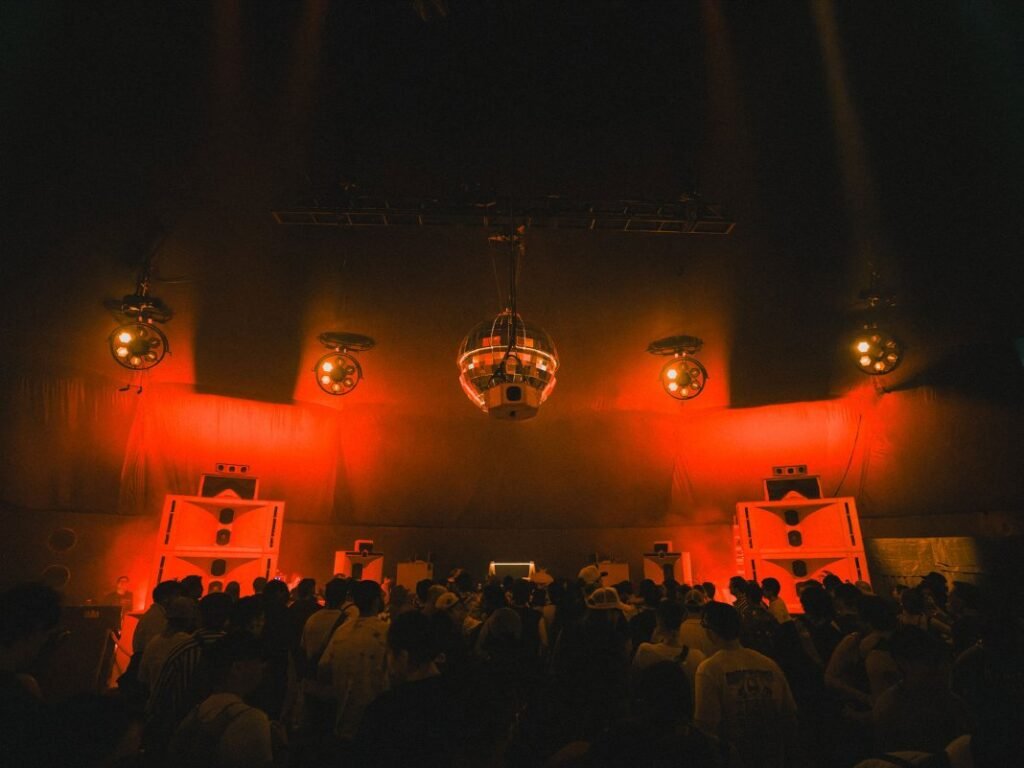
There were way fewer heads at Head Trip than I expected.
All weekend, I only had to wait in line to get into the Sunflower Sound System twice, and both times were in the earlier part of the day. Despite it being the first time Floating Points’ custom-built hi-fi audio experience had ever landed in North America, as soon as the big headliners hit the main stage, that’s where most of the festival‘s attendees wanted to be.
Most people I spoke to either had never heard of Sunflower or wandered in as a “sidequest,” not paying any mind to the pristine sound quality. Of course, enjoying Skrillex, Calvin Harris, and Swedish House Mafia in a row on the same stage is heady as well. Talk about one of the most epic single-day lineups in rave history.
But Sunflower Sound System was a technical and musical marvel. Floating Points, real name Sam Shepherd, went on a decade-long journey around the globe to search for the specific components he needed to build his ideal loudspeaker system, and it was well worth it. Head Trip marketed the sound itself as the headliner, and that was exactly the case.
The music from these eight, 14-foot-tall speaker stacks felt real. Tangible. Avalon Emerson, one of the DJs who played Sunflower at Head Trip and Glastonbury in 2025, shares her thoughts:
“Sound is number one. Either you consciously or unconsciously appreciate it. It affects everybody for sure,” Emerson says. “I respect the desire to build something like this and share it. It is such a different dance music experience, and that variety of experience is sorely needed. I’m very happy that Sunflower came over to the U.S. for this, and I got to play on it.”


Jacques Vincent was very happy Emerson was playing on the system as well. He came to Head Trip “very much” to experience Sunflower, and Emerson and Floating Points were his top two artists to listen to.
“I love Floating Points. Seeing the Sunflower system is a huge deal for me. I want to support whatever he does. Also, he’s a huge music nerd, so I know whatever he does is going to be exceptional,” Vincent says before calling the sound quality “incredible.”
The room also gets a ton of credit for the quality. Head Trip was produced by Goldenvoice, the promoter responsible for Coachella. Coachella has hosted the Yuma tent, its on-site nightclub, since 2013. The festival also hosted two separate runs of Despacio, the custom McIntosh-powered sound system designed by James Murphy, lead singer of LCD Soundsystem, and David and Stephen Dewaele, better known as Soulwax and 2manydjs.
READ MORE: Why festivals are booking hi-fi sound systems on their lineups
Needless to say, Goldenvoice has considerable experience building temporary structures to house sound systems, and, according to Jess Xanthe, the Head Trip experience was better than Dekmantel, the celebrated leftfield electronic music festival in Amsterdam.
Xanthe was one of the few attendees I met who spent the entire weekend in Sunflower. While few of the attendees followed her lead, those who did heard selections from a lineup hand-picked by Floating Points.
Day one featured Mad Professor, Theo Parrish, and “Floating Points and Friends,” exploring the far corners of music. Legendary dub producer Mad Professor busted out his bespoke live setup with a full mixing desk and analogue tape machines to play dub versions of irrefutable hits like Billie Jean and I Shot the Sheriff.
Passively or actively, people have heard these songs thousands of times throughout their lives. But this will likely be the only time they’ll hear them with live remixed basslines and vocals, literally creating an experience that can never be replicated. Then, after that, Theo Parrish was sifting through vinyl for hours, playing everything from funk classics to free-form jazz noise.

Day two was the rave day. Zach Cowie, Ben UFO, Emerson, Eris Drew & Octo Octa all played, with a closing back-to-back featuring Four Tet and Floating Points, as well as Ben UFO and Emerson once again. These lauded club DJs brought their absolute A-game under some extra lights and lasers to spice up the visuals. No set times were released for Sunflower, which may have deterred some people from checking it out, but for those who were there for it, the surprise was everything.
I walked in towards the end of Ben UFO’s set when he closed with a heavy old-school dubstep track. Eris Drew and Octo Octa played a breakbeat tune that had the fattest snare I’ve ever heard. Floating Points closed, playing music that stretched the boundaries of his creation.
Moreover, Emerson told me that all the DJs received a multi-page PDF of exactly how to get the best use of the sound system. Shepherd also curated the gear for the room, which included his custom Isonoe rotary mixer.
“On my DJ Rider, there’s a part that says, ‘I like this mixer,’ but sometimes the clubs have a secret rotary mixer in the back closet that all the other DJs are afraid to use. But I would love to use it if it’s there,” says Emerson. “I have DJed so much. This is like a new toy. It’s like I get to drive a new car.”
Naturally, this excitement influenced everything she played, and when it was her turn after Eris Drew and Octo Octa, she dragged the tempo down from 130 bpm to 90 bpm.
“I’m kind of a long-standing hater of the BPM inflation of everything. I wanted to take the opportunity to play slower,” Emerson says, remembering picks from the Norwegian legend of funky music Todd Terje as well as a new song from the burgeoning alternative electronic artist Oklou. “I play a very different set. It’s stuff that I want to hear on it. One of the cool things about a sound system as a headliner is it can be one rare space for different kinds of music.”

And even though most attendees at Head Trip preferred the sheer power of a full-scale L-Acoustics festival rig on the main stage, Sunflower demonstrated the power that these rare spaces have to bring people together around a specific intention.
When I spoke to Canadian DJ Adam Doubleyou and Kellie Kocher in the Sunflower bar area, they were sporting gear with the Despacio logo. It turns out they met each other at Portola, another Goldenvoice festival, in San Francisco, where Despacio was deployed. That was two weeks before Head Trip. They both came to SoCal specifically for Sunflower and picked up the dance party right where they left off.
“It’s interesting to compare notes to what we consider the gold standard of partying, Despacio, with this iteration of a similar concept,” says Doubleyou. “I’m very glad this is happening, and I hope Goldenvoice brings it back.”
“I like hearing things that are unexpected. That’s why I like Despacio, and I like this. Surprise me. Give me something new,” says Kellie Kocher, who especially appreciates that she could use the restroom and visit the bar without having to leave the Sunflower area and get back in line.
“I was in there holding my bladder forever, and then I came out and realised I could have come out a long time ago!” Kocher says with a laugh.


It might not have mattered that much if she did have to leave because, again, there was practically never a line for Sunflower. A part of me is disappointed by that, especially knowing the lines for Despacio at Portola were so long.
But my disappointment is vastly outweighed by the incredible experience I had. With the vast majority of attendees there for the main stage, the energy within the Sunflower was absolutely incredible. Everyone was there for the same reason. To dance their hearts out to the most pristine-sounding music (and also watch the occasional puppet show). No pushing or shoving. No overcrowding. Just sound and movement.


Harry Levin is a freelance journalist with credits in SPIN, Billboard, MusicTech, Grammy.com, Los Angeles Magazine, and more. His musical journey began 20 years ago with a Led Zeppelin CD. He played jazz trombone through college, produced large-scale electronic music events, and now spends his professional time writing and editing.