


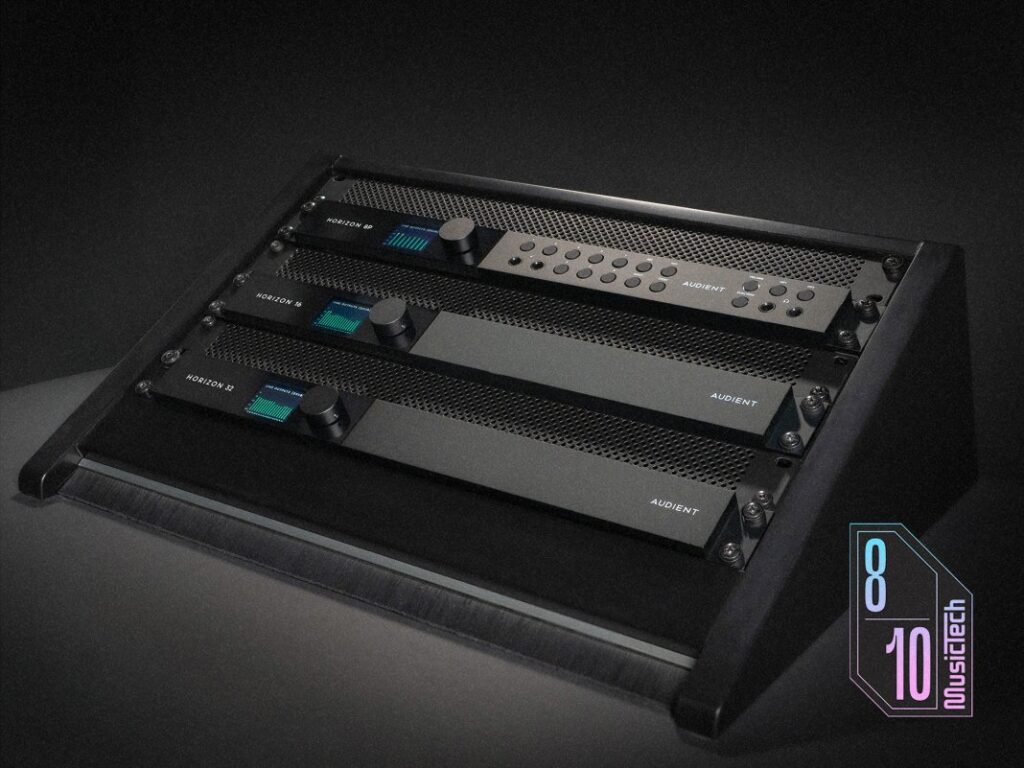
Horizon 8P: £2,199 / €2,499 / $3,499
Horizon 16: £2,199 / €2,499 / $3,499
Horizon 32: £2,799 / €3,299 / $4,299
audient.com
The Audient ASP8024 large format console came a bit late to the large format console party, arriving in 1998 just as computers were starting to become a viable alternative to a room full of expensive equipment (aka an analogue studio). Nevertheless, the ASP8024 is regarded as one of the pinnacles of all-analogue console design, and remains in production to this day, yet the company’s tentative first step towards introducing its audio interface expertise into these loftier realms came only recently in the form of the ORIA Immersive Audio Interface and Monitor Controller. With Horizon, though, Audient is going all-in with a statement of intent aimed squarely at the likes of Universal Audio, Antelope and RME.
Can Horizon cut it alongside such well established competitors? I grab a couple of units to find out.


I/O a-gogo
There are three models in the Horizon range, all of which connect to the host via Thunderbolt and are Mac only. Windows support isn’t officially on the horizon for Horizon (see what I did there?), but the brand is keeping a close eye on things and continually re-evaluating this position (so if you’re a Windows user who wants Horizon, let Audient know!).
The Horizon 8P is likely to be the most popular of the bunch thanks to a versatile I/O load-out geared towards higher-end home and project studios. The eight mic/line inputs, served from jack/XLR combo sockets, feed a set of preamps taken from the ASP8024 console (and what preamps… I’ll come back to them in a moment), while a 25-pin D-SUB connector provides a means of bypassing the preamps and feeding line signals directly to the Horizon analogue-to-digital (AD) converters.
A second D-SUB handles eight of the unit’s 12 line outputs, the remaining four being TRS jacks – I use these as monitor outputs. Analogue ins and outs can be bolstered with up-to 16 channels of ADAT I/O – connected to a pair of ASP880 preamps or similar, this would give you 24 console-grade mic/line inputs via a single interface.
Horizon 16 and 32 are aimed more towards larger studios, facilities and venues. Both ditch the preamps altogether, with the Horizon 16 delivering 18 channels of pure line input and output plus, again, up-to a further 16 channels of ADAT I/O, and Horizon 32 taking things up to 34 channels of analogue I/O alongside (you guessed it) up-to 16 channels of ADAT. With a suitable ADAT bridge and/or preamp, that’s 50 channels from a single interface, perfect for handling large amounts of outboard synths and effects, sitting between a console and DAW, driving surround and immersive monitoring systems, or even as the front end for a venue sound system.
If you’re unimpressed by 50 I/O channels then get this: up-to four Horizon interfaces can be combined in a single system, for an absolute maximum of 200 inputs and outputs. That’s more-than ample for even the highest-specced facilities and most demanding of applications.
Like the 8P, the 16 and 32 units also make use of 25-pin D-SUB connectors, with only two ins and two outs served via standard jacks. Breakout cables for all of these could be a bit pricey, but I think it more likely one would connect Horizon’s D-SUBs directly to a D-SUB equipped patchbay (and likely a high-density bantam patchbay at that). Assuming you already have such patchbays, the cost of a few D-SUB cables is negligible… unlike the ludicrous cost of a bantam patchbay!
All three Horizon models come as 1U rackmount units finished in silky black and sporting a bright, high resolution colour screen and accompanying data entry wheel. The 16 and 32 have no further adornments, but the 8P’s fascia provides buttons for controlling the preamps and monitoring directly from the unit, a pair of instrument input jacks feeding the first two preamp channels, and a pair of headphone outputs.

How good are Horizon 8P’s ASP8024 preamps?
This all looks very pleasing when installed in a rack, but the more important question is how does Horizon sound? In a word: phenomenal! Preamps deliver exquisite clarity and definition, offering up to 75 dB of gain and featuring phantom power, a -10 dB pad, a hugely useful variable high-pass filter with a 20 Hz to 250 Hz cutoff range, and Audient’s ORBIT input impedance switching, all of which is applied in the analogue domain.
ORBIT provides three settings, Low, Mid and High, which set the preamp’s input impedance to 220, 1200 and 2800 Ohms, respectively. This is a useful way to control the tone and response of the input signal, which is the intention of the system, but a three-option switch feels a bit on the blunt side. In most circumstances you’re likely to have ORBIT set to High (the default), which delivers optimised performance with 99.9% of professional mics, yet ORBIT unquestionably expands the preamps’ tonal options so I like that it’s here.
8P’s use of combination jack/XLR sockets for the preamps is frustrating, especially when installing the unit in a rack where tricky access makes connectors difficult to change when needed. The D-SUB line inputs provide something of a workaround, and are ultra clean given they feed directly to Horizon’s analogue-to-digital converters, but this also means your line signals miss out on the opportunity to be sweetened or gain-boosted via the preamps (the latter being more important when hooking up to older hardware).

Audient Horizon’s quality and control
Impressive though the ASP8024 preamps are, I’m dazzled by Horizon’s audio output quality (and here we’re talking about all three models). The sonic precision is breathtaking, delivering a tonal balance and dynamic response that’s pure perfection, and pinpoint positional accuracy that’s a joy to work with.
Also, with so many outputs on-hand, Horizon can support practically any speaker configuration you like, from stereo through to 9.1.6 surround, and can effortlessly jump between them as needed. Conveniently, you can share speakers between different monitor configurations, for example allowing your stereo monitors to also act as front left and right in a surround array.
All of this is configured within the Horizon Control software. If you’ve ever used an iD interface you’ll feel right at home here, the software having a similar clean and intuitive look and feel. From here you can control the preamps, set channel levels for the main monitor mix and any of the four auxiliary/cue mixes, control and configure your monitors, and configure all the deeper details of a Horizon setup.
As well as Horizon Control, Horizon customers can also claim Audient’s ARC software bundle that includes a two-month trial of Sonarworks speaker calibration software, Cubase LE, 2GB of Loopcloud downloads, three months’ membership of Roland Cloud, and a whole bunch of plugin effects, amp modellers and instruments.

Should I consider buying an Audient Horizon interface?
Horizon clearly has the creds to shoulder its way into the higher echelons of the audio interface market. It delivers the pristine audio quality required by the most critical of applications, and can be expanded to the extremely high channel counts demanded by high-end facilities and venues.
Pleasingly, none of this puts Horizon out of the reach of regular users. In fact, Horizon 8P is significantly more affordable than equivalent UA Apollo hardware. And what Horizon lacks in onboard effects processing it makes up for with its gorgeous-sounding, all-analogue preamps and stunning sound quality.
So, if you’re in the market for a high-end, high-spec audio interface, Audient has just made your decision a lot harder. Or perhaps it’s just made it much easier.

Key Features
All models:
- Thunderbolt 3 audio interfaces
- Colour screen
- Up to 16 channels of digital I/O via two pairs of optical ports
- Digital I/O ports support ADAT S/MUX
- Up to 192 kHz / 32-bit quality
- Combine any four Horizon units in one system
- Wordclock in and out
Horizon 8P:
- 8 combo mic/line inputs driving ASP8024 preamps
- High-pass filter (80 – 250 Hz)
- Variable mic impedance
- 2 instrument level jack inputs
- 8 line inputs via D-SUB direct to ADC
- 8 line outputs via D-SUB
- 4 TRS line outputs
- 132 dB dynamic range
- 2 headphone sockets (6.35mm)
Horizon 16:
- 16 line inputs via D-SUB direct to ADC
- 2 TRS line inputs
- 16 line outputs via D-SUB
- 2 TRS line outputs
- 133 dB dynamic range
Horizon 32:
- 32 line inputs via D-SUB direct to ADC
- 2 TRS line inputs
- 32 line outputs via D-SUB
- 2 TRS line outputs
- 133 dB dynamic range