


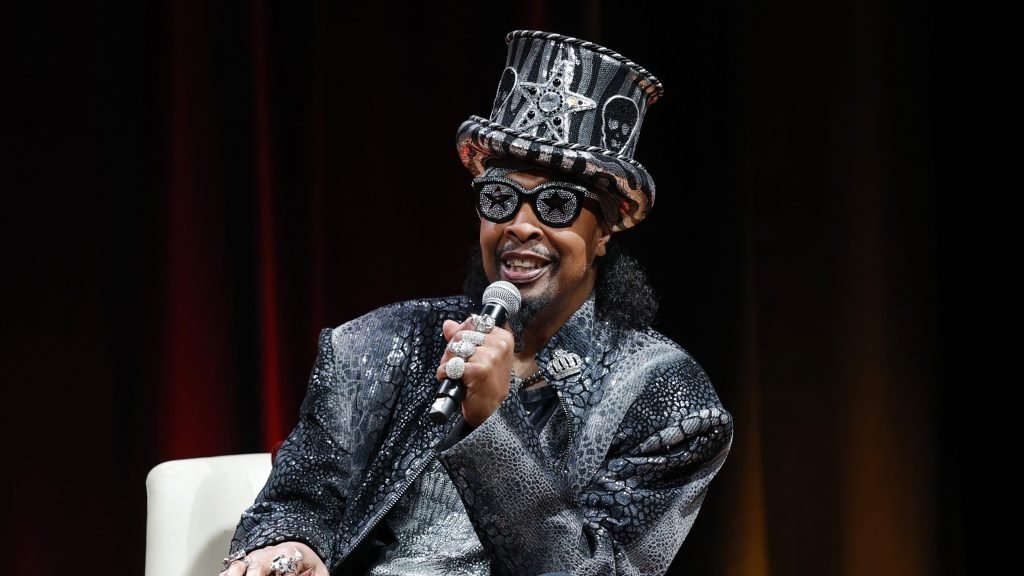
Bootsy Collins defines funk as “making something out of nothing,” a philosophy he’s always lived. Growing up in Cincinnati in the 1960s, he idolized his older brother, Phelps “Catfish” Collins, who played guitar. But when forming their first band, The Pacemakers, Catfish needed a bass, so Bootsy crafted one out of an old guitar by removing the strings and replacing them with four bass strings. That something out of nothing turned into a Rock & Roll Hall of Fame induction, two Grammy Awards, and a legendary career that has far surpassed what he ever thought was possible.
Whether as a member of James Brown’s backing band, The J.B.s., Parliament-Funkadelic or Bootsy’s Rubber Band, Bootsy has wielded his axe with the precision of a sniper. Through his otherworldly talent, bass guitars that are more like kaleidoscopic works of art, commanding stage presence, and psychedelic clothing, he’s become one of the most recognizable artists in music history and has dozens of recordings in his catalog.
Now, just days away from releasing his next album, Metal Health, he’s feeling relieved. Finally, the arduous work is behind him, and he can pivot to the next task, something he’s mastered over the last five decades. Bootsy has carved out a long career that continues to thrive—but it takes balance.
At 74, he’s learned to slow down a little and ensure he’s taking care of not just his physical health but his mental health, too. It’s a topic he’s been passionate about for years now. As the title suggests, Metal Health—a collaborative project with guitar impresario Buckethead—revolves around the awareness of one’s emotional, psychological, and social well-being. The lead single, “Manic Depression” featuring Eric Gales, is a brilliant cover of the 1967 Jimi Hendrix classic and perfectly fits the album’s tone.

“I had to check my life to make sure I was ready to inform people and let people know the challenge that comes with mental health in a way that doesn’t destruct or tear down all of us who suffer froom that problem,” Bootsy tells VIBE. “By me and Buckethead doing this record, I got a chance to vibe with him—and I’ve been knowing him ever since 1991, when we did his first record—just by vibing with him, made me realize that it’s time because I didn’t feel so all alone going through it for all these years.
“I realized that I’m not the only one that’s having problems like this. I started hearing it in him. I started hearing it in myself. I said, ‘Man, we need to do not only a record just to be doing a record. Let’s do a record with a purpose, which would probably help people and ourselves as well.’”
Parliament-Funkadelic famously funked around–a lot. But despite the wild optics, Bootsy always managed to find a deeper meaning in the group.
“Back in the day when we did the whole funk thing, it was done with a purpose,” he explains. “It wasn’t just us just jamming. It may have looked like that, but we had a purpose to funk the people. I finally found my other purpose, and my purpose now is to help others with mental health challenges.”
Bootsy’s battle with his own mental health included getting sober. P-Funk’s fearless leader, the inimitable George Clinton, struggled with drug addiction for most of his career. But Bootsy got out early, opting to put drugs and alcohol down in the 1980s with the help of his wife Patti.
“If I hadn’t gotten sober, I wouldn’t be here talking to you,” he says, matter-of-factly. “We got a couple of songs on the album that relate to what we’re talking about. ‘Recovery Day’ is the last song on the album. Before that, I take you through a lot of the mess that we went through, and on the very last song, I’m talking about my recovery. We started the album with ‘The Funk Can Save You,’ and then we wound up with ‘Recovery Day’ after 16 songs. I didn’t plan it like that. It just happened.”


Bootsy Collins performaning at London’s Hammersmith Odeon in 1978.
Fin Costello/Redferns/Getty Images
It’s clear Bootsy knows he’s lucky to be alive. Many of his contemporaries—including Jimi Hendrix, The Rolling Stones’ Brian Jones, Janis Joplin and The Doors’ Jim Morrison—succumbed to drug overdoses or suicide in their 20s. He believes “Manic Depression” is even more relevant today than it was in 1967.
“It was so taboo back in the day to even think, ‘I’m crazy’ or ‘I got something wrong’ or some kind of challenge,” he says. “It was always in the closet, raring to come out, but we wouldn’t let it, so we held it in. Nowadays, we get all kinds of information about who’s who, so you might as well just be all the way out and go ahead and say it first; be strong.”
Bootsy admits it’s harder for men, especially from his era, to confront their own feelings, but it’s gotten easier.
“Men are tore up,” he says with a laugh. “But people need to hear the benefits of the struggle. You go through this, you go through that, and then if you can get to the other side a little bit and peek up out of the manhole, you can let that vibe flow through you. It’s all about what you invite in. That’s a thing we have to grow in. It took me forever. And I’m still growing. I’m still learning. But you have to be willing.”
It can be even more challenging in hip-hop, where bravado and a tough exterior often reign supreme. Gangsta rap was partially built on a foundation of Parliament-Funkadelic music, and Bootsy has worked with a wide range of hip-hop artists, including Snoop Dogg, Ice Cube, Chuck D and Fat Joe. He’s watched the genre’s evolution since inception.
“That’s the trend of today; it’s building on top of what already was there in the first place,” he says. “Everything is exaggerated even more. It’s not even about change. It’s about keep going in the same direction. Everybody wants to be a gangster.”
Bootsy’s biological father was mostly absent from his life, but he had two father figures in George Clinton and James Brown. This year marks 20 years since Brown died, and he still remembers some of the lessons he taught him.
“James Brown was the Godfather,” he says. “Any man around him would appreciate that he was taking care of business. Black men in general love to see that kind of power, and he was doing what he loved to get there. James Brown told me one time that it’s 75 percent business and 25 percent music. I did not want to hear that. To me, it was 150 percent music. Period. I didn’t know nothing about no business and didn’t want to know, so it took several stages to understand he was right.”
Brown could be hard on The J.B.s after a show, often berating them for whatever he felt went wrong during the performance. One particular evening, before Bootsy got sober, he was on acid, and Brown wanted to have a few words with him.
“I just remember his face when he told me I got to keep it on the one,” he says, chuckling at the thought. “He was dogging me out in front of everybody. For a man to do that to another man…well, I wasn’t exactly a man yet, but I thought I was. I was tripping, and when I looked at his face, it started melting and turning purple. His eyes were on fire. I’ll never forget that.”

George Clinton and Bootsy Collins of Parliament-Funkadelic performing at the Grammys in 2004.
KMazur/WireImage
As with Brown, Bootsy will always have a special place in his heart for George Clinton. Although they don’t tour together anymore, he was blown away by P-Funk’s recent unveiling of the Mothership 3.0 earlier this month.
“It’s the bomb!” he says. “With the new technology and stuff, it makes it as exciting as it was back in the day because people have never seen it. It builds on top of the old mothership. It’s new, and people want to see the newness. That’s going to be really cool because they’re probably going to follow up with a Mothership tour.”
Any hopes for a surprise appearance from Bootsy are quickly dashed when he says, “I like the way we got it now. We can talk and be friends without being dependent on each other. I’d like to have it like that rather than bumping heads in the business. Business definitely gets in the way.”
Bootsy’s relationship with the bass has changed over the years, too. He describes it like a lover, saying, “We are so cool. We don’t have to pay attention to each other all day, every day. She knows I’m still in love.” But he has no idea how many he owns. “I need to count,” he adds.
In the meantime, Bootsy is focused on his upcoming appearance at PALEFEST x Land of Illusions in Middleton, Ohio, July 24-25. Those unable to attend in person can pay $5.99 for a livestream. Proceeds will go toward Bootsy and Patti’s Funk Not Fight initiative and the Bootsy Collins Foundation.
“We’re going to do our best to touch as many people as we can with the music,” Patti concludes. “We really believe music is healing.”