


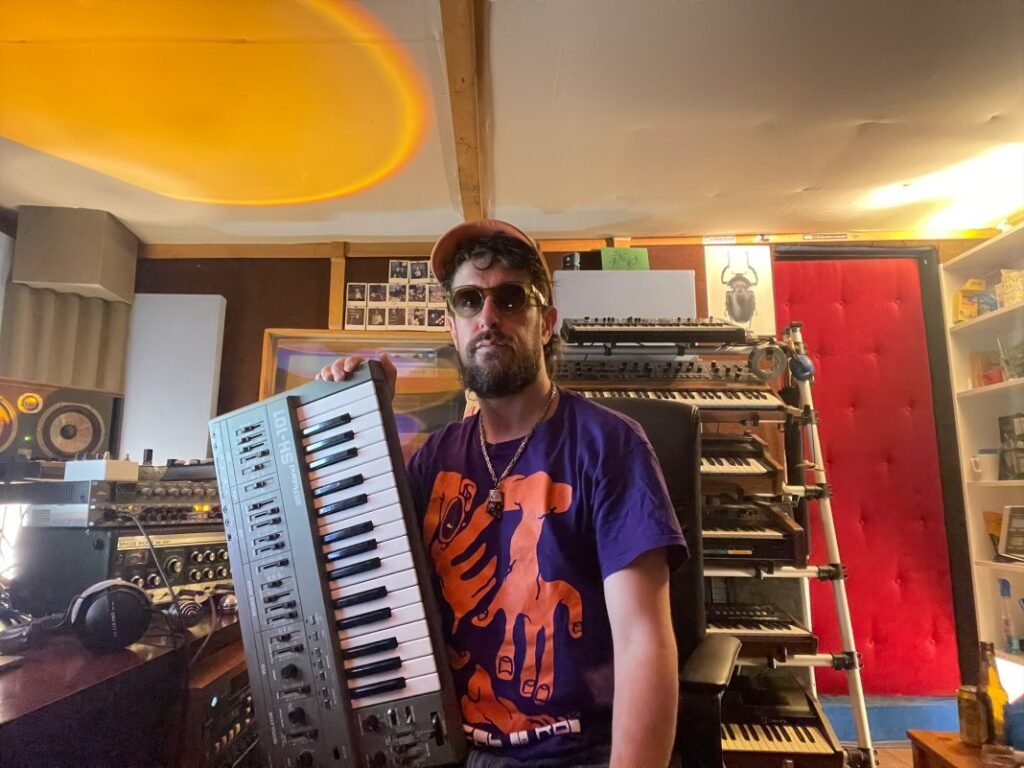
With a stage name like Danalogue, you’d hope that London-based producer Dan Leavers conjures rich synth sounds with a host of prized analogue studio gear. Thankfully, he does. His new album, Teleportations, is a prime showcase of Leavers’ talent for building luscious synthscapes, infusing elements of jazz and space disco — a characteristic found in his work as one-half of Soccer96 and as a member of The Comet Is Coming. The 10-track LP is bubbling with sci-fi themes, even arriving with its own mythology. It’s also positioned as a response to the “digital overload” of current times, inviting listeners to think of “imagination as a radical act.”
In this outing of Studio Files, Danalogue explains how he finds inspiration from synthesizer giants such as Wendy Carlos, why he’s so obsessed with vintage gear, and why you should try more “no-strings-attached unrecorded jams”.
Teleportations comes with its own sci-fi mythology and short story about astral travel and consciousness. Can you talk us through how that world took shape and how it steered the music you made?
Danalogue: It all started in a little synth studio in Paris. I took a walk and discovered the French illustrator Moebius through the window of a comic book shop. The shop was closed, so I could only have a tantalising glimpse of this psychedelic otherworldly planet, but it set my mind racing, unlocking the inspiration for building a sonic world of an imagined exoplanet, which then led to travelling between different meta spaces as a means of exploring my psyche and processing emotions through the sounds and structures.
Teleportations was built around a largely vintage analogue setup — the Juno-60, SH-09, Jupiter-4, Oberheim and old samplers. Walk us through how that rig shaped the record, and which machine ended up doing the most work.
D: I love the tactile feel of synths, and moving faders around to craft your own sounds, trying to make the sound in your imagination or sometimes get a surprise. The Roland Juno and SH-09 are my main axes. I’ve travelled the world with them and have a deep relationship with them both. I was keen to try out other studio spaces and try different synths. The Jupiter 4 and Oberheim OB-X8 were in Paris and blew my mind a little bit with the mysterious qualities each one had. It’s hard to remember, but in the end, possibly the SH-101 I used the most, as it sits right next to me in my studio going through the space echo, so it’s easy to reach for. I feel like I can make so many different sounds on it too.


You gravitate towards these older instruments because of their limitations, right? Can you talk more about that, and give us an example from the album where a constraint forced a better production decision?
D: It’s hard to say what a better production decision is! I tend to make fairly rogue or intuitive decisions based upon what gets me amped up, which isn’t necessarily a case of better, more a frequency of resonance that I want to emit for some reason. I love old synths because often they have a simplicity to them, and every knob does something fairly immediate and fun, rather than multi-edit screens and assignable knobs — I don’t really have the patience or personality for that. The old visual aesthetic also looks really cool, which inspires me to want to play, and they sound kind of gooey and colourful…a bit dank and filthy sometimes as well.
Tell us a bit more about your studio.
D: My spot is in East London. So for years I had bits and pieces everywhere, at friends’ houses, in my bedroom and at this place called the Total Refreshment Centre in Dalston. I always dreamed of putting it all together in one room, so I’m super grateful to have this place. I have made it so it’s almost all ready to go at the drop of a hat, including recording drums, and I mainly use it for recording my own bits and mixing and producing for others too. I also sometimes have friends over to jam real loud late at night, trying to remember that ‘playing’ music is playing, you know? Sometimes a no-strings-attached unrecorded jam is a sacrifice to the music gods, and you learn something along the way or rekindle a love with something.

What’s your latest gear purchase?
D: I just got this piece called Chaos Engine, which is awesome! It’s got 5 oscillators triggered by these sort of old school computer keys, and they all combine with a chaos knob to create unpredictable resonances; it sounds a bit like Silver Apple, pure direct oscillators. It was recommended to me by Malcolm Catto when I was at his studio, and it’s really good fun, and curiously cheap as well. It’s great to have a synth that’s removed from associating with piano keys.
What’s the most underrated piece of gear in your studio and why?
D: I have this cool old synth by Jen called the Piano73; it was left to me by the previous producer from the studio called Simbad, who kindly hooked me up with the space and the synth. It’s a humble keyboard, but it has an inbuilt phaser and a piercing attack, a bit like a cosmic harpsichord; playing it is always a good idea.
I love the eerie and charming sounds in Mother of Mars. How much of your music is just experimenting with synth patches until something sounds right, versus dialling in exactly what feels right for a concept?
D: So Mother of Mars is a little clue to the synth I used for every sound on that track. I basically wanted to make a love letter to that keyboard and combine different arpeggios that weren’t synced in time but had an organic connection, sort of building the sounds visually, sort of like a painting of a landscape of a liminal space. I do sometimes have a sound in mind, but so often if you just freak the sliders around you can find something better than you could if you were too controlling; the synths always reward playfulness.

You’ve cited Joe Meek, Wendy Carlos, Tomita, Laurie Spiegel, Mort Garson among your influences. What did you actually take from them into Teleportations?
D: I pull different inspiration from different characters. With Wendy Carlos (plus Tomita and Mort Garson, to be fair), it was the idea of building a whole track from layers of synthesizers, and almost making a little orchestra of different sounds, and expressing yourself entirely from synths. So a track like Arrival at Rho Ophiuchi isn’t a million miles away from Switched on Bach, but rather than it being a classical piece, I’m trying to create a kind of alien ensemble.
Is there any particular moment in the album that stands out to you, from a sound design and production perspective?
D: The middle of Moebius Triptych stands out; it has this melody line that I double-tracked on the SH-09, and it’s so melted and warm and gooey. I also ran the Juno through a Red Panda Particle pedal on that to create pitched delays, which were great to automate in and out. The connection to the emotional aspect of being alive was pretty close on that section. I used this Roland flanger on the hats and ride of the drums and made a sort of synth cowbell through a spring reverb, which I was quite happy with. I then tried to make a guitar solo sound similar to Robert Fripp on the Prophet 10, which I was quite chuffed with.

What’s a music production myth you think needs debunking?
D: That there’s “a way to do it”. Somebody is always telling you how to create, like there are rules. Like, “You have to write every day” or “You have to use hardware”, or “You have to use software”, or “You can’t run a tape machine channel insanely into the reds until it distorts making a bass note”. I especially found this when I was younger and older studio engineers would just be saying what you couldn’t or shouldn’t do the whole time.
I reckon everyone has their sound to make and their soul to express and their version of creativity, so whenever anyone says something absolute, I just switch off. Do it your own way! And also, the people you want to collaborate with will gravitate towards you when you do your own style, like when Snapped Ankles ask me to mix their album, they referenced some very saturated filthy lo-fi tracks I’d done with my band Soccer96 — I was like, “Really?! You want it like this?!”

Who gave you the biggest lesson in your career?
D: Too many to count. I’ve been blessed with different mentors growing up who saw how insanely obsessed I was with music and have helped me out. The producer Capitol K took me under his wing when I was first in London, and we shared a studio for many years. He showed me some wicked things with EQ and compression, the more detailed subtractive parametric EQing and more pragmatic compressing, to complement the colourful, exciting additive stuff that I was doing at the time; a way to find a real balanced mix. He also introduced me to the Eventide Harmonizer H3000 and Lexicon reverb unit that I bought doubles of when I got my own studio — almost every preset is a winner. He showed me so many things, also how to carefully and methodically comp vocals, lots of engineering chops, and the general mentality of keeping a studio in good order.


Sam is the Commissioning Editor at MusicTech, where he’s helped shape the publication’s editorial voice since 2019. With nearly two decades of music-making and a degree in music technology behind him, his focus is on the stories behind studio gear and the artists who use it. He’s spent way too much time sampling disco records.
Get the MusicTech newsletter
Get the latest news, reviews and tutorials to your inbox.