


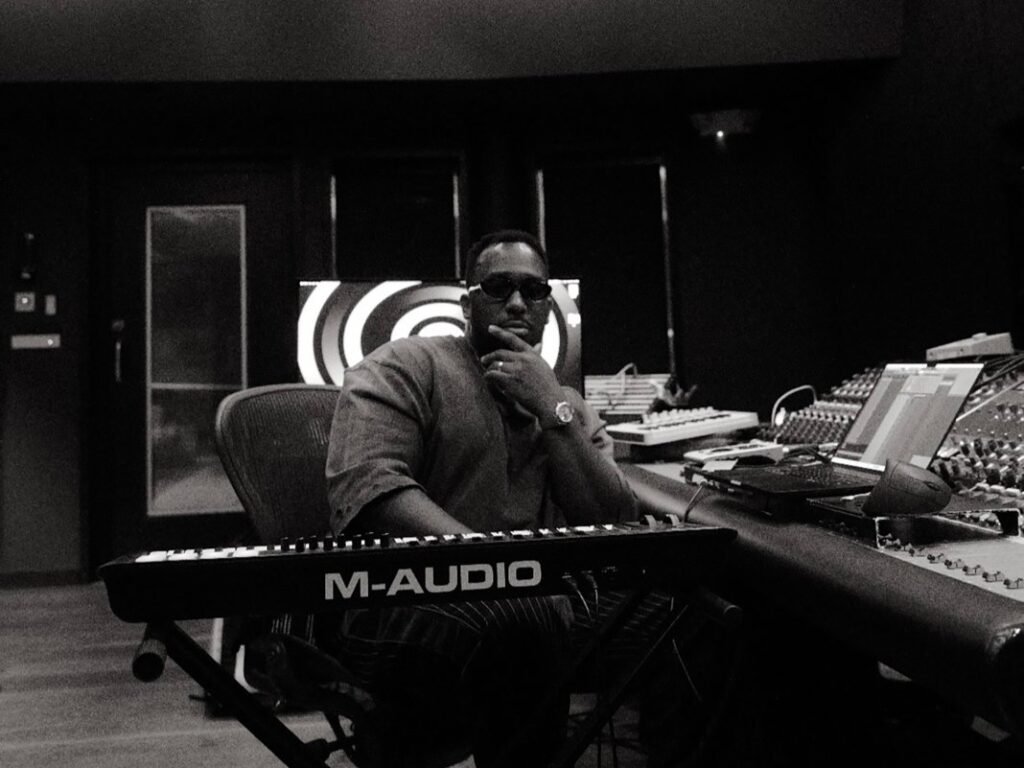
Daramola can barely believe his fortune. “It doesn’t make sense, bro,” he laughs. The Grammy-winning producer grew up around music in Nigeria, watching his mother sing gospel, and has been making beats since high school. He “loves music too much not to do it”, but even he couldn’t foresee where his career in music would take him.
Born Abraham Olaleye, Daramola is speaking to us from his home studio in Miami. He’s quietly hyped about his recent Latin Grammy nomination for his production work on Elena Rose’s Alma, with credits on chart-topping records by Shakira, Beéle, Danny Ocean and Kapo, and is working towards the release of his fourth album, Le Di Sentido.
Lagos is Daramola’s native turf, but he spent most of his teenage years in the UK, dividing time between Frome, a small town in west England, and London. He then travelled to Alabama, where he studied as an undergrad and post-grad, and started selling his beats to Christian rap artists. After happening across a “situation that led to an opportunity to get signed,” Daramola says, Sony Latin Pub signed him as an artist, and he ended up living in Miami. Now, he’s perfected his version of the contemporary Latin-Afro sound.
A self-confessed music production nerd, Daramola talks us through the secrets of his sound in this edition of Studio Files.


You’ve collaborated with a vast number of artists. What’s the one constant you keep across all sessions, regardless of style and genre?
“The constant line is the love of music and treating people the same way. You could be the biggest artist in the world, or you could be someone who doesn’t have a name, but when we get in the studio, you’re going to get the same energy. There’s no preferential treatment. And typically, when you deal with life like that, things tend to work in your favour because you’re not being filled by the wrong things; you’re serving a purpose. If you live for the approval of people, you will die by their rejection.”
What does that energy actually look like in the studio?
“If you get in with me, we’re gonna be there for a minute. We’re probably gonna play FIFA. We’re probably gonna chill; we’re just gonna laugh and get to know each other within the first hour. And then we’ll knock out the record. ”
Tell us a bit about your studio.
“Dude, I’m a nerd. [Laughs] I have the PMC 6-2 speakers – these are the best monitors in the world to me. I have the Akai MPC Sample, the Telepathic Orchid, a Moog Muse, a Sub 37, a Prophet Rev2…I have a lot of toys. And I just like to see colour in the house – I make a lot of Lego, and I love art. I still have a painting from the vinyl of Kanye West’s My Beautiful Dark Twisted Fantasy, the one with the sword to his head, which means something about death of ego. And I look at that every morning. But, yeah, I just love synthesizers.”

How do you decide which gear and furniture earn a place in the studio?
“I like to consider myself a futurist. I think technology is amazing if used the right way, and I’m always looking for what’s next. I found this software the other day that groups all your plugins in such an amazing way. But I just felt like it was too much, because I also need to be able to work fast, right? I remember when I was deciding between a Prophet-12 and a Moog Matriarch, and I just didn’t think I’d have time to start wiring stuff up [with the Moog]. I played with it for a while. And it’s great if I’m creating sounds and all, but I just didn’t have the time.”
Do you have a dream piece of gear?
“I want the OG Roland Juno-106. I just used it in a studio one day. There’s a studio out here called Custom Studio [owned by Carlos Imperatori]; it’s super cool. He’s Italian. He’s a cool guy, and I’ve made a lot of good tracks in there. On one record, I used the Juno for this particular sound, and I’ve wanted one ever since. But, I mean, Behringer has the JN-80, which is like a Juno on crack with aftertouch sensitivity, but it’s been on ‘coming soon’ for months…”
What’s been the biggest investment into your studio?
“The PMC 6-2 monitors. My mixing is a thousand times better because of those. And it matters, because a lot of the studios I go into now have PMC monitors as standard. Plus, I moved out of downtown, and I wanted to bring artists to the house so I can barbecue for them and we just chill. So I made this space intentionally cosy, but I also had to get good gear.”
You’ve curated a nice selection of instruments and gear. How do you choose which instrument to use on a track?
“As a producer, I get so used to a piece of gear that I want to challenge myself to step outside of that framework. I love synthesizers, but a lot of Latin music and Afro stuff leans heavy towards guitars. So for the past few months, I told myself I wasn’t going to use a guitar, and I was just going to work on the Moog Muse, and I needed to make it work. It can’t sound like synthesizer music, but it should have synthesizer leanings all while still feeling organic enough. But I’m big on effects, too.”


Tell us more about the effects.
“I like strange sounds. I’m using this plugin from Dezert Audio called Polyfreq, and it makes leads sound crazy. I was also using Valhalla’s reverbs for a while, and I still do, but I’ve been using Baby Audio’s Crystalline lately. One thing I’m trying to do a lot more is use effects to get strange sounds that lean into still being the highlight of a record, all while keeping it organic. I have to satisfy a larger crowd and a larger base, which is easy listening and easy-to-digest music. Like, Bon Iver doesn’t go with the larger base. So how do I bring Bon Iver to a larger base? And the people who know listen and say, ‘Wow, he did that!’”
What’s a music production myth you think needs debunking?
“I don’t know right now what I can debunk, but I know what I’ve been growing into understanding. It might seem like a very obvious ‘duh’ moment, but a lot of music production is just sound selection. Because anyone can throw anything together. But why did you use that synthesizer on that part of the song? Why does the reverb duck at the end as opposed to just simmer through the middle?”
Who gave you the biggest lesson in your career? Can you tell us about how it impacted you?
“Foundationally, it was my mom. She was a musician in Nigeria, and as a kid, I heard her do everything. I heard her do country. I remember the electric grid would go off, and we’d go to the balcony in our house upstairs. All of us. She had five kids, and she’d get a guitar and just play everything. She was multi-genre, so I guess that really did affect me in more ways than I thought it did back then. In retrospect, this is why I never considered myself a beats guy. I’m just a Nigerian man who makes music.”


Sam is the Commissioning Editor at MusicTech, where he’s helped shape the publication’s editorial voice since 2019. With nearly two decades of music-making and a degree in music technology behind him, his focus is on the stories behind studio gear and the artists who use it. He’s spent way too much time sampling disco records.