


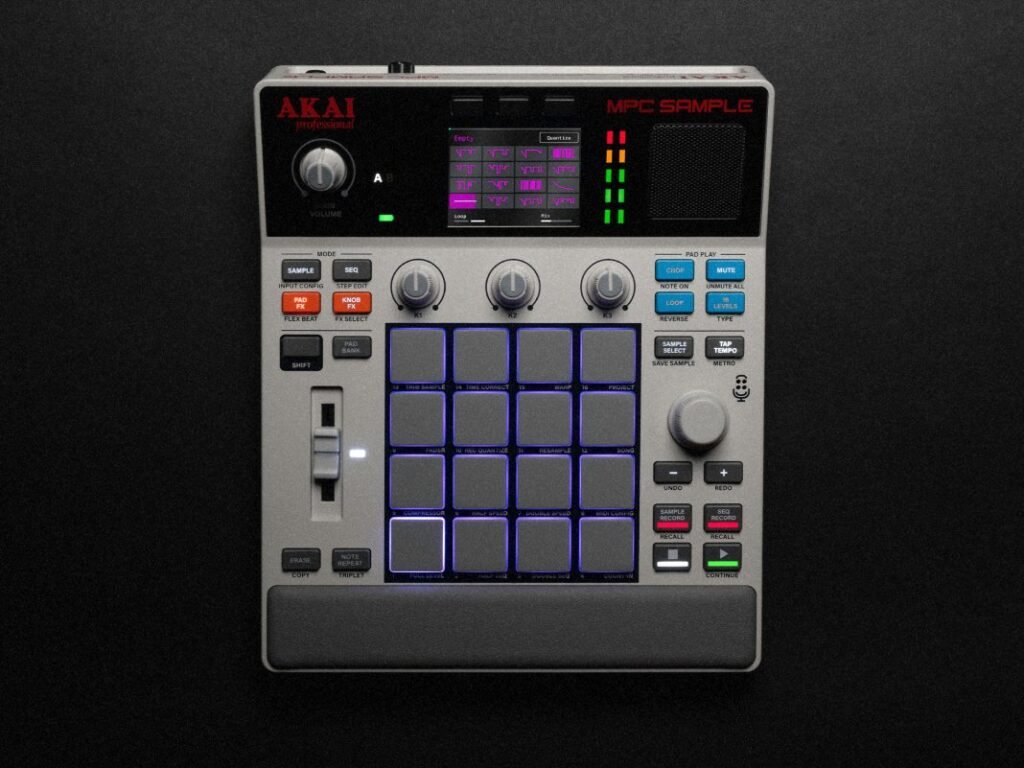
Akai has launched the MPC Sample, its most affordable and portable MPC ever.
After several weeks of leaks and weird AI renders made by MPC fans, the battery-powered sampler is finally available at the promised price of $399 — a price tag that some content creators believed to be fake.
What is the Akai MPC Sample?
The Akai MPC Sample is a portable hardware sampler combining the retro aesthetics of the MPC60 and the features of modern MPCs. Akai says that “MPC Sample continues [the MPC] legacy by delivering the hands-on MPC workflow in a battery-powered device designed for spontaneous creativity, whether at home, on the road, or in the studio.”
The MPC Sample is a direct competitor of other portable samplers such as Roland’s SP-404 Mk2 and Teenage Engineering’s EP-133 K.O II. Casio also teased a new handheld sampler at NAMM 2026.


What are the key features of the AKAI MPC Sample?
Portability is obviously a major selling point of the MPC Sample, with a size of 23.6 x 19.4 x 5.0 cm, and a rechargeable lithium-ion battery with up to 5 hours of use off-charge.
But here’s a ton of other features that make this sampler so intriguing.
The iconic MPC look is present on the MPC Sample, with 16 RGB velocity-sensitive pads, complete with polyphonic aftertouch, and the expected 16 Levels button for playing and manipulating sounds. In total, there are 32 stereo voices of polyphony, with eight sound banks available (from A through to H), and over 100 factory kits included.
Slicing up samples is made possible with the Instant Sample Chop mode, real-time Timestretch and Repitching. You can get more specific with your waveform editing using the full-colour 2.4-inch LCD screen and the three real-time control knobs. There’s also the legacy MPC parameter fader, straight from the vintage MPC models, to make fast changes to settings. Internal resampling with FX is also on board.

MPC Sample boasts four effects engines with 60 effect types, which you can trigger using Pad FX and Knob FX. Effects range from the stylistic lo-fi mode, multiple filters, and distortion, to more utilitarian ones such as pumper and limiter.
You can use the MPC Sequencer to lay down complete ideas, with real-time swing available for looser beats. MPC Note Repeat, Sequence Recall and Sample Recall are all available, too. You can record samples using the built-in microphone, load them directly onto the unit using an SD card or the browser-based library manager, or record them using the two quarter-inch TRS inputs on the rear. There’s a total of 8GB of internal storage on the MPC Sample, and 2GB RAM.
To listen back to your beats, a 3-watt speaker is on the front, while two quarter-inch TRS outputs are on the back, and an eighth-inch headphone output.
You can also hook up external gear to the MPC Sample with MIDI In/Out, Sync Out, and USB-C compatible MIDI, audio, and I/O. The same USB-C port can be used to charge the Sample, and transfer files — samples, projects and recordings.
When will the Akai MPC Sample be available, and how much does it cost?
The Akai MPC Sample is available now at a price of $399/£349/€399.
You can purchase it from Thomann, Sweetwater, Guitar Center, Zzounds, and other authorised retailers.

What do the reviews say about the Akai MPC Sample?
We’ve had a review unit of the MPC Sample for a few weeks now, and will be publishing our review imminently. So far, we can say that it’s immensely fun and a lot more powerful than you might think, especially for the price. Check in on MusicTech.com this week for the full review, and be sure to sign up to our newsletter for regular updates.
Read more music technology news.
The online hype around the Akai MPC Sample
[Last updated 16 March 2026]
The MPC Sample leak, as it happened
The Akai MPC Sample was leaked by a retailer based in the US earlier this month via eBay. The leak dropped a lot of details about the MPC Sample, including images and features — online viewers sussed out its sampler engine, sequencer, and effects processor. Even the effects were leaked: a granulator, ring mod, Lo-Fi, colour, delay, reverb, half-speed, chorus, flanger, phaser, beat repeat, and more.
The leak also shared info about the lithium-ion battery, a microSD card slot, an internal microphone, a built-in speaker, and USB-C connection.
Akai’s official post
Akai dropped this Instagram post in response to the leaks, offering a comparison of the MPC 60 and MPC Sample, with a 24 March announcement date.
AI-generated Akai MPC Sample mockups exist – and yes, they are very fake

With so much hype and speculation surrounding the launch of the MPC Sample, numerous AI-generated videos hit the internet that misrepresented the sampler. For example, in this Sora-generated video, the unit’s controls and text are distorted. Or this one, which features a 5×3 pad grid instead of the confirmed 4×4 grid. These are hilarious, but certainly not legit.


Sam is the Commissioning Editor at MusicTech, where he’s helped shape the publication’s editorial voice since 2019. With nearly two decades of music-making and a degree in music technology behind him, his focus is on the stories behind studio gear and the artists who use it. He’s spent way too much time sampling disco records.
Get the MusicTech newsletter
Get the latest news, reviews and tutorials to your inbox.