


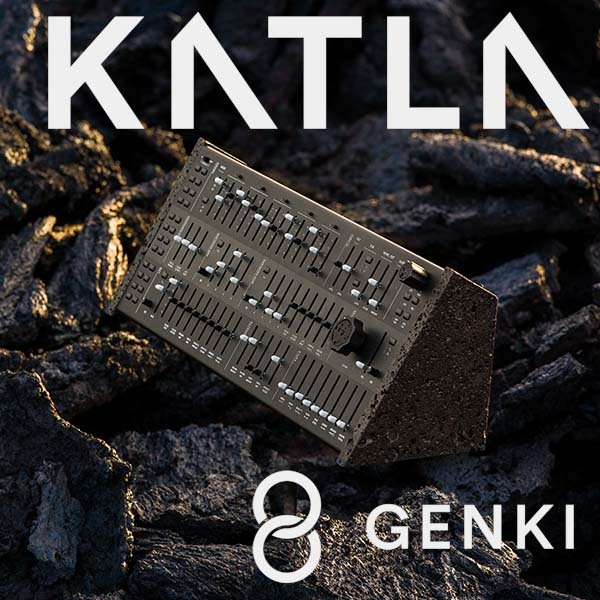
Katla Parameters
» MODA, a way of adding tuning instability by simulating an old synthesizer drifting out of tune to give a vintage character.
» KVIKA, applies slow pitch fluctuations per voice using a slewed random waveform, inspired by the wow modulation found in vintage tape machines.
» SKJALFTI, applies faster pitch fluctuations to each voice, reminiscent of the flutter characteristics found in vintage tape machines.
» GLOD, produces brief bursts of pitch modulation applied independently to each voice, similar to the effect of momentarily slowing a tape by pressing on the reel.
» ASKA, inserts random modulation on per-voice volume and filter cutoff, and also introduces short bursts of noise that result in a chaotic and unpredictable sound as the most complex of the KATLA parameters.
» SKRIDA, applies random values to the A (Attack), D (Decay), S (Sustain), R (Release) times of the Amp Envelope.
» ROKKUR, spreads notes across the stereo field, positioning voices 2 and 4 to the left, 3 and 5 to the right, with voice 1 remaining centered — think notes shaped by dedicated left and right distortion channels, immersed in a spacious stereo reverb.
» RUSTIR, Katla’s wavefolder generates harmonics by folding the signal back on itself.
Katla’s five independent voices, each paired with its own dedicated sub-oscillator with global SUB controls for waveform and octave, allow for five-voice polyphony, with individual filters, amplifiers, LFOs (Low Frequency Oscillators) offering combinations of their minimum and maximum outputs which are used to modulate stereo effects (including a lush stereo 1980s digital reverb). This enables non-repetitive modulations that feel organic and alive, while looping envelopes blur the lines between envelopes and LFOs, letting users craft rhythmic, evolving patterns or tempo-synced modulation. Katla can be synced to the BPM of a Digital Audio Workstation or any external clocking device, allowing all modulations to lock tightly to the music, while envelopes and LFO timings can be quantized to musical intervals, such as quarter notes, eighths, or triplets.
The keyboard tracking adapts envelopes, LFO timing, and filter cutoff to the pitch of each note, making every key respond with its own unique character and movement. Moreover, Katla is fully MPE (MIDI Polyphonic Expression) compatible, with per-note response to pressure, pitch, timbre, and aftertouch. And when in unison mode, all voices are allocated to a note, so when releasing a chord one of the notes will linger slightly longer than the rest, all the voices being assigned to that note, resulting in a monophonic release phase; alternatively, Unison Grace Period enabling introduces a slight timing offset, allowing Katla to let all notes fade out smoothly and naturally.
Finally, Katla features five external inputs, each routed to its corresponding voice, so users can freely feed audio from any source, sequence between the inputs, and process the signals through the Voice Rotating Polyphonic Synthesizer’s analog signal path, thereby adding warmth, distortion filtering, and character to external sounds.