


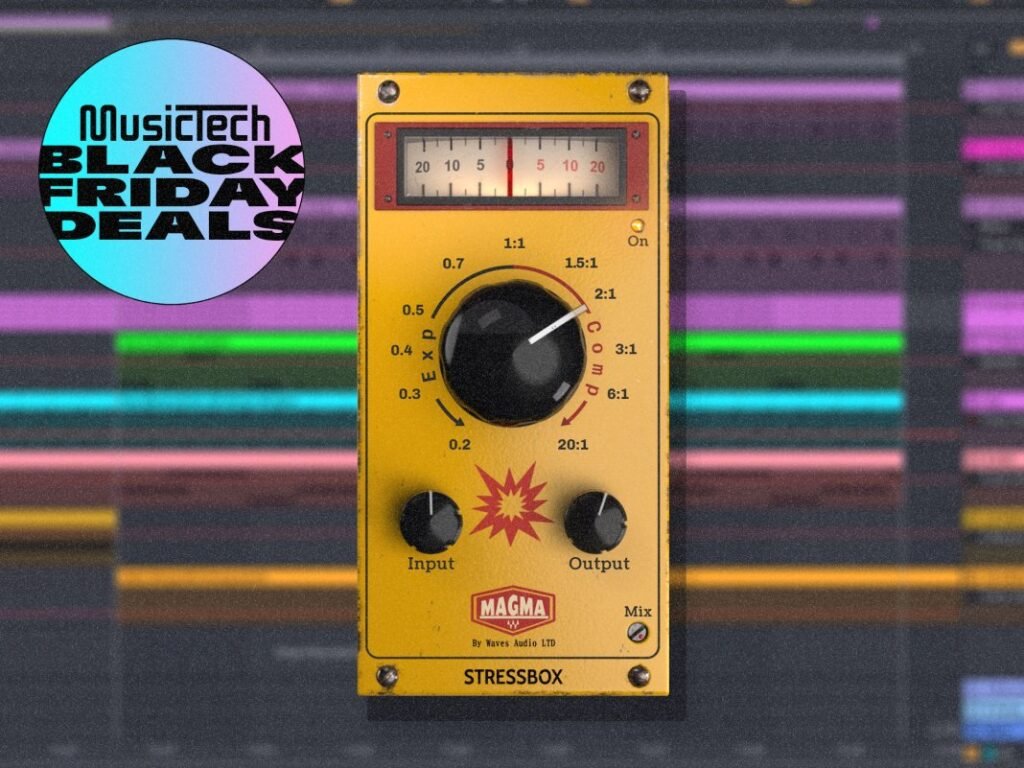
Who doesn’t love a free plugin on Black Friday? In addition to its Cyber Weekend sale, Waves releases a new, secret plugin each year. This year, it’s giving away an addition to its Magma series: StressBox.
Control the dynamics with one knob
Producers already familiar with Waves’ product range might liken Magma StressBox’s workflow to the OneKnob series. But unlike OneKnob Pressure or OneKnob Pumper, StressBox packs two functions into its one knob.
As you turn it left, you hear a significant downward expansion effect. At 0.2, it imitates a noise gate pretty well.
When you turn it right, you get coloured yet smooth compression. Even at an extreme ratio like 20:1, StressBox maintains punch while evening out the dynamics.
For vocals and instruments that require surgical control, StressBox isn’t an ideal fit. You have more flexibility, even with stock compressors that include threshold, attack, release, and knee parameters. But StressBox promises to tighten or inflate the overall sound. By automating a single knob, you can quickly enrich the dynamic variety in your mixes with it.
Say you’re working on a track with a steady beat. You have the same drums looping in the verse and chorus sections. It gets dull after a while, so you drop StressBox on the drum bus. You run it in expansion mode during the verses, then transition to compression in the choruses. Problem solved.
Here’s how that transition sounds in real time on a drum loop from Splice.

Running it in expansion mode
As you can hear, StressBox lets the highest peaks through in expansion mode. It latches onto transients that reach above an invisible threshold. But it doesn’t eliminate the quieter details between them. It just makes them even quieter.
This type of processing is called downward expansion. It’s useful for reducing reverb tails, boosting the bounce of rhythmic pads, and tightening any instrument with percussive qualities.
Here’s how StressBox’s expander sounds on guitar, compared with a noise gate such as FabFilter Pro-G.

Exploring the StressBox compressor
There aren’t many practical and dedicated downward expansion plugins on the market. That alone makes StressBox a valuable addition to any music producer’s library. But it’s the compressor that’ll get you hooked, especially if you don’t already own other standard tube compressors like Teletronix LA-2A.
Like a transient shaper, StressBox’s compressor amplifies and sustains the quieter details in your mix. And somehow, it does this job without squashing the transients. In other words, it combines traits of both downward and upward compression.
There are similar compressors on the market, like Waves’ own MV2 and Xfer’s OTT. MV2 provides subtle control, while OTT lives up to its name by compressing in an over-the-top manner.
StressBox’s compressor is the compromise between the two. It may not work on every instrument or master bus you throw it on. But when it does, it takes little effort to dial in.
Because StressBox highlights lost details so well, I wanted to test it against a transient shaper like Native Instruments’ Transient Master. Here’s how they compare.

The signature Magma sound
Although StressBox isn’t a saturator, it has analogue character like all the other plugins from the Magma series.
If you own the Magma Tube Channel Strip, you already have the features StressBox offers, and much more. The key difference is the fluid simplicity of a single knob interface.
In Magma Tube Channel Strip, the compressor and expander are separate modules. You have the benefit of using both at the same time. But for moments that call for drama and a shot of extra energy, StressBox may be the better choice.
Music creators first got a taste of the Magma line with Lil Tube, the Black Friday freebie for 2022. Still available in the Waves Free Plugin Pack, Lil Tube comes with three saturation modes that take the analogue flavour of StressBox to the next level. Here’s how they sound together on a master bus.

Waves later introduced a paid version of Lil Tube: BB Tubes. With extra EQ and distortion features, BB Tubes delivers additional grit without sacrificing control.
A year later, Magma collectors got their first vintage reverb, Magma Springs. Seven types of spring units, plus drive, feedback, and EQ controls in a no-frills box, with the same tube sound.
It’s unclear whether we’ll see an advanced version of StressBox in the coming days. But it wouldn’t be a surprise to see the Magma series continue to expand. With retro revival still thriving online, demand for vintage-style plugins shows no signs of slowing.


SIRMA is an Istanbul-born, New York-based artist, songwriter, and producer. With her distinctive vocal textures, she bends her sound across genres—from pop and electronic to ambient and cinematic soundscapes. Outside the studio, she writes for MusicTech and Roland Articles, diving into the creative and technical sides of music production.
Get the MusicTech newsletter
Get the latest news, reviews and tutorials to your inbox.