


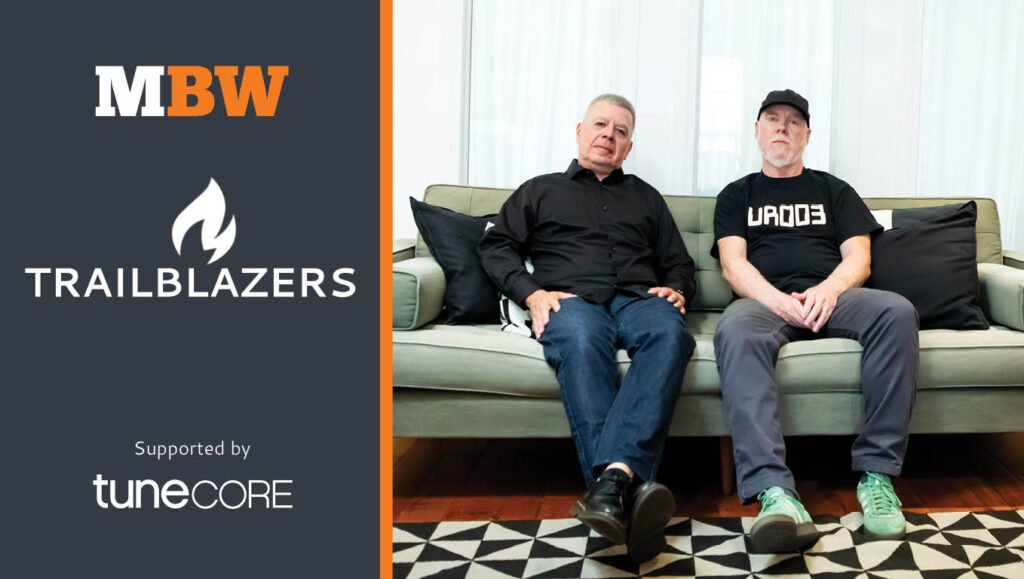
Trailblazers is an MBW interview series that turns the spotlight on music entrepreneurs with the potential to become the global business power players of tomorrow. In this feature, we speak to Jeff Waye, Co-Founder and COO, and Patrick Curley, Co-Founder, President and CEO, of global independent music publisher Third Side Music. Trailblazers is supported by TuneCore.


Third Side Music started life in Montreal in 2005 with a $150,000 investment by two music industry veterans. Now, it’s an independent publishing powerhouse.
The company, founded by Jeff Waye and Patrick Curley, tells MBW that it’s averaged 15-20% year-over-year growth and generated over USD $25 million in annual revenues in 2025, all without ever taking a cent of outside capital.
Waye started his career in record distribution and retail before spending a decade running Ninja Tune‘s operations in North America.
Curley, meanwhile, came from the indie rock world, eventually becoming an entertainment lawyer and founding Plateau, one of the first agencies to offer sync as a dedicated service.
Today, their company’s track record speaks for itself: “Over 95% of our deals have been fully recouped, and we’ve had 99% client retention across our active roster,” says Waye of Third Side Music.
“Our passion is music not market share.”
Jeff Waye, Third Side Music
TSM’s 75,000-plus title catalog spans a roster that includes SOFI TUKKER, Sky Ferreira, BadBadNotGood, Courtney Barnett, Future Islands, Kurt Vile, Waxahatchee, and Colin Stetson, alongside iconic legacy catalogs such as The Clyde Otis Music Group, Studio One, Galt MacDermot, and Alan Watts.
The company’s sync division – with dedicated teams in Los Angeles, New York, London, Montreal, and Mexico City – has been the engine of much of its success, landing music in everything from The Bear and The White Lotus to brand campaigns for Apple, Dior, and Hermès.
The power of TSM’s sync operation was on full display in late 2025, when client Wolf Parade’s 2005 track I’ll Believe in Anything was placed in the TV series Heated Rivalry.

The song nearly doubled its lifetime Spotify streams – from 21 million to over 40 million – in just two months. Wolf Parade’s monthly Spotify listeners, meanwhile, surged from 196,000 to over 2 million.
“In my 35+ years in music, I’ve never seen a sync have this kind of impact — both statistically and culturally,” says Waye.
Curley tells MBW that TSM experienced “record growth” in 2025, including its best-ever year for sync, and says the company is building on that momentum in 2026.
“TSM is expanding ways we can partner with artists, including new admin deals, joint ventures, and partial catalog purchases — while staying disciplined about the kinds of deals we do,” he says.
In an industry increasingly shaped by consolidation, Waye and Curley’s insistence on full independence has become central to their pitch to artists.
“Companies have offered to buy us,” says Waye. “But I suspect often their interest is mostly in burying a competitor. The minute you have to prioritize investors over artists, it will never benefit the artists, and I’m not interested in that.”
Here, Waye and Curley discuss TSM’s two-decade journey, the state of independent publishing, and why they’ve never been tempted to sell…
YOU BOTH CAME FROM DIFFERENT BACKGROUNDS IN THE BUSINESS — HOW DID THOSE EXPERIENCES INFORM YOUR VISION FOR THE COMPANY?
Jeff Waye: In the early 2000s, record sales were taking a dive, people were buying the odd track on Apple, streaming hadn’t really come in yet, and it was getting increasingly hard to make a record label work. But at the same time we’d land a six figure sync, and I’d increasingly wonder why we were sending so much mechanical income to passive publishers.
So it led me to think about creating a new kind of artist-focused publishing company that would be an equitable destination, treating them as partners and not commodities, and actually bringing services to the table.
Patrick Curley: Since Plateau had been specializing in B2B marketing to music supervisors and production companies, I saw firsthand how powerful it could be when it was done right. So we merged this, and modeled TSM after the indie labels we loved, focusing on creative and sync, administration, proper registrations, paying accurately, and building long-term partnerships instead of locking people into lopsided deals.
COULD YOU DESCRIBE THE STATE OF THE PUBLISHING BUSINESS WHEN YOU LAUNCHED COMPARED TO TODAY, AND WHAT HAVE BEEN SOME OF THE BIGGEST CHANGES YOU’VE WITNESSED?
PC: When we started, sync was relatively under-serviced by a lot of the major publishers, and many artists looked at sync as selling out. Today it’s central to how they build their careers, and publishers have since added full-service sync operations that didn’t exist in the same way as when we started twenty years ago. As publishing revenues have grown substantially, so has the appetite for catalog acquisitions, and valuations have changed accordingly.
“WHEN WE STARTED, SYNC WAS RELATIVELY UNDER-SERVICED BY A LOT OF THE MAJOR PUBLISHERS, AND MANY ARTISTS LOOKED AT SYNC AS SELLING OUT.”
PATRICK CURLEY
JW: Back then, you’d pitch more seasonally to a few networks and advertising agencies, and generally the business wasn’t as global as it is today. But as things shifted to streaming, the demand exploded. Not to mention the rise of video games and other media. Today we’re pitching on hundreds of projects a week. Over the last two decades, the quality of content became way broader, and music needs more global. Syncs can also catapult a career. That really changed the perception of many who had previously viewed sync as a sellout.
YOU’RE CELEBRATING YOUR 20TH ANNIVERSARY WITH up to 20% YOY GROWTH AND $25M ANNUAL REVENUE. WHAT’S DRIVING THIS REVENUE GROWTH?
PC: Jeff and I launched TSM with $150,000 of our own money and have averaged up to 15-20% growth every year by sticking to a basic philosophy: pay accurately and regularly, offer very fair deals, and win people over through services and results rather than hype. We focus on building catalogs that have depth, not just a couple of headline hits, and staying genuinely independent so we can make decisions with a long-term view.
“Jeff and I launched TSM with $150,000 of our own money and have averaged up to 15-20% growth every year by sticking to a basic philosophy: pay accurately and regularly, offer very fair deals, and win people over through services and results rather than hype.”
Patrick Curley
JW: Our model has proven to work in practice. Over 95% of our deals have been fully recouped, and we’ve had 99% client retention across our active roster. Many of our clients are on their fourth or fifth contract cycle, which means two things: we’re picking the right partners, and delivering enough value that they choose to stay. They also recognize we’re in it for the long haul and not looking to flip their copyrights to someone else. Our passion is music not market-share.
PC: On top of that, we’ve deliberately invested in building a worldwide copyright admin platform, which means collections expertise, fixing registrations and doing the heavy lifting on complex, often non-Western catalogs.
We also ensure music supervisors can license music easily. This approach has turned a lot of under-exploited repertoire into steady, recurring income. When you combined that with a high-retention of the roster, and staff that has been with us 10–18 years, and you get compounding growth, not just incremental. Our current head of royalties, Monica Castilla, was TSM’s first employee back in 2007!
TSM IS STILL FULLY INDEPENDENT AFTER 20 YEARS. WHAT DOES INDEPENDENCE MEAN TO YOU, HAVE YOU HAD BUY-OUT OFFERS, AND HOW HAS STAYING INDEPENDENT SHAPED YOUR DECISION-MAKING?
JW: With no third-party investors, parent company, or corporate oversight, TSM is not beholden to anyone but our artists, songwriters, and their teams. This lets us take a long-term approach, and back music we believe in.
YOU’VE BECOME A PROMINENT PLAYER IN THE SYNC SPACE WITH OVER 17,000 PLACEMENTS. HOW HAS YOUR SYNC STRATEGY EVOLVED, AND WHAT DIFFERENTIATES TSM’S APPROACH?
PC: We started as a sync-focused company before it was an industry norm, and built our foundation around doing that extremely well—pitching, clearances, relationships, and making sure every artist has approval over what is licensed.
Our approach hasn’t changed. But as the market for syncs exploded, TSM’s sync reputation and global reach has grown. TSM has dedicated teams in Los Angeles, New York, London, Montreal, and Mexico City, and we invest heavily in catalog research and rights-clearance especially for non-Western repertoire so that supervisors don’t get hit with claims later. That’s why we can place nine tracks from one catalog in a single season of a show like The White Lotus and not have any issues.
“We started as a sync-focused company before it was an industry norm, and built our foundation around doing that extremely well—pitching, clearances, relationships, and making sure every artist has approval over what is licensed.”
Patrick Curley
JW: If I do say so… we have hands down the best sync team and sync strategy. But, not here to share our special sauce except to say, it’s nothing without the A&R team bringing in constantly exciting and relevant new music partners, and a sync team that makes it their job to make clients’ lives easy and not waste anyone’s time. Also, we don’t sit back and wait for the phone to ring. We are insanely proactive, know each catalog inside out, and make it easy and safe for supervisors to use our music.
YOUR ROSTER SPANS LEGACY CATALOGS LIKE STUDIO ONE, THE CLYDE OTIS MUSIC GROUP, GALT MACDERMOT, JOE DARION, AND SOUNDWAY, TO CONTEMPORARY ARTISTS LIKE SOFI TUKKER. HOW DO YOU BALANCE DEVELOPING NEW TALENT VERSUS ACQUIRING ESTABLISHED CATALOGS?
PC: At a basic level, we’re all music nerds and record collectors. So we tend to gravitate towards great art irrespective of whether it’s new or old. The beauty of being a music publisher is that you’re not public facing, so there’s no need to stick to a particular sound or style. Very deliberately, we try to get world class quality music in all genres, styles, and eras.
In the case of SOFI TUKKER (pictured inset), TSM has helped to land them over 450 syncs to date, which have absolutely played a unique role in developing their successful career. For a lot of our writers, sync isn’t just ancillary income, it’s integral to how they reach fans.
“We’re not out there trying to buy a $50 million catalog to flip it. We’re interested in carefully chosen catalogs where TSM can add real value.”
Jeff Waye
JW: We’re not out there trying to buy a $50 million catalog to flip it. We’re interested in carefully chosen catalogs where TSM can add real value —especially non-Western catalogs, where rights are sometimes messy, as historically there weren’t rights management structures in place when the music was created.
Our copyright team led by Melanie Santa Rosa excels at the heavy lifting — tracking down heirs, doing due diligence, fixing splits, and making sure the right people get paid. That lets us hang an “open for business” sign on deep Nigerian, Ghanaian, Thai, and Jamaican catalogs, and bring them safely into modern sync and streaming.
At the same time, we sign and develop new artists that we’re genuine fans of. We want the best of the best in every genre possible, so we never leave an opportunity on the table. But, not so much of one thing where we’re then competing against ourselves and the artist we made commitments to.
WHAT M&A OPPORTUNITIES ARE YOU SEEING IN THE MARKET?
PC: The most interesting opportunities for us are less about big headline acquisitions and more about targeted catalog partnerships. With so many reversions happening, there are a lot of writers and estates getting rights back after long periods.
“We’re also seeing a gap in financing for artists with mid-size catalogs that are off the radars.”
Jeff Waye
JW: We’re also seeing a gap in financing for artists with mid-size catalogs that are off the radars. So we have been positioning ourselves to offer partial catalog purchases and joint ventures on an as-needed basis. However, we will only do these deals if they are genuinely mutually beneficial and tied to our long-term work growing the income of a catalog.
WHAT OTHER TRENDS ARE YOU SEEING IN THE MARKET THAT WE SHOULD KNOW ABOUT?
JW: First and foremost is the industry obsession with treating music catalogs as financial assets. We’d rather just talk about music as music and then figure out how to make good money for musicians we respect. Also can the AI bros please just move on to their next shiny object. AI output that by design can only be derivative is just such a boring topic.
PC: Overall publishing revenues are growing, and organizations like NMPA and others are fighting the big battles. And then there’s AI and the wave of panic around it. From our perspective, good music isn’t going anywhere.
WHAT ARE THE BIGGEST CHALLENGES IN THE MUSIC PUBLISHING BUSINESS TODAY?
PC: One immediate challenge is platform behavior — Spotify’s bundling being a prime example. Another is the sheer amount of capital chasing catalog acquisitions, and majors bidding up assets. It can be hard for independents to compete on upfront money where the multiples makes no sense (i.e. deals that won’t recoup in the Term). However our clients know we know we can deliver better services and better results, and ultimately help them increase the long term value of their catalogs.
JW: There are also challenges around rights clarity, especially with non-Western catalogs. There can be decades of inaccurate registrations that rights owners face, copyright gaps, and mistrust. We’ve invested in providing the highest level of services to help solve these issues and maximize income for our clients. The work is painstaking, but if you don’t do it, supervisors and artists end up dealing with the issues down the line. And thumbs down to the constant tech-bro-ification of music.
IF THERE WAS ONE THING YOU COULD CHANGE ABOUT THE GLOBAL MUSIC BUSINESS, WHAT WOULD IT BE AND WHY?
PC: I’d undo the kind of moves we’ve seen with bundling and similar tactics that strip millions from songwriters and publishers. Songwriters need to be properly valued.
JW: I’d love to see the industry stop talking about music as if it’s just another asset class. When boardrooms treat songs like real estate, you end up with decisions that are totally divorced from the creative reality and lives of working musicians.
Trailblazers is supported by TuneCore. TuneCore provides self-releasing artists with technology and services across distribution, publishing administration, and a range of promotional services. TuneCore is part of Believe.Music Business Worldwide