


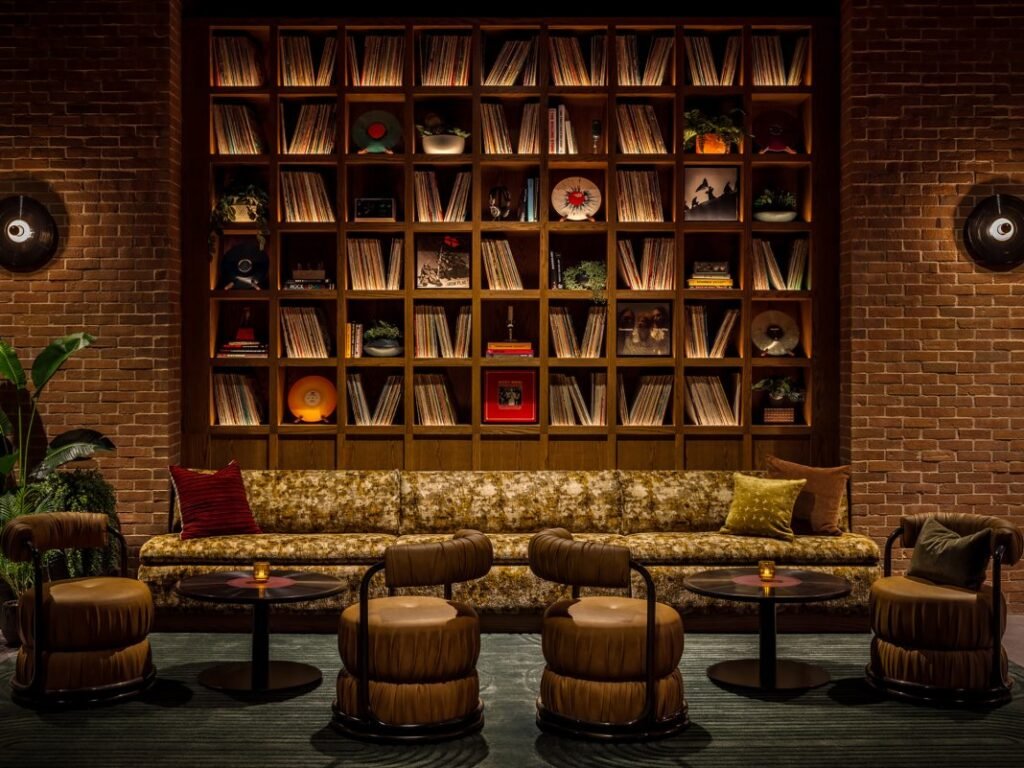
In 2018, the first hi-fi bar in the United States opened in Los Angeles. It was called In Sheep’s Clothing. While that establishment unfortunately closed in 2020 during the pandemic, it started a trend of hi-fi bars and spaces spreading all over the City of Angels. Hollywood. The beach. Northeast LA. Downtown. No matter the neighborhood, a place to have a drink and listen to a top-tier sound system in LA is never too far away.
As MusicTech reported earlier this year at VinylCon Los Angeles, the explosion in vinyl sales has sparked greater interest in hi-fi listening, and these spaces can serve as entry points to showcase analog quality.
READ MORE: Inside 5 of New York City’s best hi-fi bars: Where they are and why they sound so good
I meet with the owners and curators of hi-fi bars all around Los Angeles to learn the systems they installed, how they fit each space, and how they contribute their individual aesthetics.
1. Gold Line
“People want to have a good time and let loose. That doesn’t mean the system has to sound bad”
Gold Line opened in Highland Park the same year as In Sheep’s Clothing, but thankfully this spot was able to survive the pandemic, making it the oldest hi-fi bar in the country. Curation is taken seriously at Gold Line — Peanut Butter Wolf, founder of Stones Throw Records and co-owner of the bar, has stocked the shelves with thousands of his own records for DJs to play on the system.
“The best DJ sets here are people who come in and freestyle it,” says Jason McGuire, co-owner of Gold Line and general manager of Stones Throw. “They have access to 3,000 records within arm’s reach, and Wolf goes through all of these.”


“It’s perfectly curated. You just grab something, put it on, and it’s pretty good,” adds Jake Viator, who designed the Gold Line sound system as part of the audio purveyor Analog Workshop. He also built the Stones Throw studio that is upstairs from Gold Line.
The bar has two sets of stereo speakers. The front has two Altec Lansing Malibus among the various Japanese whiskey bottles on offer. The Malibus are flipped over so the horns are at ear level. The wider lounge in the back has two Altec Lansing Valencia 846B speakers. Both sets are powered by a McIntosh amplifier with a Bozak CMA-10-2DL, “the original disco mixer of the 70s,” as Viator describes, between two Technics SL-1200 MK2s.
Ahead of Gold Line’s grand opening, McGuire and Peanut Butter Wolf spent a lot of time at the original Japanese hi-fi bars where silent listening to jazz and classical music is the norm. But they wanted to bring something more lively, and frankly, in line with the kind of releases Stones Throw puts out.
The label, which celebrates 30 years in 2026, has welcomed J Dilla, MF Doom, Sudan Archives, and countless other artists making music fit for a party. Anderson .Paak and Knxwledge filmed the video for their NxWorries track, FromHere at Gold Line.
“It’s pointless to force the Japanese patient vibe on people here. Bar culture is a lot different,” says Viator. “People want to have a good time and let loose. That doesn’t mean the system has to sound bad.”
Address: 5607 N Figueroa St, Los Angeles, CA 90042
2. Only The Wild Ones
“We’ve always had this romance with a really nice-looking speaker. It’s like having an appreciation for classic cars”
Two years ago Heather Tierney bought her first hi-fi sound system for her home: a set of Tanoy speakers with an Accuphase amp. She’s now opened three hi-fi bars throughout the US. They are all named Only The Wild Ones (OTWO), and they are in New York, Austin, and on LA’s Venice Beach. The latter is where I meet her.
“When I really get into something, I go all the way in,” Tierney says. “There’s something about slowing down and really feeling the music. It’s the vibration. It’s almost like a three-dimensional sound.”

1 / 6
Only The Wild Ones bar
The Venice location was the first. It started as a natural wine pop-up next to Butcher’s Daughter, the cafe and market in Venice Beach that Tierney also owns. By the time the current Venice location became available, she had already bought her system, so she combined those two concepts: hi-fi listening and natural wine. She sees a lot of overlap in the spirit of both.
“Natural wine is how wine has always been made. It’s just going back to the old way,” Tierney says, comparing it to vinyl. “It’s real music that’s pressed into the wax. It’s connected to the source. You feel the soul.”
Tierney’s music director, Max Van Ville, designed the system that delivers the soul to OTWO. It features four Klipsch + OJAS KO-R1 speakers spread throughout, with two subwoofers. One is built into the bar, the other is built into the wall right across from the bar, creating a central hub for the low end while the highs are spread further around.
There are also two more speakers at the back of the bar Van Ville built himself. Similar to Tierney, he only started building speakers relatively recently, and now has built custom models for establishments all around Los Angeles and in the New York OTWO.
“[We’ve] always had this romance with a really nice-looking speaker,” Van Ville says. “It’s like having an appreciation for classic cars.”
Address: 1031 Abbot Kinney Blvd, Los Angeles, CA 90291
3. Johnny’s Hi-Fi
“We want the room to feel like your favourite old leather jacket”
Johnny Dysthe opened a bar called Johnny’s in the Highland Park neighborhood of Los Angeles in 1946. Today, Johnny’s is still around, and not a lot has changed. It’s still in the same location, and it’s still owned (in part) by a guy named Johnny (his last name is Santiago). The main difference is that Santiago put a hi-fi system and DJ booth in there.
Like Gold Line, Analog Workshop also set up the system at Johnny’s. It includes two Altec Carmel 838As, two speakers custom-built by Analog Workshop, two McIntosh 7270 amplifiers, a MasterSounds Two Valve MK2 mixer, and two Technics SL-1200 turntables.

1 / 6
Johnny’s hi-fi bar in Los Angeles. Bar shot.
Of course, vintage gear like this is often desirable for its focus on quality sound, but at Johnny’s, it fits a curatorial purpose as well. Santiago wanted to maintain the bar’s history as a local haunt rather than transform it with a trendier design. The lighting is still dim, and the booths are still comfy as hell, but now the sound is crystal clear.
“We want the warmth of that neighborhood bar,” Santiago says. “When we were building it out, our north star was: we want the room to feel like your favourite old leather jacket. The booths. The color. The lighting. Everything.”
Other than the classic feel, Johnny’s really stands out because of one key piece of equipment. Most hi-fi bars these days only have turntables, but Johnny’s has a Pioneer RT-909 reel-to-reel mixer. Unfortunately, Santiago says it doesn’t get used as much as he would like. He wants to do reel-to-reel listening parties and have a reel-to-reel monthly night, so if anyone reading in LA can make that happen, drop by.
Address: 5006 York Blvd, Los Angeles, CA 90042
4. Vinyl Room
“We don’t need to use the same people over and over. We want the punk DJ. We want the hip-hop DJ”
Every new velvet rope in LA is a cause for intrigue. In February 2026, a new one popped up outside the Hollywood Palladium, when the legendary music hall opened a new hi-fi bar called the Vinyl Room. This spot is unique because it’s not open to the public as a separate establishment. Instead, it’s an extension of the venue.
That applies literally because the space used to be a bare storage closet in the Palladium where they kept posters and other random objects. Now it’s a highly curated restaurant and bar with a MasterSounds Clarity-M hi-fi speaker system and Full Fat Audio amplification. Surprisingly, they didn’t have to do any acoustic treatment to maintain the audio quality.

1 / 3
Hollywood Palladium’s Vinyl Room, bar
The main cabinets are placed behind the bar that has shelves filled with vinyl (this time just for decoration, not performance like Gold Line), and well-hidden Fulcrum Acoustic reference speakers on the ceiling create a very full sound that spreads the length of the room.
The space is also figuratively an extension of the Palladium, which first opened in 1941, because it is decorated with artifacts from the venue’s history. Original tour posters and photos of artists from Chuck Berry to Korn adorn the walls above mid-century-style sofas and a table that looks like a vinyl record.
To see it for yourself, there are a few ways in. When it’s open for show nights, ticket buyers can purchase access as an add-on. There are also memberships that allow access for every show. With this association between what’s happening on stage, Ryan Blank, general manager of the Palladium, has to look further for DJs than most vinyl bars. Because when Jack White plays on September 28-29, the crowd will want to hear vastly different music preshow than when Schoolboy Q plays on October 9.
“We’re focused on LA-based DJs, all vinyl. We got a steady roster, but we’re able to flex that muscle,” Blank says. “It’s exciting to go on that journey as people do digging through record crates. We don’t need to use the same people over and over. We want the punk DJ. We want the hip-hop DJ.”
Those who aren’t coming for a show can check out the vinyl room for standalone events. Recently, they’ve hosted comedy shows in the round with prized comics such as Bill Burr. Vinyl Room also had a free listening party for Billy Strings’ new album, So Much For Goodbyes. It was one of the only listening parties in a hi-fi establishment.
Address: 6215 Sunset Blvd, Hollywood, CA 90028
5. Bar Franca
“Franca is tiny, warm, and personal. You are never very far from the person selecting the music”
Rolando Alvarez is known throughout LA for running the popular underground party Midnight Lovers, but since October 2025, he’s taken his curation to Bar Franca, a charming former lesbian bar turned hi-fi oasis in the grit of Downtown LA.
Another link to Midnight Lovers is Bar Franca’s sound system. Alvarez relies on Danley for his parties, making a Danley system the natural choice when he was building out the bar into a space that would honor his commitment to music.

1 / 6
Cinthie performing at Bar Franca
“Danley has been part of the Midnight Lovers sound for many years, going back to its introduction into our corner of the dance music community. We have used Danley almost exclusively for Midnight Lovers productions because of the warmth, clarity, and acoustic character of the systems,” Alvarez writes over email. “There is also an incredible efficiency to Danley. You can achieve a tremendous amount of sound with a relatively small physical footprint and power requirement, which becomes especially important in a room the size of Franca.”
The main loudspeakers are Danley Sound Labs SM96s and Danley THmini subwoofers, with a Danley BRKT-Mini monitor. Everything runs through a Danley Sound Labs DSA 125×4 four-channel power amplifier, powered by CVR Audio amplification and an NST Audio D48X digital signal processor.
While occasionally, Midnight Lovers-level headliners like Axel Boman will stop through Bar Franca, it is also a place to support local LA talent. After all, proper all-night rave energy isn’t the move for a bar where people want to socialize. So, Alvarez brings in selectors who know funk, jazz, and other softer, warmer sounds.
“That contrast is part of the fun. Franca is tiny, warm, and personal,” Alvarez explains. “You are never very far from the person selecting the music.”
Address: 438 S Main St, Los Angeles, CA 90013


Harry Levin is a freelance journalist with credits in SPIN, Billboard, MusicTech, Grammy.com, Los Angeles Magazine, and more. His musical journey began 20 years ago with a Led Zeppelin CD. He played jazz trombone through college, produced large-scale electronic music events, and now spends his professional time writing and editing.