


There’s a scientific phenomenon called a “death surge,” which describes a person’s last-ditch effort to survive before their demise. Also referred to as an “end-of-life rally,” it indicates a sharp rise in energy or activity just before demise. This idea is akin to what’s happening to anti-Blackness and patriarchy in America.
As cataclysmic events like worldwide protests against the murder of George Floyd and a historic run for president by Kamala Harris signal their susceptibility, whiteness and misogyny are doing their worst to stay alive—and this death surge inherently brings the most violence to one group: Black women.
In her book The Essential Guide to Counseling Black Women, therapist and educator Dr. LaNail R. Plummer puts it plainly: “Without women, patriarchy could not exist, and without Blackness, racism could not exist. Black women were needed and weaponized for the very systems that kept them oppressed.” That reality, one’s very existence defining the parameters of their own oppression, brings on what Dr. Plummer describes as a “massive psychological and emotional toll.”
This metaphorical death surge of whiteness and misogyny has already proven to be catastrophic for Black women—from hundreds of thousands suffering job loss, to declines in business funding, to a rise in Black femicide. After a year of collective economic recovery and being ousted from corporate America, national headlines took the onslaught even further. In April 2026 alone, at least a dozen Black women were murdered in acts of domestic violence, with Florida Vice Mayor Nancy Metayer Bowen and Dr. Cerina Fairfax among the women killed by their husbands. In another horrifying case, two women were shot and eight children were killed in Shreveport, Louisiana. Not long after that, the sanctity of Black women became pop culture fodder for (mostly male) commentators looking to defend NBA star Klay Thompson against infidelity claims made by his now-ex-girlfriend, Megan The Stallion.
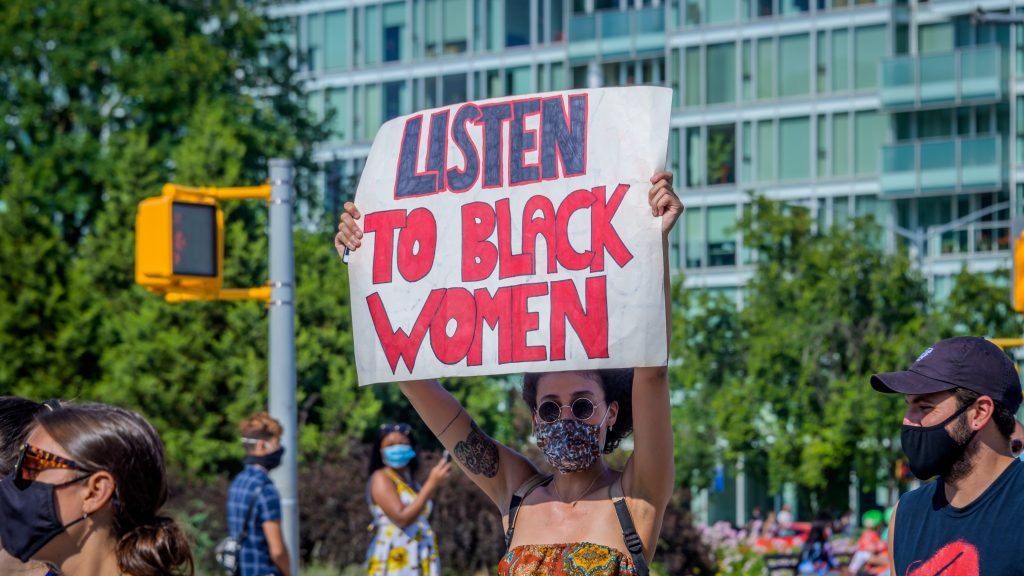
At every recent turn, Black women have been forced into playing excruciating levels of defense—further necessitating their recurring, often life-saving plea: to simply be listened to.
Points made by Black women leaders seem to fall on deaf ears. Congresswoman Ayanna Pressley brought the issue of Black women’s unemployment to the Congress floor, stating: “With Black women being among—just so y’all know—the most educated and most active in seeking work, their pushout is a glaring warning sign for where our economy is headed, because Black workers, Black women in particular, have always been the canaries in the coal mine.”
In the case of rising physical and emotional violence towards Black women, digital creator and host of REVOLT’s The People’s Brief, Lynae Vanee, brought a tough question to the forefront with a Substack post titled “Is the Black Manosphere Just as Bad as MAGA?” In it, she lays a growing feeling bare: “It’s like they are not even fighting to be heard anymore; they are just fighting to wear us down, to tear at our self-esteem, to see us depleted. It’s saddening, truly. And it feels a whole helluva lot like MAGA. Arguing for argument’s sake, with no historical knowledge, parroted talking points with no nuance to aid in depth of understanding, and bewildering allegiance to an ideology that wishes to destroy them.”
Put more artfully are battle cries like that from artist, creative entrepreneur, and former TikTok DEI lead SHAVONE. In her latest lyrical offering, “TRIUMPH,” she refuses to mince words:
Black women in America, who gon’ cherish us?
Spoiled men perish us
Drownin’ in a sea of lust
They not really seein’ us
While these other women bein’ us
For licensed professional counselor and Transpire Wellness founder Tamara Thomas, two accessible solutions exist for Black women: rest and community. “Black women are tired. We are exhausted,” she says. “We have carried the weight of work, of home, of our communities, of our families—and we’re tired. We’re tired of being taken advantage of for our skill set, for our level of investment in the place where we work.” To address this disproportionate demand, Thomas encourages Black women to challenge their tendency to equate rest with laziness. “Part of what has happened in our culture is that rest has been equated with being lazy. There’s so much work to do, and we have been socialized to be superhuman. And we’ve got to stop.” The rest Thomas is referencing goes much deeper than taking naps; she encourages Black women to practice separating themselves from all obligations.
Thomas also warns against Black women only finding rest in isolation. “We have to find communities of rest,” she notes. “If that is your place of worship, if that is your girlfriend group or prayer circle, if that is certain people in your family. Not everybody in your community gives you rest, and so you need those people you can go to and say, ‘Sis, I’m tired,’ ‘Sis, this is something I’m going through, can you help?’”
As for the gender wars plaguing Black men and women, Thomas points to the need to heal a swelling lack of trust. “Single Black men and single Black women are struggling. And I think that it is creating this space where people are beginning to become disillusioned with what it truly means to be in a healthy partnership. And because of their past experiences with infidelity, with domestic violence, they are choosing not to trust.”
The trouble with failing to trust Black women, however, is that their fates and the fate of the country are intrinsically linked. From Shirley Chisolm, to Coretta Scott King, to Stacey Abrams, to Justice Ketanji Brown Jackson, America has famously relied on them to progress toward true democracy. Further, in everyday terms, the “Strong Black Woman” trope continues to be an expectation—at home, at work, and in relationships. In that sense, the sharp rise in dismissing and demeaning Black women is fatal for us all.
As the “death surge” of whiteness and misogyny aims to throw its weight onto the very population needed for either of them to exist, it also seeks to destroy the very population everyone will turn to when the question inevitably becomes: “What now?”