


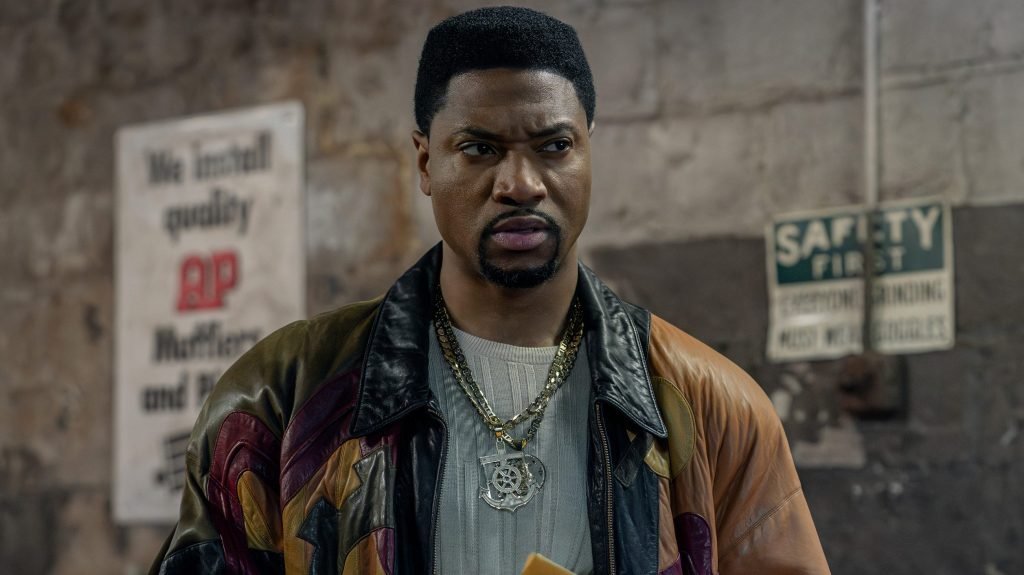
Whether captivating viewers with his effortless charm or displaying an emotional depth that belies his humorous quips, London Brown has carved out a space as both a dramatic force and an undeniable comedic standout. A native of Los Angeles, long before scene-stealing performances and breakout television moments, Brown was a kid discovering the thrill of performance in church productions and school plays across Southern California. Encouraged by a high school acting coach who recognized both his charisma and raw talent, the aspiring thespian committed himself to pursuing acting professionally, sharpening his instincts through theater work that he still credits for strengthening his range and discipline.
“Theater gives you a work ethic that you don’t get from other forms,” Brown, sitting in a New York City office, says during a May afternoon. “You just develop a different kind of presence doing theater. There are some TV actors who have a great presence, but I think, fundamentally, there’s a way to separate yourself when you come from theater. Most of the greats, the Viola Davises, the Denzel Washingtons, and Don Cheadles got cast in the theater. That’s the place to be.”


Starz
Before Hollywood fully embraced him, the actor’s path included working as a barber and later at a rehabilitation center — experiences that grounded him in relatability and emotional intelligence that now define many of his performances. That authenticity translated naturally into early television appearances in CBS’s Diversity Sketch Comedy Showcase and the short-lived Fuse series The Hustle, opening doors to high-profile opportunities on some of network television’s biggest dramas, including HBO’s Emmy Award-nominated drama Ballers.
Sharing the screen with megastar Dwayne “The Rock” Johnson and other acclaimed actors during the show’s five-season run and commanding viewers’ attention in the process, Brown has steadily evolved into one of TV’s most compelling personalities. Now, returning in his role as Marvin Thomas, the underboss and enforcer of Raquel Thomas’ (Patina Miller) drug empire in the fifth and final season of the hit Starz series Power Book III: Raising Kanan, Brown’s place within the modern pantheon of actors feels firmly cemented, with “Starvin Marvin” already immortalized as one of the most beloved and memorable figures in recent television history.
I discovered you on Ballers as Reggie. How did that role come about?
I had been doing stand-up for a few years and toured with Chris Tucker on the weekends. Everything I own is in my garage, in my mother’s garage, or in my trunk. I’m staying with friends, just hustling, figuring this out. Anyway, I get a call. Someone over at HBO said a friend was looking for me. Shout out to Chris Spencer. They contacted me, and I went to audition. At this time, I’m podcasting. This is in 2012. I’d get like seven callbacks, and that’s always the fight because the network didn’t want to go with me because nobody knew me. They wanted a bigger name for the part, but the showrunners were like, “We think London is the guy.” They fought for me, and then HBO bought into it after the fact.
They liked what I did; they made the character a lead. In season one, I was only supposed to do one or two episodes. I ended up becoming the antagonist. All my scenes were across from Dwayne. Even if you didn’t know who I was, you had to see me. It lined up perfectly for me to get the look. Then, if you can’t be the hero, the next best thing is the person people don’t like. That’s what I need it to be to keep him interesting, so he sticks around because the writers will write you off. Reggie could’ve easily been in the car accident after season one, and that’d been it. In seasons one and two, I did a lot of improvising because they didn’t have those kinds of lines for me, because I wasn’t supposed to be there. I was feeding them lines. HBO is a very well-respected network. I feel like Ballers was the project that really put eyes on me.
When you mentioned The Rock earlier, you said Dwayne. What was it like working with him and building that relationship?
When I first got there, I was trying to figure out what to call him because again, we’re talking about WWE, WrestleMania. We’re all fans of The Rock, but when I met him, he wasn’t The Rock. He wasn’t the people’s champ; he was Dwayne Johnson. The energy is totally different. That’s kind of what we would say on set ’cause he’s not The Rock. He’s not doing The People’s Elbow in between takes. He ain’t coming out there with a wrestling belt. He really is Dwayne Johnson. Real chill, eating his protein meals, but he was cool. A real nice guy. The thing about him is his presence. Dwayne’s trailer was like a mobile home truck.
When he arrived on set, it was like Moses; the sea parted, and the weather would change. You just knew. You didn’t see him, but you could feel the atmosphere change. I haven’t really seen too many people like that. Whatever superstar you think he is, he was 10 times that at the time. That’s when he was at the apex. Dwayne was the guy.

You were also in the series Bronzeville, which was about a historic neighborhood in Chicago, right?
That project came about during the hiatus of Ballers. I got a call from the Tate Brothers, who are Larenz Tate and Larron Tate. They said, “We’ve got this project for you called Back to the Goode Life. It’s going to be starring you and Kyla Pratt, and we want you to play her love interest.” I was like, “All right, well, cool.” They offered me the part. I flew out, lived in Atlanta, and went to shoot that for the summer. From that project, they said, “We’re doing this audio book, we want you to do this project. There’s going to be a whole lot of people in there, you and Lawrence Fishburne.” I go over the project script, and then I’m at the studio.
I think Lawrence Fishburne was there, and some other cats, and we knocked it out. That was just on the strength of working with them on one project and saying, “Yo, we got something else.” I met Larenz Tate [previously]. I did a comedy show, and afterward we were all standing out in front of a restaurant. We didn’t know each other then, I mean, I obviously knew him. I just spoke to him, but we didn’t really have a conversation until I met him backstage at an event. I think he had watched Raising Kanan at that point.
Then, I could tell it was different. When you speak to people, they acknowledge you, but they don’t see you. That was cool because I had always been a fan of his work. I didn’t really see any young cats really doing what he was doing back in the ’90s. Larenz Tate, to me, was one of those young actors with the chops. Menace to Society is just one of those ones. I didn’t even realize he was 17 at the time with what he was able to do. I feel like he’s slept on. For black people, Larenz Tate is in the same category as Leonardo DiCaprio. He’s one of the ones for us. I always looked at him that way, and I still do.
How do you merge the comedic chops that you have with drama? You’ve got scenes where it’s really intense, and you’ve got scenes where you can laugh. How do you balance both of those extremes?
For me, it’s not really that crazy because I’m a layered person. I’m not always telling jokes; I’m not always serious, but when it comes to the drama, it’s important for me to take advantage of the eyes I have for these things. The writers don’t always know what these characters are supposed to do. So it’s up to us as actors to create that energy and to show them, “I’m not just this. I can give you tears. You want a leading guy? Whatever you’re trying to do, let me show you a bunch of options, and then you can start writing about the things I present. That transition wasn’t extreme because again, I do standup, but I am an actor. That’s why we train. That’s why we take classes to know how to go in that bag whenever we need to. We’ve got those tools there to work for us.
I’m always in a showcase position. I don’t know who’s going to turn on one day and catch me, and it happens to be my scene. It’s like the [Michael] Jordan effect. You can’t really afford to have the off nights because you don’t know who bought the ticket, who saved up their money to watch you play. You want to make sure you put on that show.

Starz
Moving on to Power Book III: Raising Kanan. How did that whole opportunity come about?
I meet with my current agent. He’s like, “I’ve been hearing good things about you, I’m familiar with your work. Why don’t you go read for this project called Raising Kanan?” I do about seven auditions for Raising Kanan, and this is like February of 2020. They told me I got the part, and it happened so quickly. It was on a Sunday morning, I think. When I got a call that I’d gotten the part, I took my family out to eat, had a quick meeting on Tuesday, and then moved to New York that same week.
At the time, I was staying on 131st and Madison Avenue in Harlem, by the Stinking [Abraham] Lincoln [Projects]. I just wanted to be next to a couple of things. I need to be by some convenience stores; I just need to be in the mix.
Then, after the first season, I remember the energy started picking up a little bit, so people started speaking. By season two, I had to move. I don’t need nobody coming back to my place thinking I got something. All I have are some shoes anyway. I knew I really had to move when I was walking in from the gym, and I used to pass corner boys all the time. One particular time, I remember a guy said, “Hey yo, you’re the dude from the show.” I was like, “Yeah, man, I appreciate it.” He said, “That’s what’s up. Now you get a pass.” I said, “Now I get a pass?” I’m like, “How long have you been thinking of robbing me?” I’ve been passing these dudes every day. But they were cool. They were triplets, and they lived up the block. When things started to pick up, I ended up moving just to make sure I ain’t dealing with nobody crazy because the hood is still the hood.
Fortunately, [my character] Marvin is a street dude, so he gets a lot of respect in the street. One time, a dude wanted to take a photo, and he grabbed me to take the photo; he had the pistol on him. The streets really embrace Marvin because I think a lot of them identify with Marvin. They understand who Marvin is. He’s not just a dude who’s always eating; if you really understand Marvin, you realize he’s a really thorough guy.
What would you say is different about that role, or why it resonates with so many people?
If Marvin wasn’t played authentically, the streets would have lit him up. New York is so honest about that sort of thing. It was just as important to play the truth as to play a caricature. I didn’t want Marvin to come off like some character that was just written. I know people like Marvin. Marvin’s a real person as far as what he is standing on. There are lots of people who move like him and are loyal, trying to do the right thing. They get caught up, but their hearts were in the right place to do it. For example, there are guys I know who sold drugs, but they weren’t selling drugs to try to floss and shit. They had responsibility. That’s why I like that line that Biggie said on that “Juicy,” when he was talking about how his neighbor called the police when he was just trying to provide. It’s those fundamental things that I think people really understand with Marvin.
Also, with characters like that, there has to be some redeeming factor to them. They can’t always be ruthless and running the streets. There’s something about Marvin where people are like, “He be messing up. But you know what? I hope he figures this out. I hope he pulls through on this.” That sort of thing I think is what people connect to. Also, Marvin’s not just one note.
I think Marvin is the only character on the show you can see in one scene holding his daughter; the next, he might be holding a cigarette, some candy, or a gun, and none of them seem out of place. Marvin is a kind of character where, if he’s upset, angry, snacking, cracking jokes, or crying, no one looks at him weirdly for having those emotions.
You talk about hugging your daughter, Jukebox, on the show. Can you talk about the chemistry between you and Hailey Kilgore and the arc of that father-daughter relationship?
When we first got to set, I think she felt I didn’t like her because all I knew was that Marvin and Jukebox had a rocky relationship. It wasn’t really solid, so I just played that intent in real life. I didn’t hang out with her as much, but I needed that kind of energy so that by the time we got to the whole domestic dispute in season one, it wasn’t really that hard to play because I didn’t really know her. I didn’t want to be too social with her, and then have to go into that.
That was one of the most difficult scenes to shoot because I was trying to keep it grounded. I went to speak to some of our friends in that lifestyle and then asked ’em, “Is it a thing when you come out to your parents like that?” Especially back in the day, we’re talking about the ’90s. It wasn’t that liberal back then. So, Marvin’s reaction is legit.
The Lebanese comment.
How he said that lets you know he didn’t know anything about that lifestyle. That caught him totally off guard. But that’s why it was important for the following season to start to arc Marvin early, because I’d be out and about after season one, and old women would come up to me [saying], “Don’t you put your hands on the baby like that!” They were mad at me for real, but that’s why it was important we had him go to therapy. Marvin did recognize that what he did was wrong. That’s why, even by season three, we start to see that change in Marvin, where he becomes almost like a super-dad trying to show up for the auditions. He was extreme in one way and then in the other. During [seasons] three and four, we started to see Marvin kind of balance out a little bit and really show up for her.
Marvin also had to realize that some of Jukebox’s energy began to manifest as if he were influencing it. She started to really watch her dad, and she’s not a pushover. When Marvin, in season four, is always trying to warn her, “Listen, man, I don’t think you need to go down his path. She was. But as a person, she was great to work with. I think we had the closest emotional connection on the show, as far as characters go, because we had a lot of sentimental moments when it was just us, and she was always prepared. Great person. I can’t wait to work with her again.

What has your experience been like around 50 Cent?
He was cool. He wasn’t on set like that all the time, but a few times he was there. We spoke more off-set. I remember one time I met him at an event, and it was a whole club, and everybody was there. There was a whole lot going on, sparklers and bottles and everything, but we just sat off to the side, and he spoke to me for about two hours and just gave me the game.
This was like season one. In fact, I think season one might not have even dropped. He just talked to me and just let me know how things are going to change and move. He’s a really smart guy. I know that much. Through all the antics and all that stuff that people see, 50 is smart. He knows how to position things and put people in place.
Even if he doesn’t do them himself, he knows how to put the right people around them, and they know how to do them. That’s the part I focus on, just the game that he’s got. Even if you watch his interviews, he’s always dropping gems, but they’re not set up in a corporate way. They’re just really off the block, gems of just how to navigate.
What’s it like working with Joey Bada$$ and seeing him blossom as an actor?
Shout out to Joey. I remember a couple of years ago, I think he got an Oscar for one of his short films that he did. It’s nice ’cause I was already a fan of his music anyway. So, to have him join the cast, that was good energy, and we had our scenes together, man. Marvin, low-key, had his own storyline throughout the show.
Marvin’s in the show, but while watching, you can follow his story on your own. Between what he does with the Italians, his beef with Unique, him and Jukebox, and even within these last few seasons, Marvin connects with everybody.
I like characters that do that, and I try to give the writers enough range so that they can do that ’cause they did it on Ballers. They were pairing me up with a lot of different people, so for them to take that sort of interest to have Marvin with his own storyline, that’s cool. The stuff we did with Unique, that’s one of my favorite scenes.
I forgot the director who shot the scene, but in season one, I think it was episode eight or nine when Unique is coming out of the movie theater with his son, and Marvin comes out with the van. To me, out of the whole series, that’s what I call one of my Denzel beats. That’s the action shot that you want. Not only did I get to use that type of gun and was just letting off those rounds, but it’s slow-mo’d. I mean, the shot is sexy. That’s the one that you want as an actor because I’m thinking past Raising Kanan. You want these nice cinematic clips that put you in the lead role, like, who doesn’t? That’s the cool thing about acting: I get to do all these things. I’m not trying to shoot anybody in real life, I’m trying to see Christmas. Playing Marvin or acting lets me take on these cool parts.
I think that’s why the streets love Marvin because Marvin gets to shoot the gun, drive the fly car, and have a fly wardrobe. All of that stuff has been fun, and that’s the cool thing about working on a project like this. It’s a little nostalgic, too, because it’s taking place in the 90s. So you get to wear all the wardrobe, the style, and the language now. All of that stuff. Raising Kanan and working with this cast has been great.

What was it like working with Shameik Moore, who plays Breeze, and bringing him into the fold?
Fortunately, this cast, everyone was cool. There was no weird energy like that on set.
And I think we also have to tip our hat to Patina Miller ’cause she was the captain of this. Even though Mekai Curtis, Kanan, he’s like the star and the face of it, Patina’s the captain of it. She was always on her stuff. There was no option not to show up because she was there, ready to work.
We’ve got a lot of good stuff coming up, a lot of good scenes together, but since she was cool, everybody else was cool. He had to get in order because she was in order. I think people are going to enjoy what he brings to this season because they introduced him at the end of season four. There are many storylines that will unfold this season and keep people interested.
I think this season is going to really feel like a movie. In fact, I’m going to look into some theater spots to really watch the season in. Because the way Raising Kanan is shot is very cinematic.
The camera moves in a way that feels like a movie, just shot in 40 minutes. It’s really going to be good. I’m excited to actually see this one and really watch the season because, sometimes, I catch up on the other ones. I kind of find out. But this one might be the first one where I actually really sit down to watch it as a fan. I think people feel like actors look at it for themselves, but you don’t really see yourself as a character. So I’m really just watching it. Marvin’s funny to me, too. I’m not looking at me saying, “Oh, look what I did.” I’m looking at Marvin and Marvin’s choices. This is going to be good. It’s a popcorn, snacks, dim the lights down, watch it on the big screen type of [show].
What’s next for London Brown?
Right now, I’m working on a podcast. We’ve been going for a while, now it’s called Killin It. On the podcast, we’re doing me, my guy Justin Harris, and BT Kingsley. The three of us have guests on the show who are, as the title mentions, killing it. Cats who are making moves. We basically pick their brains about how they’re navigating through the industry, the ups and downs of it, how they overcome, how they book their projects, how they get a million followers, and how they’re touring. We just cover the game by asking them about it. That’s been doing really well. You guys are going to see more of that. Lots of fun guests on there. Also, I’m touring right now. I’m doing a bunch of different comedy tours and stuff like that, and that’s been doing great. Of course, I’m still in the auditioning process and reading scripts. I get projects that come in, but it’s just choosing the right project. I’m always working on the craft, reading these scripts, and trying to find the right thing. So, it’s all in the works.
In addition to that, also doing a tour with this organization called NCRF, National College Resources Foundation. What I do when I’m not shooting or touring during stand-up is help students get into college and HBCUs.Shout out to Yo-Yo. Me, Yo-Yo, Kel Mitchell from Kenan & Kel, Da’Vinchi from BMF. We’re all ambassadors of the program. We’re the ones who give the scholarships and are trying to help these students get their education going and stuff like that.