


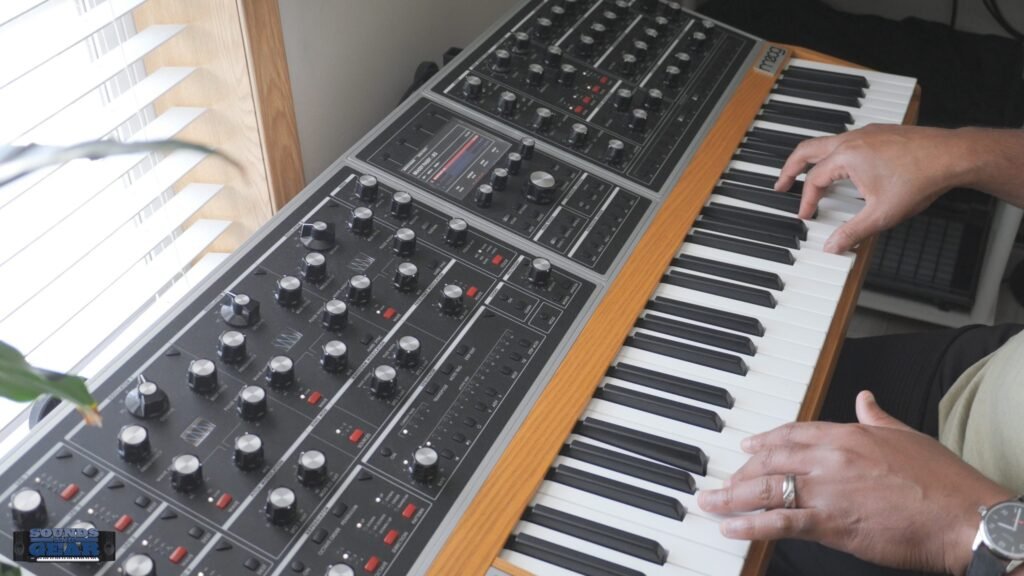
Title pretty much explains the situation. Been using the Moog One for a few years now and absolutely love it. So much so that I’ve not felt bad about letting go of quite a few synths at this point. Various Moogs, Matrix/Polybrute, plus joints from Korg, Sequential, Oberheim, Behringer, Roland, etc.

Am I saying the Moog One can do everything each of those can do? No, not at all. What I’m saying is that for me, I connected more with the One overall. Plus, I can get the type of sounds I was designing on those synths out of the Moog One.
Some things I dig about it
First, the data management is really top notch, like nothing I’ve seen in any hardware synth that I’ve used. There are no preset numbers, no one even knows if there is a preset limit. With the use of type, category, mood, and groups, you can quickly drill down into whatever type of sound you want.
You can edit these by adding your own custom tags. Groups is a great way to manage separate banks, and you can even create multiple “user spaces” which contains everything on the synth. This is perfect for separating the state of the One for different projects, or I imagine shows/performances for live and studio musicians.
For me, it is just a great way to organize different states of the synth. Oh, not to mention being able to save things like modulation matrix presets, arps, sequences, etc.
Second, it is just fun to program, super flexible, and I enjoy playing it. The actual instrument itself is just a great experience. The more I use it, the more I learn, the more I love.
There were some bumps in the road though…
One of the first issues I had with it was the output was super noisy! That was…until I found out that 12 o’clock on the volume output is actually unity on this synth. Why they did this is beyond me. So I leave the synth at or just below 12 and manage gain staging later in the chain via my interface or anything else I’m running into.
The fan is audible, which is to be expected with the amount of electrical components in there. There is an option to set it to low, which makes it less loud, but I prefer to keep it on normal just in case lowering it impacts the cooling over time. As an IT guy, it isn’t as loud as a rack of servers or switches, or even some computers. However out of the box, if you’re recording vocals or anything with a mic in the same room you’ll definitely notice it, the option to set the fan to low is useful in that situation.
I know some had issues with MIDI, I haven’t experienced this as it isn’t my use case. Other’s have had tuning issues, again, not something I’ve had a problem with. I don’t have one of the super early units so it is possible things got worked out by the time I acquired mine.
Ultimately I just dig it!
I was always a fan of the Moog One ever since I first played one at the Thomann Synth Reactor event

I love the build of it, the layout of the controls, the feel of the keybed, and yes, even the overall look sparks hours inspiration. Many times it isn’t just about the utility of an instrument, but the fun and joy you get when using it. I’ve owned and sold a lot of gear over the years, but some joints just hit different.
It’s just straight fun to create sounds on this synth. The engine is so deep that you can really experiment with an immediate tactile experience that rivals many vst synths. The benefit, in my opinion, is the hands on process of that deep exploration.
Do you need the Moog One? Probably not. Do you want a Moog One? Only you can answer that.
Do I dig the Moog One? Absolutely!