


While the consumer world has been fighting over the iPhone Duo, Meta’s Smart Glasses, and Googlebooks, the music technology world has been thriving in 2026. Our industry is much quieter, but we’re largely unbound by annual updates, major shareholder pressure, and great expectations. There is, of course, much criticism from producers, publications, and YouTubers, and plenty of clickbait in between.
However, 2026 has mostly brought us some pleasant surprises, from open-source and affordable synthesizers, innovations in the microphone industry, and meaningful updates to already outstanding products. We’ve reviewed dozens of hardware products this year — not all of them were a hit, but a handful were truly exceptional.
MusicTech’s reviewers have selected their favourite studio gear of 2026. Here’s what they chose, and why.
M-Vave’s FM-1 is unshackling James Langley
M-Vave’s FM-1, a nearly smartphone-sized DX7-compatible hardware FM synth for about £50, was already a pretty compelling proposition in its own right. But once users started creating — or, for the most part, vibecoding — custom firmware, I became truly convinced. Projects like Felucca and Sloop have converted the unit into a fully fledged four-track groovebox, while X0X, Karma, and OberVave transform it into a variety of beloved hardware classics.
Others have taken to creating weirder ambient or generative instruments, and even if the experience varies wildly in quality, I’ve had a lot of fun messing around with the custom firmware on offer. It feels like we’ve entered an exciting new age of gear where users, freed from their OEM shackles, are in full control of how their hardware serves them.
James Langley
Shure’s MV360 is making Clovis McEvoy feel cool again
Field recording is the musical equivalent of bird-watching. That is to say, it’s always been pretty niche, very nerdy, and most of the people who do it seem kinda lonely. Not me, though; I’m cool.
At least, I am now. Because Shure is helping take field recording mainstream with its new MV360 ambisonic microphone. It’s rugged, easy to use, pocket-sized, and the audio quality and spatial imaging are excellent. Best of all, it’s crazy cheap for a spatial microphone.
It’s not often that microphone technology takes a step forward, but the newly patented ambisonic array that Shure created to make the MV360 possible feels like a real innovation in spatial recording. With all the barriers to entry gone, I’m certain that everyone will be out field recording by next spring… right?
Clovis McEvoy
Expressive E’s Osmose CE has put Adam Douglas’ Juno-2 into storage
I’m not the greatest keyboard player. Like the way I write stories, I’m more of a hunt-and-peck keyboardist. So it may surprise that my favourite product of the year was a MIDI keyboard. Not just any MIDI keyboard, however, but Expressive E’s Osmose CE, the controller version of the company’s game-changing Osmose MPE synthesizer.
Before the arrival of the Osmose CE, I had been getting along just fine with a Roland Alpha Juno-2 as my main controller. Although the aftertouch was fading, I really just liked the feel of the keys. That all went out the window the first time I laid my hands on the Osmose CE, though.
The Osmose controller feels like a synthesizer, not a piano, which is important to me, but the fact that you can do so much more with it — individual note pitch bends, deep polyphonic aftertouch – suddenly had me thinking about music composition in an entirely new way. Expression wasn’t something to be added later with DAW automation but an element that could happen in real time.
My music is fundamentally changed. And the Roland? Gathering dust in a closet.
Adam Douglas
Novation’s Launch Control XL Mk3 is an insta-buy, says Hollin Jones
Rebuilt from the ground up and priced at a very reasonable £200, Novation has geared the Launch Control XL MK3 towards as many possible use cases as they can. Sure, there’s still the tight Ableton Live integration the company’s controllers have always been famous for, but pains have been taken to directly support other DAWs more comprehensively, including newer versions of Cubase, Logic Pro and FL Studio.
With plenty of tactile knobs, faders and buttons, you also get USB-C and three 5-pin MIDI ports, including one thru, making it better integrated with hardware MIDI gear. In fact it can work entirely without a computer, controlling a bunch of hardware, or in tandem with software; its controls all customisable via the Components system. This also unlocks maps for various instruments and other software. Freed from being targeted mostly at Live, the Mk3 is truly a controller for all seasons.
Hollin Jones
Adam Crute is blown away by Audient’s new iD audio interfaces
I’ve had numerous new and updated audio interfaces through my studio this year, but Audient saved the best till last with not one but two major releases. I did consider nominating the all-new, and hugely impressive, Horizon range, but it’s the next-gen iD range that’s going to have the biggest impact.
Rather than chase single-digit improvements in on-paper specifications, this third iteration of Audient’s highly popular iD range, aimed at home, project and mobile studios, tears up the rules on the art of the possible for affordable USB audio interfaces: Class-A preamps, analogue-domain signal conditioning, on-board DSP powering EQ, compression and reverb on all inputs, and integrated RoomTune monitor calibration.
With each next-gen iD model priced to compete directly with competing units offering similar I/O counts, I’m looking forward to seeing how Focusrite, UA, SSL, et all will react. Whether they bring their own innovations to their ranges, or simply drop their prices, it bodes well for those buying a new audio interface in 2027.
Adam Crute
Garling Wu is moved by Audima Lab’s Sway
I’ve been into gestural controllers since my university days, when a professor wowed the class by using an Xbox Kinect to perform a bass-drop using his entire body. Since then, sadly, it’s been slim pickings for those of us who want something more than aftertouch and endlessly scrolling dials.
That’s why Sway, the first release from Australian-based Audima Labs, caught my attention right away. It’s a performance-focused controller that not only tracks your hand’s position for note triggers and parameter modulation, but it also cleverly adds in aftertouch, velocity, and a host of other expression controls via micro-gestures.
Having had the chance to briefly use the Sway in person, I was extremely sad to say goodbye to it. The latest batch is sold out, but reserving a unit for the next release might just be my Christmas present to myself.
Garling Wu
Lewitt Audio’s LW6 Studio Headphones surprised Chris Barker
One wireless set of headphones really did rule them all when it came down to it.
They might not win any beauty contests, but the Lewitt LW6 headphones quickly win you over where it matters. The sound is fantastic, latency is imperceptible, and any audio tweaks needed to suit your personal taste are easily customised and handled through the companion app.
An ultra-comfortable fit, great on-board controls and excellent battery life make extended sessions a breeze, while the impressive range of connectivity options means these are headphones you’ll happily keep using long after you’ve left the studio. Add build quality that feels suitably premium and a price point that’s surprisingly competitive given the technology on offer, and you have a genuinely versatile pair of headphones that excel both in and out of the studio. A thoroughly deserving Headphone of the Year.
Chris Barker
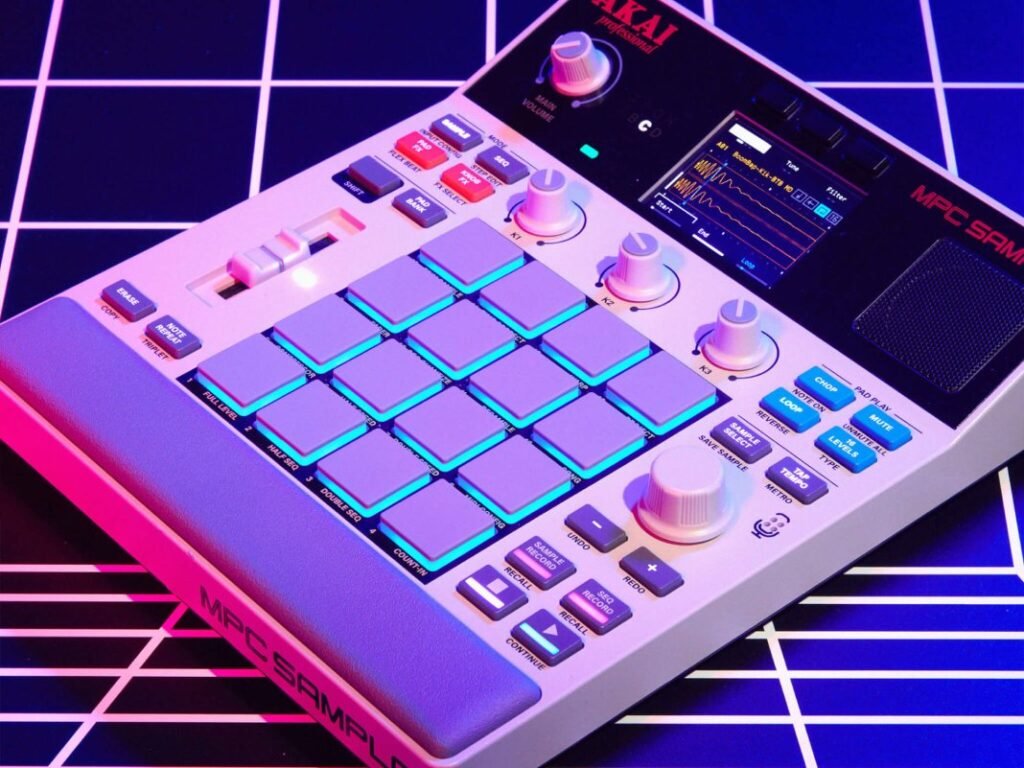
The Akai MPC Sample hype is real, says Sam Willings
They said it looks too much like a cash register. They said it was a rip-off of Teenage Engineering‘s EP-133 K.O II. They said it’s just a “demo” for a “real MPC”.
They’re all quiet now.
Akai’s MPC Sample turned out to be a banger of a sampler. The first batch sold out almost instantly, and once more people had hands-on time with it, they realised how powerful it could be, and why limitations are still an outstanding means of breeding creativity. Akai just released the V1.4 firmware for it, introducing Community Plugin Support, a scale mode for 16 Levels, a resample pad, remote screen access and more, which brings even further value to this already affordable sampler.
Akai having the gall to open up its product to community-made software is also a tone-setting move, and I think we’ll see other brands soon follow suit (thanks, M-Vave!).
I know, I’m glazing, but I had endless fun with this sampler, and there really was so much hype around its launch. And, in my view, it lived up to the hype — surpassed it, even.
Sam Willings
Editor’s Picks: