


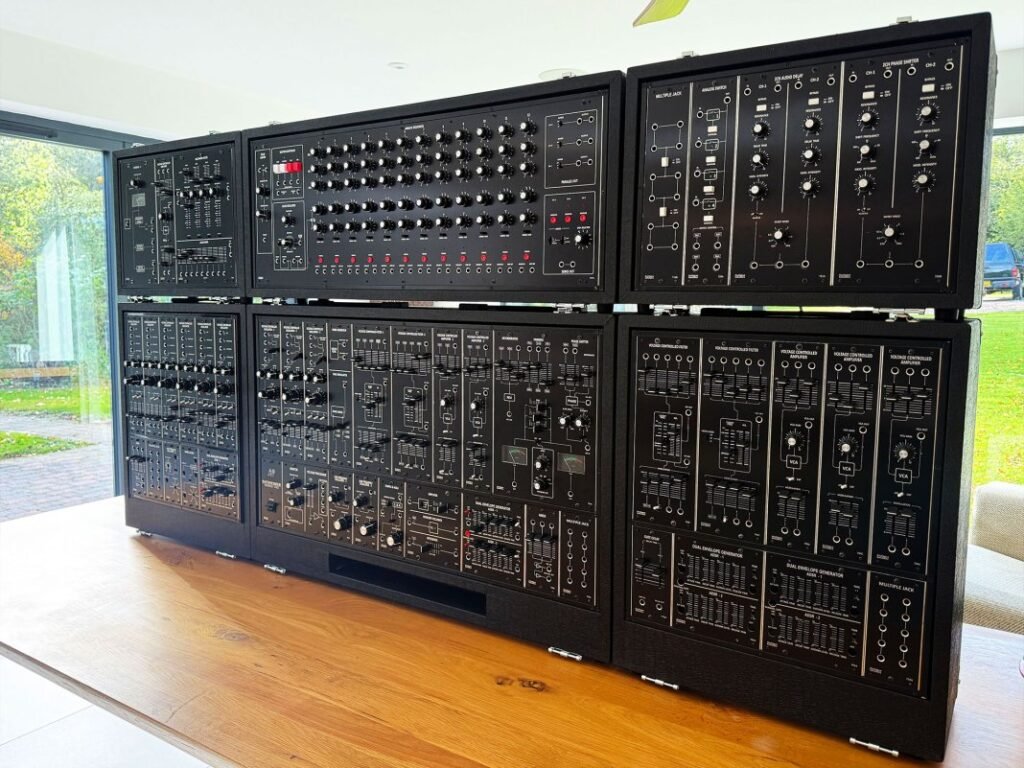
British synth builder Analogue Solutions has launched the Series 700, a recreation of Roland’s rarely-seen System 700. A full six-block system doesn’t come cheap though, priced at a princely £33,000…
Built to the original spec
Analogue Solutions says it set out to match the mid-1970s design as closely as possible. Almost every circuit has been reproduced from the original schematics, with changes only where components are no longer available. The company has also resisted altering the feature set, with one exception: a basic single-channel MIDI-to-CV converter, added mainly to sync the 3 x 12-step analogue CV sequencer to MIDI.
The look and feel follow the original design, too. Analogue Solutions has used custom-made knobs, including dual-concentric fine/coarse tune controls for the VCO waveforms, as well as custom slider caps, switches and potentiometers. The cabinets are Tolex-wrapped wood with strap carry handles and blue-lined lids. Block one keeps the letterbox-style slot for cables or manuals.


Each block matches the dimensions of its Roland counterpart: Block one measures 860 x 560 mm, Block three measures 860 x 362 mm and Blocks four, five, six and seven: 460 x 362 mm each. All blocks are 310 mm deep with the lid on (255 mm without)
Each block’s configuration is fixed because of internal patching. Analogue Solutions doesn’t currently plan to sell individual modules for use in an original System 700, though it notes the panels are the same size as Roland’s and that a different power connector would be needed.
What’s in each block

Block one, is the largest housing three voltage controlled oscillators, a noise generator/ring modulator, two voltage controlled amplifiers, a reverb/panning/phase shifter section with VU meters, two LFOs, sample & hold, a dual envelope generator and a three-channel mixer.
Block three is the 717A analogue sequencer and master controller. Block four adds six more oscillators, while block five offers further filters, three voltage controlled amplifiers and a gate delay. Block six is an interface/mixer with a multicode filter section and Block seven contains an analogue switch, two-channel audio delay and a two-channel phase shifter.
You may be questioning where block two is… This is the 701 keyboard controller, which Analogue Solutions is developing separately as an optional upgrade. Based on Roland’s 701A 61-key controller, it is planned to add four-CV-channel polyphony, velocity CV output, MIDI in/out and minijack connections for Eurorack, other modular synths and vintage mono-synths.
Why it matters

The system 700 was the most expensive synth Roland ever made, costing more than the company’s Jupiter-8. Complete systems are scarce and second-hand examples can fetch over £150,000. The System 700 is perhaps best known for its part in The Human League’s 1981 album Dare, with producer Martin Rushent’s Genetic Sound studio unit credited in the original sleeve notes.
Because the Series 700 so closely mirrors the original, Analogue Solutions will not write a full manual. Instead, it will upload the original System 700 manual alongside a supplementary guide covering the differences.
Pricing and availability
Pre-orders are now open for the Series 700, with the full unit priced at £33,000. Buyers can alternately pre-order individual blocks, or combinations of them, directly from the company. Block one, the main console costs £13,000; block three, the analogue sequencer costs £6,000; block four, the VCO Bank costs £7,000; block five, the VCF/VCA bank costs £6,000; block six, the interface/mixer costs £3,000 and block seven, the phase shifter/audio delay costs £4,000.
A deposit is required to secure a placement in the build queue. Analogue solutions will send payment details, an approximate build time and a shipping cost after the order is placed. Wait times depend on the size of the order and queue position.
Learn more at Analogue Solutions.
Get the MusicTech newsletter
Get the latest news, reviews and tutorials to your inbox.