


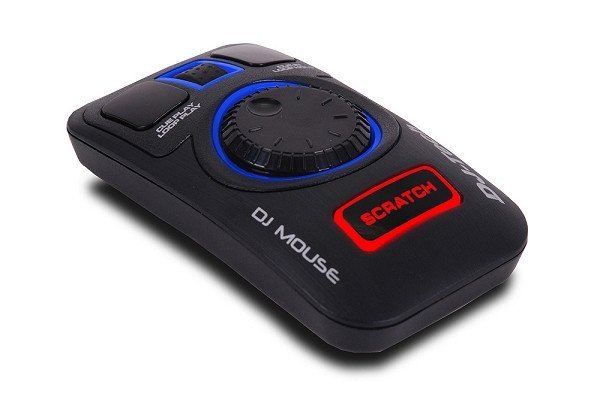
There are bad ideas, there are genuinely terrible ideas, and then there are ideas so magnificently misguided that they transcend criticism entirely and arrive somewhere close to performance art. The DJ Mouse, launched by DJ-Tech in August 2009, sits firmly in that last category.
Cast your mind back to 2009. Serato was tightening its grip on the professional market, Native Instruments’ Traktor was winning converts by the thousand, and controller culture was just beginning its inexorable march toward the CDJ-shaped future we now inhabit. It was, in short, a moment that demanded bold thinking. DJ-Tech duly obliged. Their answer to the question nobody was asking was a 120-gram USB mouse with a built-in jog wheel, blue LED illumination, and a scratch pad that the company described, with admirable confidence, as being “optimised for scratch performance.”
Reader, it was a mouse mat.
To be fair to DJ-Tech, the ambition here was not entirely without logic. DJs were already staring at laptop screens. They were already reaching for a mouse to navigate software. Why not, the thinking presumably went, put a jog wheel on the side of one and call it a revolution? It is the kind of reasoning that sounds perfectly reasonable at two in the morning after a long session, and rather less so when you write it on a product brief the following day.
The spec sheet, translated from what Future Music diplomatically described as “broken English,” was genuinely quite something. The DJ Mouse promised real-time mixing and scratching with digital files, six effects with X and Y control pads, Auto BPM, Auto Mix, scratch direct access memory, and something called “aluminum feel.” Not actual aluminium, you understand. The feel of aluminium. The aspiration of aluminium. A mouse that had clearly been watching a lot of MacBook unboxing videos.
It shipped bundled with Deckadance LE, Image-Line’s DJ software, which at the time was a perfectly respectable piece of kit. One rather suspects that Deckadance did not consider this particular hardware partnership its proudest moment. As Future Music noted at the time, the Image-Line brand “kinda takes a hit on this one.”


The jog wheel, which DJ-Tech called a “virtual vertical wheel,” was positioned on the mouse in a way that required you to operate it while simultaneously attempting to move the mouse, triggering effects, and presumably maintaining some semblance of musical taste. The wheel could handle rewind and fast forward, fader and knob control, and playlist scrolling. So could, it bears noting, a laptop’s trackpad. Or a finger. Or the mouse that already came with your computer.
There was also the small matter of the scratch mat. Turntable-themed, naturally. DJ-Tech encouraged users not to get excited about it, which was sporting of them. In practice, scratching on a mouse with a jog wheel while staring at a laptop screen produced something that resembled DJing in roughly the same way that air guitar resembles playing a Les Paul. The spirit is present. The outcome is somewhat different.
To be clear, this was not entirely without precedent. The industry has a long and honourable tradition of peripheral controllers that promised to bridge the gap between traditional DJing and software, and most of them failed because the gap in question was rather more philosophical than physical. What DJs actually wanted was the tactile feedback of hardware that felt like the real thing, not a computer peripheral that had been given ideas above its station. The DJ Mouse sat at the wrong end of that argument, and it sat there with considerable conviction.


What makes the DJ Mouse genuinely loveable, in retrospect, is the sheer optimism of it. This was a product built on the belief that the DJ community would embrace a paradigm shift in how they interacted with their software, and that this paradigm shift would be mouse-shaped. That belief turned out to be spectacularly wrong, but you cannot fault the commitment. The blue LED illumination alone speaks of a team that cared, even if what they cared about was, structurally speaking, a rodent.
The DJ Mouse faded from view with the quiet dignity of a product that never quite found its crowd. You can still find the occasional listing for one online, usually at a price that suggests the seller has either a sense of humour or a very optimistic view of vintage collectibles. It was, by any reasonable measure, a failure. But it was a failure that deserved to exist, if only to remind us that the history of DJ technology is littered with the wreckage of perfectly sincere ambitions, and that sometimes the wrong idea at the wrong moment is still a better story than no idea at all.
The DJ Mouse had six effects, a scratch mat, and the soul of a dreamer. It deserved better than a world that was not ready for it. Then again, the world was entirely ready for it. It just chose not to bother.
Related
Discover more from Decoded Magazine
Subscribe to get the latest posts sent to your email.