


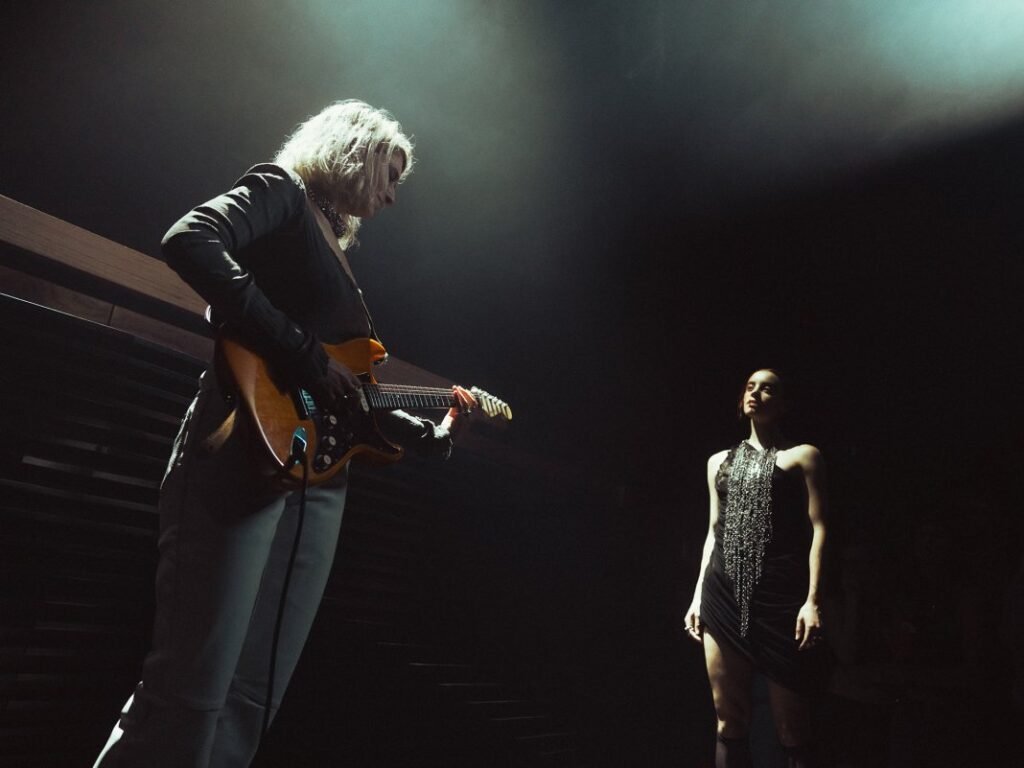
Music producer and DJ EREZ is at a friend’s house by Lake Tahoe, taking a well-deserved break, when I catch up with her. After an exciting surge in her career, playing Coachella and opening for Gorillaz, she set her sights on a new mission: Future Forms.
In essence, EREZ’s new collaborative project is a multidisciplinary performance installation that originated from private sessions between her and dancer Madi Tanguay. “I met Madi through a friend of a friend. I was doing this music video, and I was looking for a dancer of her style. Guttural, very raw, and European-leaning,” says EREZ. That music video never came out, but their connection evolved into a romantic relationship. Developing their mutual creative language would soon follow: “We didn’t set off to make Future Forms. It was more like, ‘Let’s see what happens.’”
Initially, EREZ and Tanguay met once a month for a few hours. EREZ’s laptop came packed with stems from her older tracks, many of which were unfinished. “I didn’t want to sit there and figure out the chords. That felt heavy to me. After touring, I had a massive Ableton session that I’d built for months with all my music. I thought, ‘What if I fire different clips from different songs at the same time?’” That’s how Ableton Live’s Session View became integral to their process. Responding to Tanguay’s movements with music, EREZ would then record her improvisations into Arrangement View, with each compositional element laid out in separate channels.
“I would have two hours of material, then go in and listen to everything. You know how you can add little play points? I would write, ‘great,’ ‘sucks,’ ‘amazing,’ or ‘use this,’” she recalls, while explaining how extracting her favourite moments led her to compose a 22-minute score.
“I feel like every DAW informs creativity. For Future Forms, Ableton Live makes so much sense. The warping algorithms and being able to chop samples up so quickly— I could take a guitar stem and chop it into twenty little bits. Some could be a four-bar loop, some could be one sample of the flesh touching the string,” she says, pointing out how this technique alone enables her to obtain countless textures from one source.
By deconstructing and reconstructing her creations, guided by Tanguay’s choreography, EREZ found herself in a sonic territory that falls somewhere between IDM, techno, and cinematic music. At its core, she says, “it’s underground, unapologetic, feminine, sassy, and punk.” But it’s rave culture that feeds Future Forms above all: “We go out dancing all the time. The community and the feeling you get on the dance floor is a massive source of inspiration for us.”
And that’s why the live experience that they’ve designed reflects their own. The first part of the show, titled Base, involves multiple dancers who know EREZ’s score well. Then, the rehearsed choreography disintegrates and spontaneity gradually takes over in the following chapters, Modular and Output. EREZ’s improvisational input on stage mostly occurs in the second chapter.


“Modular is elastic. I have a Push with me that I use to trigger different clips and an APC40 that I’ve mapped out to different effects like filters, reverbs, and delays. So, that allows the ability to react in real time to Madi and also the audience,” she says. I ask her to give an example. “In the last show, I stopped a few clips that usually would be playing there. I only left one kick and snare to create this dramatic effect of explosion after.”
EREZ takes a skeletal approach to the interactive portion of the show. The only other instrument she plays, in addition to the MIDI controllers, is her guitar. But her dream is to expand her setup with live vocals, synthesizers, and drum machines.
In her workflow, she often benefits from her go-to plugins, such as Valhalla VintageVerb, Soundtoys Decapitator and PhaseMistress, or Ableton’s own bitcrusher Redux. Still, she values the warmth and weight of analogue processing. Each piece of audio in her session is treated with saturation and EQ to be mix-ready. On stage, she live-processes her sounds with master effects through Macros in Ableton Live, tweaking multiple parameters with the turn of one knob at a time.
She likens this method of controlling effects to performing with CDJs, but her Future Forms sets are much more complex in comparison. Ableton Live’s Session View comes with visual limitations, which is why EREZ has everything mapped and colour-coded in a way that makes sense to her. “Every song has a colour in terms of scenes. If the colour changes mid-song, I know what that means. I just find ways to hack my brain to immediately understand where I’m at.”


To have maximum control over her live mix, EREZ typically gives in-house engineers a stereo mix out of her UAD Apollo Twin interface. She even dials her electric guitar tone inside the UA console on her laptop.
“Some in-house sound engineers are pretty jaded or tired. They don’t care. But I put so much time into making the music sound incredible. I want it to translate into the space. So I walk around the room and start mixing.” To engineers who protest, EREZ’s response is polite but straightforward: “It’s all good. It’s less work for you. Just make sure that I don’t clip.”
Of course, there are exceptions. She remembers the time she played Refuge in New York fondly, where she barely had to tweak anything at all, as the sound system was already phenomenal. And at National Sawdust, she had an incredible live sound engineer, Arno Miller, guiding her through the process of spatial mixing.
Although EREZ is very hands-on, she cares deeply about collaboration. In each Future Forms event, there are guest DJs setting the tone for the final chapter, Output. “Last time we had x3butterfly, who is one of our best friends and one of my favourite DJs. And Physical Therapy was also playing,” says EREZ, and hints at involving other artists in the future: “I have so many incredible electronic musician friends that never dabbled in making anything for dance. Not only would they absolutely crush it, but they’d also be inspired by it. Part of the mission is bringing these two worlds together.”
When asked how making music with a dancer feels, she elaborates: “You have a 3D figure in the room that’s embodying your sound. It’s crazy what one note can carry with a dancer in the room. You can tell a three-minute story by just playing around with the delay on that one note because the dancer is reacting to it.” If there’s one thing she’s sure of, it’s that she wouldn’t have arrived at the same result if she were working alone.
Future Forms has become EREZ’s experimental playground, free of song structures and predictable sound design. It’s not meant for digital platforms or the radio, but that doesn’t mean some recorded components of the project won’t be available in the future. With a single titled Beauty already out, EREZ feels the urge to share more tracks from, or inspired by, the score. And that may not be all: “I want to release a vinyl and an art book and make things that are physical. I’m playing it by ear right now.”


SIRMA is an Istanbul-born, New York-based artist, songwriter, and producer. With her distinctive vocal textures, she bends her sound across genres—from pop and electronic to ambient and cinematic soundscapes. Outside the studio, she writes for MusicTech and Roland Articles, diving into the creative and technical sides of music production.