


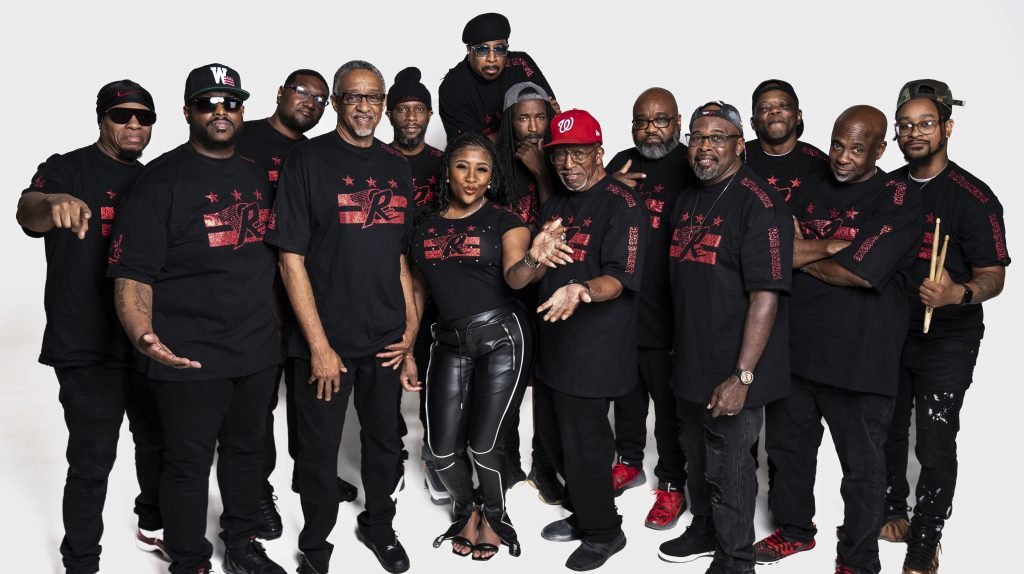
As Go-Go marks its 50th anniversary this year, few bands embody the genre’s heartbeat quite like Rare Essence—a group whose longevity and live-wire performances have made them both torchbearers and innovators.
Hailing from Washington, D.C., a cultural epicenter whose global influence often goes underrecognized, Rare Essence stands among the longest-tenured Go-Go bands commanding stages while converting a new generation to the genre’s call-and-response spirit. Comprised of several natives of the district’s southeast section, the group’s legacy is inseparable from pioneers like Chuck Brown, whose “Bustin’ Loose” topped the Billboard’s R&B Singles chart and helped define the sound, and from cultural touchstones such as “Da Butt” and “Pump Me Up.”
In 2021, the Recording Academy recognized Go-Go within the Best Regional Roots Album category—yet the genre still lacks a proper digital streaming platform (DSP) designation, an ongoing fight for visibility. As Rare Essence member Andre “Whiteboy” Johnson puts it, the band’s loyal, homegrown base is evidence of Go-Go’s drawing power, which locally trumps that of artists from other cities; “There are a lot of bands,” Whiteboy tells VIBE of the current landscape of Go-Go in D.C. during a call on a March afternoon.
“The mainstays are the Rare Essence, Junk Yard Band, Backyard, Northeast Groovers. E.U. is still around. Trouble Funk, they play from time to time. All of the groups from back in the day are still working. That’s the one thing that some of the New York guys used to tell us. They were like, ‘We’re so jealous because y’all get to play right in y’all backyard five, six, seven times a week. We don’t get nothing like that in New York. We have to go on the road, and it’s hard for us to be able to get gigs.’ And this was back in the day. It’s hard for them to get gigs like that right there in the New York area. Here in D.C., every band was playing every night of the week. So, there was not one night that you couldn’t go see a Go-Go band.” As it’s bled into various music genres and been incorporated into chart-topping hits ranging across decades, Go-Go remains relevant and is here to stay.
VIBE spoke with Rare Essence members Andre “Whiteboy” Johnson, James “Jas Funk” Thomas, Mike “Funky Ned” Neal, and John Jones about their legendary career, the ongoing mission to solidify Go-Go’s status as a recognized music genre, working with Diddy and Andre Harrell during the Uptown Records era, allegations of JAY-Z stealing their song for one of his early hits, and more.
How did Rare Essence form?
Andre “Whiteboy” Johnson: We were all in the same classroom. One day, [when] me and John hanging out, he said, “Hey, man, we should start a band.” And I was like, “Yeah, I want to be in a band.” Then we talked to a couple of the other members, talked to Mike Neal the next day, and a couple of other people, and everything just came together from there.
Was Go-Go already a thing at that time?
Whiteboy: It wasn’t even called Go-Go at that time. We started off just playing whatever we heard on the radio, top 40 songs or whatever. It evolved into Go-Go after we heard Chuck Brown and what he was doing with it.
James “Jas Funk” Thomas: The events, the places that we went and partied were called Go-Gos. Then, around late 1975 into ’76, when “Bustin’ Loose” was released, they started calling the music Go-Go, thanks to Chuck Brown.

How did the name Go-Go being used as slang for parties come about?
Jas Funk: I don’t know if you’re familiar with Smokey Robinson and the Miracles’ “Going to a Go-Go.” Even some of the Blues joints, even though they were juke joints, were called Go-Gos. Even Stevie Wonder had a song called “Love a Go Go.” The terminology was already there. Chuck Brown just took it and added to the sound of the music.
Speaking of Chuck Brown, how would you describe his influence and impact on Rare Essence?
Jas Funk: Well, I was a DJ first. When I was DJing with him and doing his breaks, I had been hanging with him for a while. Andre, Funky Ned, and Godfather. I took them to see then-The Soul Searchers, before they were called Chuck Brown The Soul Searchers. And then they learned how to maneuver themselves, because I always told them to learn their craft, learn their instruments, because that’s what I was told. So that put a big spark in there. They were so elated that they took it back to the rest of the band. I had to ask the owner of the company because I don’t even think they were 15. This was a place that had a bar, but the owner allowed me to bring them in. He ain’t have no problem with it because I told him I was going to keep them with me, because my DJ set up was in the corner. So they stayed over there until the band struck up. They went over there and just stood in front of the band in amazement, which was what I wanted. So from that point on, it was a shining light.
Chuck had gone on the road because “Bustin’ Loose” was becoming a No. 1 hit, and we would start to be called The Baby Soul Searchers. We’ve had so many names, from The Baby Soul Searchers to the Red Essence, instead of Rare Essence. Inner City Groovers, D.C.’s Total Groove, just so many names that went with the band.
I’m kind of glad that I took them to see The Soul Searchers, because D.C. has always been a live town, from Duke Ellington and Count Basie to all the vocal groups that came in. In the late ’60s, bands started taking over, even though there were still vocal groups. I would’ve loved for them to have seen some of the groups that I had seen, like Young Senators and Black Heat.
How did Rare Essence transition from performing covers to developing its own sound?
John Jones: We were young, enthusiastic kids. We were just trying to do our thing, and things just started happening. We just started making up stuff, and one thing led to another. It was really a creative time for us back then because we wanted to learn how to play and perform. Music was coming from everywhere. People were making up riffs, and the next thing you know, it would just come together to songs that we were developing for ourselves. We developed a lot of songs.
Mike “Funky Ned” Neal: I distinctly remember Jas Funk taking us up to the Maverick Room to watch Chuck Brown and The Soul Searchers rehearse. We’d sit there and watch those guys sit out there in the seats with us, learn a song, and then walk up on stage and play that song like they made it. I was always blown away by that. And then we’d come back to the basement up on Xenia Street, up Ms. Mack’s house, and Funk would always be upstairs listening to us. He would come downstairs with a record, “Hey, learn this record. This is going to be a hit.” I distinctly remember one record that he did that with, that I hated, and sure enough, about two, three months later, that song was a monster. That was one of the things that separated us from other groups. We were playing songs no one else was playing, and we did so before they became hits. That was due to Funk being the DJ, who, I think, at the time was getting records before they hit. So you got these young kids running around on stage, trying to do what Chuck does, but with a whole lot more energy, a whole lot more energy.
How did the vibe of D.C. itself influence Rare Essence and seep into who y’all were?
Funky Ned: You can thank Mayor Barry for that. Thank Mayor Barry, for that show mobile.
Jas Funk: Well, more of Raymond Gray, because he was the chairman at the time. Most bands that came out before us came through the show mobile, so I had caught wind of that, and I had to talk to Mr. Gray. From there, we played in every nook and cranny. When I say we were almost working seven times a week, that was our foundation, because now we’re playing in all sectors of the city. The best thing about it was [that] a lot of the bands that came on around us, they didn’t want to play in a lot of those places, which opened up the door even more for us.
Two of y’all bigger joints are “Live at Breeze’s Metro Club,” and you also got “Do the Mickey.” Why do you think they resonated so widely?
Jas Funk: We had a group called The Don Perignon Crew. Duck, he slips me a paper that says, “If you like Champagne, just pop the cork.” I’m just reading the paper that he gave, but it came right on time, because we were getting ready to go into “Do the Mickey.” The music’s ours, but the lyrics came from Smokey Robinson and the Miracles. Jungle Boogie, our first percussionist, we had already named him because of his playing style. He learned African rhythms, so that’s why we called him Jungle Boogie.
“Do the Mickey” just happened. Another friend of mine hollered that to me at the Parkway Gardens, and that’s how Mickey came in. Then, as we were recording that live album at the Metro Club, one of our fans handed me that piece of paper. If you hear me, I’m laughing because it was funny, but it fit with the crew because a bunch of them followed us. They’re all excited, and I’m laughing, and then we went into the song.

Y’all were once offered a deal with Uptown Records, correct?
Jas Funk: The first one was Fantasy, then Polygram, I think. Then Uptown Records.
How did that go with labels?
Jas Funk: I didn’t know my brother and D. Floyd; they had Colossal Records. I ain’t even pay no attention to Puff Daddy. I didn’t know he was a dancer to one of the rappers from here, Vinny D, who did the song, “55 Dollar Motel.” Did you help produce that, Ned?
Funky Ned: Yeah, we did it in my basement.
Jas Funk: Somehow, Puffy got fired, and it kind of backfired on us, but I couldn’t tell because I didn’t really pay any attention to him. He would come down to this place that we called Black Hole Celebrity Hall, then Capital Center Pavilion. He was coming down when we were calling it Celebrity Hall. When he got on stage, nobody else could get up on stage to dance because he’d be all on stage dancing to where other girls couldn’t get up there. By this time, we have Darryl Brooks from CD Enterprises. He’s our manager and helped bring Darryl and Puffy to one of our shows. From there, to me, anything that we sent them, Puffy didn’t like.
I’m like, “How you don’t like it and you bust a serious sweat on stage?” I don’t understand why he don’t like it.” Everybody else likes it, but Puffy. Just like the first two record companies, they tried to change our sound, make us somebody that we weren’t, and we weren’t feeling it. It got to the point where they brought Al B. Sure!, Keith Sweat, and somebody else.
They said they wanted a Go-Go group, but they didn’t really want a Go-Go group. They wanted to try to merge Go-Go with hip-hop. But at that point, as strong as Go-Go was and as strong as we were in this region and through the Carolinas, all they had to do was just pick up the records that we were putting out and support them, promote, market, and do everything that they would do with a regular R&B or hip-hop record. They decided that they didn’t want Go-Go full on. What they wanted was a merger, and that’s not what we did. That’s not what we were selling them. And I think one of the other main contributing factors was that they didn’t understand what was going on on stage.
They saw it and liked it, but they didn’t understand how to market and promote it. They didn’t trust us enough to let us do it. Because had they done that, we feel like that would’ve worked. We wouldn’t have sounded like everybody else out there, but it would’ve worked because it was already working.
Funky Ned: Do y’all remember when Andre Harrell came down and spent the weekend with us? So we’re at the Black Hole, Celebrity Hall, whatever you want to call it. We’re jamming, working the walls, and he’s having a ball. He goes back to New York, and he calls us up to New York. We went up there on the Monday morning, and we’re sitting in his big old office, and he’s playing the tape from Saturday night. He’s asking us, “Is this what I was dancing to all night Saturday?” He was like, “Yep, all night long, you were working the walls.” He said, “Fellas, I’ve been listening to this all weekend, trying to figure out what is going on here.” Prior to this, he was excited about signing a Go-Go band, because he had seen The Go-Go Live. He’s like, “I was like a kid at the candy store, I want one of those.” He wanted one of those Go-Go bands. He didn’t want Chuck Brown and them, because they were too old. He didn’t want Trouble Funk because of all the Jheri Curls. He didn’t want E.U. I don’t even want to say why he didn’t want them, but he wanted us. He got all these young, good-looking, energetic guys. But he said his problem was, “I’ve never had a band before. I don’t know what to do with y’all.” As a matter of fact, he said, “Let me show you something.” He took a cassette and said, “You see these guys here?” He said, “I’m going to sign them.” He said, “In about a year, they’re going to be household names.”
He put the tape in and played it. We were like, “Yeah, that sounds great.” The name on that tape said “Jodeci.” This was a year before anybody else, but he’s like, “I don’t know what to do with y’all. And honestly, I’m getting real busy right now.” That TV show he had, New York Undercover, was blowing up. He says, “I’m getting real busy, but I’m going to turn you over to my right-hand man. He’s going to take care of y’all.”
We looked, [and] it was Sean Combs. He wasn’t Puff Daddy yet. Everybody went [throws hands up], because we all knew the history with the Colossal and all that stuff.
He wanted to do something. As a matter of fact, I remember Darnell was sitting in the room, and Andre Harrell had an idea. He said, “What I would like to do is try to break y’all with one of my other groups,” which I thought was smart. He was thinking maybe Heavy D would do a song with us. And he looked at Darnell and said, “But you want to do the rap, don’t you?”
Actually, about a year ago, Darnell had a come-to-Jesus moment and said, “Man, we could have been millionaires.” And he let Andre do what Andre knows how to do.. But that’s how I remembered it. He had a hot Go-Go band [and] had the music. He loved what he saw, just didn’t know what to do with us.
We got tossed around to all these producers who didn’t know us and tried to make us something that we weren’t. We just weren’t having it.
Y’all performed with the Soul Rebels Brass Band in tribute to Chuck Brown. How’s the relationship and synergy between the two bands?
Whiteboy: We had heard of the Soul Rebels and saw clips of them, but never met them. That particular show was supposed to be Slick Rick, The Soul Rebels, and Chuck Brown, but he passed away a month or two before that. They called and said, “We need somebody to sit in for Chuck. Would you guys be willing?” So we said, “Yeah, we’ll do it.” While we were there, we talked to a couple of their guys and said, “Look, we’re about to do something. If y’all want to come out on stage and join us, you’re welcome to.” While we were playing Chuck’s version of “Hoochie Coochie Man,” they decided to come out. It has a big horn line in it that he did, so they decided do that. “Synergy” is a great word because it felt like we had been knowing each other for years, the way everything just came together right there on stage. There’s a clip on YouTube right now. That clip, what you see is just us meeting for the first time. You can see James Funk asking, “Who’s the first trumpet,” because we didn’t know anybody. My guy raised his trumpet. He brought the first and the second trumpet. It was just great. That was a really fun gig to do, and a really fun moment to be a part of.
There was a bit of controversy behind your track “Overnight Scenario” and Jay-Z’s “Do It Again.” Can you speak on that situation?
Whiteboy: The controversy is that he took the exact same format. It’s in clips on YouTube. I mean, almost anything you want is on YouTube [laughs]. There’s one with one of the guys who cowrote the song, saying, “We heard Rare Essence playing this song at Norfolk or Hampton’s Homecoming. We went back, flipped it, and used it.” But he took the exact same format. The only thing he changed was he started at 12:00 a.m., when we started at 3:00 a.m., but it’s obvious.

Did that ever get resolved, or did you ever speak on it?
Whiteboy: No, we didn’t. We talked to a few legal people about it, and they weren’t as enthusiastic as we thought they should be about pursuing it. So we kind of left it alone.
The rumors out there that we sued them and we got paid, none of that happened. I’m not sure where that came from, but we’ve never received any money or anything from that.
Moving on to more pleasant things [laughs]. In 2009, you performed at Barack Obama‘s Inaugural Ball. What was your reaction to receiving the call and the honor to perform?
Whiteboy: It’s Barack Obama, the first African-American president. I mean, it really does not get any better for us to get that call. We said yes without even knowing if they were going to pay us. Like, “Yeah, we want to be there. We need to be a part of this.”
The fact that they wanted to embrace the city’s music, we were really appreciative of that. The political side of D.C. is away from the cultural side, and on that night, the two came together. We were able to show the out-of-town people what D.C. music is all about.
It was a tremendous honor for us to be a part of that. We are very thankful to them for reaching out and inviting us to be a part of that, and we’re going to remember that forever.
You worked with Kelela on the remix of the song “Take Me Apart.” How did that come about?
Whiteboy: She reached out to us. She’s local, and she’s a big fan of the song “Pieces of Me,” the Ashlee Simpson cover we released in 2004.
She kind of wanted to recreate that with one of her songs. So she reached out and said, “Hey, would you guys be interested in doing this?” And of course, we know her from being around here, so we were like, “Yeah, yeah, we’d do it.” We just got in the studio and put everything together. It was great. We had a really good time.

Who are some other artists today carrying on the tradition of Go-Go?
Whiteboy: Jill Scott has a song out right now that is a Go-Go song. As soon as the song comes on, she says it. She says, “This is a Go-Go song.” Ever since she came out 20 years ago, she’s been a big fan of Go-Go as well. One of her breakout songs, “It’s Love,” is just a straight-ahead Go-Go song. You would have sworn that she did that song with a band around here. That’s how well the song was done. She’s just a big fan of Go-Go, and we appreciate that ’cause we’re fans of her.
Despite Go-Go celebrating 50 years and still going strong, it’s not designated as a genre on the DSPs. What efforts have been taken to fix this?
Whiteboy: What we’ve been doing is reaching out to all of the streaming platforms to make them aware of this. They say that they’re going to look at it and get back to us, but we’ve been waiting on that call for a very long time. The hope is for us to be properlye categorized because it’s always under a category of R&B, hip-hop, or alternative, as opposed to just saying Go-Go. Most people who have heard the music know, “Okay, this is Go-Go.” If you have a Go-Go category, you’ll be able to list at least 30 artists under that category.
We’re trying to raise awareness. We hope this makes the music easier to find, so when people want to stream it, they can just go right to the Go-Go category, and pick who they want to hear.
In what ways do you feel that Rare Essence’s longevity reflects the resilience of Go-Go?
Whiteboy: To be around for 50 years, for any artist in any genre, and still be relevant is a huge accomplishment. To be able to come from then to now, generations of people just love the music and carry it on.
I run into people all the time who say, “Hey, my son just turned 21, and he wanted to finally come and see y’all so I brought him. We’re celebrating his birthday.” He wants to hear “One on One,” or “Roll Call,” or “Take Me Out to the Go-Go,” which are songs we did in the 80s. The only way he would know that song is if his parents or father played the songs on tapes while he was young. To have that type of effect on people is really flattering; it mean they love the band and the music so much that 50 years later, we’re still here.

Funky Ned: I think you hit it on the head. You’re talking about a community of people who have embraced a genre of music that didn’t exist before, and they helped shape and create. You can’t leave those folks out of it. I think that says a lot that 50 years later, people see you on the street and recognize you from way back when. They say, “Hey man, I grew up listening to you. I appreciate the way you play. Keep doing what you’re doing.” They start naming all these clubs, like the Club LeBaron or Cherry’s or the Las Vegas 5000, places where we used to play. And they’re a part of it. It means a lot to them. Even standing there with the mayor when they signed this Go-Go music as the music of Washington D.C., you can see all those dignitaries that were there that were into it, and it’s just amazing to see
Whiteboy: All of the clubs that he just named are all from the ’70s. They’re not around anymore, but that just goes to show that from the ’70s until now, people are still in love with this music. There are people who are constantly telling me, “Hey man, I’ve got a 1982 Maverick room tape that I’ve been listening to for all this time.”
Can each of you speak on the brotherhood of Rare Essence that y’all share?
Funky Ned: I’m smiling. It’s a brotherhood. Like Dre said, we go way back to the second grade. I don’t know when Funk came into the picture. I just remember him bringing records down the steps saying, “Hey, you learned this.” [Laughs]. I actually left the group in ‘98. I was traveling with this person and that person. I started touring with the young lady Meshell Ndegeocello. We were doing world tours starting in ’94. Then I left her and went with this kid named Maxwell, who was this R&B singer, and a couple of others like Citizen Cope and Jay Kay. There have been others, but the Go-Go music is always going to be a community, as you’re here in the D.C. area. You can’t help but be a part of it because it’s everywhere. Thanks to our D.C. council and the mayor, it’s now the official music of Washington, D.C., which is the capital city of the country. I’m with Dre and the rest of these guys, like, why can’t this genre of music be on the list of names of music genres? R&B is here, polka, where’s Go-Go? Although I’m not with them, I come to play with them. Every five or six years, I’ll do one gig with them. And it’s fun.
What’s next for Rare Essence?
Whiteboy: Right now, we are celebrating 50 years of being around, 50 years of us being out here in the city. We’ve got a couple of festivals that we’re doing around town. One is, I think, Memorial Day weekend, and then one is at the end, Labor Day weekend, plus a bunch of other shows that we are doing. We’re just going to be celebrating for the entire year. We’ve got a project we’re working on that will hopefully be released later this year, and a bunch of other things we’re doing. We are out there just chipping away at it.
There are some collaborations, and we’ve collaborated with a few other artists, but I can’t say who. One is a major, major artist, but I can’t really say yet because they’ve got the handcuffs on me. But I can’t wait for this to come out because I think everybody’s going to love it.