

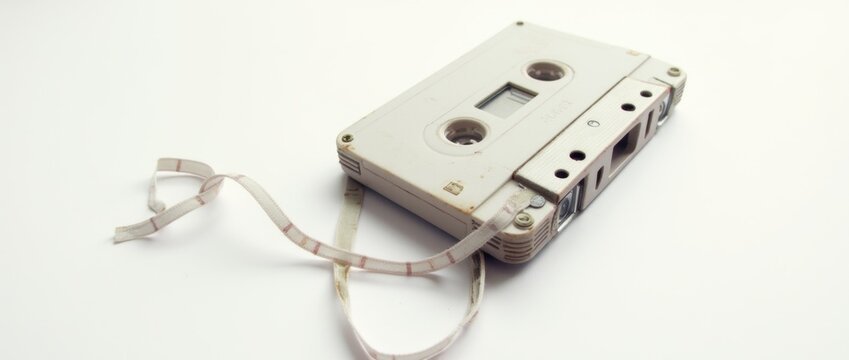
Remember cassette tapes? Those beautifully analogue rectangles of magnetic wonder that soundtracked the 80s and 90s, eternally vulnerable to being mangled by your car stereo or requiring emergency pencil surgery when the tape decided to unspool itself? Well, they’re back. Sort of. Except this time, instead of storing your carefully curated mixtape, they might just save civilisation’s entire digital footprint.
Scientists at the Southern University of Science and Technology in China have developed what they’re calling a DNA cassette tape, and it’s about as far removed from your old Walkman as you can imagine whilst still maintaining that familiar form factor. The concept borrows from that nostalgic format but replaces magnetic oxide with something rather more sophisticated: actual genetic material encoded with digital information.
The principle is straightforward enough. DNA, as it turns out, is nature’s ultimate hard drive. Each strand can theoretically store around 3.2 gigabytes of data, roughly equivalent to a thousand songs or a couple of films. Scale that up to a 328-foot cassette tape and you’re looking at the storage capacity for over three billion songs. To put that in perspective, that’s every track ever recorded by every artist you’ve ever heard of, and then some, all wound up in a package roughly the size of a VHS cassette.
What makes this particularly clever is the way the researchers have solved one of DNA storage’s most persistent problems: actually finding your data once you’ve stored it. They’ve printed barcode patterns onto a polyester-nylon composite tape, creating millions of tiny, addressable sections. Think of it like having individual folders on your computer, except these folders are physical partitions on the tape itself. The system can locate specific files at a rate of 1,570 partitions per second, which is impressively rapid when you consider the biological gymnastics happening underneath.
The encoding process works much like binary computer code, except instead of ones and zeros, you’re using the four building blocks of DNA: adenine, guanine, cytosine, and thymine. Digital data gets translated into sequences of these bases, deposited onto the tape through a process involving hybridisation and polymerase extension, then sealed with a crystalline protective layer to prevent degradation. The whole operation takes about 50 minutes for a complete cycle of storage and retrieval.
What’s particularly appealing about this approach is its sustainability credentials. Current data centres consume around 4.4% of all electricity in the United States, a figure that’s only climbing as AI applications proliferate. According to reports, households in Ohio saw their monthly electricity bills increase by at least $15 in June, largely driven by the energy demands of AI data infrastructure. DNA storage, by contrast, requires no electrical maintenance whatsoever once the data is written. The protective coating allows the tape to preserve information for potentially thousands of years at room temperature, or considerably longer if you fancy storing it somewhere properly cold.
The research team successfully demonstrated the system’s functionality by encoding and retrieving a digital image, proving the concept works in practice rather than just theory. The prototype device offers a storage capacity of 36 petabytes, equivalent to 36,000 terabyte hard drives, all in a remarkably compact format that could feasibly sit on a desk.
There’s an undeniable elegance to the solution. Whilst the tech industry has been frantically developing ever-smaller transistors and more complex solid-state drives, these researchers have essentially looked at one of computing’s oldest portable storage formats and asked: what if we made this work with the most efficient data storage system we know of, which happens to be the stuff of life itself?
Of course, practical implementation faces some hurdles. Large-scale, cost-effective synthesis of oligonucleotide pools remains a significant barrier. The reading process still requires sequencing equipment, and the whole operation needs rather more specialised knowledge than popping a cassette into a deck. But as proof of concept, it’s remarkably compelling.
There’s something rather poetic about returning to tape storage just as the digital world seemed to have abandoned it entirely. Perhaps the future of data storage isn’t about smaller chips or faster drives, but about learning from four billion years of evolutionary refinement. After all, if DNA can store the complete instruction manual for building and running a human being in a space smaller than you can see, it’s probably up to the task of archiving your photo library.
The researchers’ work appears in the journal Science Advances, and whilst we’re likely still some years away from seeing DNA cassette tape drives at your local electronics retailer, the technology represents a genuinely innovative approach to a problem that’s only going to intensify as data generation continues its exponential growth. Sometimes the best way forward is to look back, even if that means reimagining 40-year-old technology with molecules that predate humanity by several billion years.
If you love science like us, you can read the full study here
Related
Discover more from Decoded Magazine
Subscribe to get the latest posts sent to your email.