


In 2015, Wu-Tang Clan put a radical idea to the test: What if the hip-hop supergroup recorded an album that captured the sound of its early-’90s heyday, then sold just one copy to the highest bidder?
The result was Once Upon a Time in Shaolin, an audacious experiment conceived by Wu-Tang affiliate Cilvaringz under the guidance of RZA. By treating the album like fine art akin to a painting or sculpture, the project challenged conventional notions of music ownership and accessibility in the streaming era. It also set off a bizarre chain of events.
That ordeal unfolds in The Disciple: A Wu-Tang Fable, a new Netflix documentary directed by Joanna Natasegara. Now streaming, the film follows Cilvaringz’s unlikely journey to bring the project to life and revisits the turbulent aftermath of its $2 million sale to Martin Shkreli, the former pharma bro who became notorious for dramatically raising the price of a life-saving medication.
Between an 88-year restriction on commercial exploitation, fans clamoring to hear the album, Shkreli’s public taunting of Wu-Tang members, and the federal government’s eventual seizure of the album following his securities fraud conviction, Once Upon a Time in Shaolin became one of hip-hop’s strangest stories.
The project also drew criticism from within the group: Method Man once called its release strategy “gimmicky” and said he hadn’t known the music would be packaged as a Wu-Tang album. The album later earned a Guinness Book of World Records title as the most valuable album in the world. For RZA and the Wu, the saga is just another chapter in a history of breaking molds that began with their 1993 debut, Enter the Wu-Tang (36 Chambers).
That trailblazing legacy will reach another milestone next month, when Wu-Tang Clan is inducted into the Rock & Roll Hall of Fame. The group’s 10 inductees include its original nine members — GZA, Ghostface Killah, Inspectah Deck, Masta Killa, Method Man, Ol’ Dirty Bastard, Raekwon, RZA, and U-God — as well as Cappadonna, who later became an official member.
VIBE spoke with producer, artist, and filmmaker RZA about The Disciple, Wu-Tang Clan’s enduring legacy, and plans to celebrate the 30th anniversary of Wu-Tang Forever in 2027.

—
VIBE: How did The Disciple come together, and when did you realize there was a larger story to tell beyond the music on Once Upon a Time in Shaolin?
RZA: The crazy thing is, when that album was sold, the dude Cyrus [Bozorgmehr, the album’s senior adviser] broke his leg. He was incapacitated for a few months. He said, “Yo, I used the time of my leg being broken to write the fucking book.” [Laughs] We read it, and I was like, “Yo, it’s cool.” I gave him the green light to make a deal and put it out. There were screenplays being written; Paul [Downs Colaizzo] wrote one of the best scripts for it. But during the pandemic, it kinda faded away.
Then, around 2022, I started getting inquiries from different people to do a documentary. I told everybody, “Yo, do it!” [Laughs] But it was first come, first served. Joanna [Natasegara] brought me in about a year ago to show me 20 minutes of what [she] had accumulated. And we just kept building it. She was determined. She came to America and went to Park Hill [in Staten Island]. She found the Killa Beez. She did her shit. For me, that’s the most important thing: somebody being motivated to complete something. Then let me come and help.
The intent of Once Upon a Time in Shaolin was to counter the devaluation of music by releasing only one copy of the album. But when Martin Shkreli emerged as the buyer, the conversation became about wealth and ownership. Did you ever anticipate things playing out as they did?
No. I remember making a deal with Shkreli. It took time for the contract [to finalize]. We don’t talk about this a lot — it’s not in the documentary. The reason Martin said he wanted to buy it is that he heard some of it at that 13-minute MOMA listening. He said he heard lyrics that spoke directly to him. But I’ll never forget the day I was home with my wife watching TV and CNN came on [showing] the most evil man in America. I’m like, “Hold on, baby. I know that dude! That’s the dude that bought the album.” He didn’t pay for it yet, but we signed a deal. We couldn’t get out of it. It was bugged-out. And then all the negativity that came with it. But that’s the beauty of art. It’s controversial sometimes. It’s inspiring. It makes you angry. It makes you happy. Once Upon a Time in Shaolin did that.


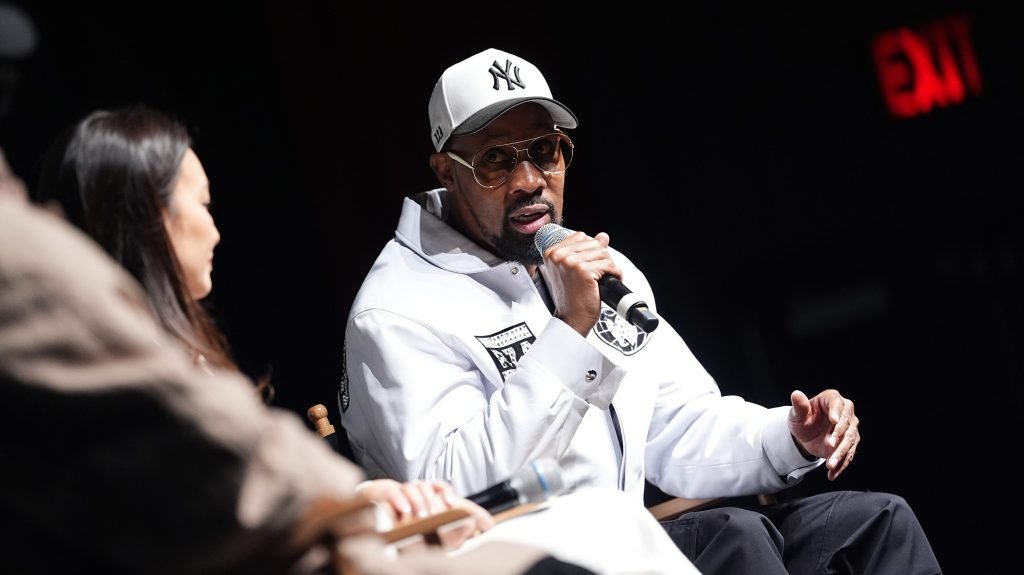
RZA and Joanna Natasegara at Netflix’s The Disciple NYC launch event at SVA Theater on October 10, 2026 in New York City.
John Nacion/Getty Images for Netflix
Even if he wasn’t cartoonishly immoral, fans still wouldn’t have access to the music if another wealthy person purchased it.
The Lex Luthor of him made everything bigger. There’s a lot of fucking drama going on here, a lot of shit that you couldn’t even write. He was pre-podcasting [addressing] Ghostface, like, “Yo, I’m coming to your crib.” And Ghostface was answering him back. This shit was not planned. These are natural reactions. And we don’t know what the documentary is gonna spark. Hopefully, it sparks inspiration, [not] controversy.
Cilvaringz caught some flak for the way the Once Upon a Time in Shaolin saga unfolded.
The good comes with the bad. Let’s talk about the good: Every student and member of Wu gets a chance to add to the canon. You wanna know U-God, you gotta read his book, Raw. Listen to Inspectah Deck’s Uncontrolled Substance or Method Man’s Tical. Everybody has something; Cilvaringz has this. Some of the Killa Beez are probably like, how did he get a whole film? But the good is, wow, Shabazz the Disciple is in there. Shabazz was rolling with me before Wu-Tang’s first album. I saw Beretta 9, 9th Prince, Killarmy, and the nine generals of Wu-Tang in the documentary. Some of the footage has never been seen before. Cilvaringz should feel proud that [he] added something to the Wu legacy that will stand the test of time. And then, of course, you gotta feel the threat of some of my brothers like, “Yo, who the fuck am I to do that? [Laughs]

The RZA and Tarik “Cilvaringz” Azzougarh in ‘The Disciple.’
Courtesy of Netflix
Aside from archival footage, you’re the only original Wu-Tang member to appear in The Disciple. Have you spoken with any of the others about the film and how they’re feeling about the album today?
Nah. They haven’t seen the film yet. We talked a little bit about it on tour. I was like, “Anybody got any pros and cons you wanna discuss?” Nobody had much to say. We’ll see what happens after it comes out.
Do you think another artist will try to replicate the idea behind Once Upon a Time in Shaolin?
Why not? The Wu, we spark a lot of wicks. When we came out with [Raekwon’s Only Built 4 Cuban Linx], the whole hip-hop industry changed their names. I remember N.O.R.E. was like, he became Noreaga based on listening to that album. We started finding other ways to express and identify ourselves. Wu is known for that. For this album idea, I think somebody will do it again. In their own way, of course.
The Disciple covers how Wu-Tang’s influence helped hip-hop grow by embracing different cultures and lifestyles, such as kung-fu and chess. Can you elaborate on the role Wu-Tang Clan played in hip-hop’s explosion in the ’90s and beyond?
It’s hard to praise yourself, but you could see the result of the work. Hip-hop was already growing and was a strong entity. But we were able to open up more chambers. Allow a chess player who’s a nerd to find some references in Wu… Iron Man was kind of esoteric. It wasn’t the top-seller [in Marvel comics]. But then [Ghostface Killah] makes an album called Ironman, sells a million records, and the first big movie Marvel hit is Iron Man. So the Wu is not only blending Asian culture, Native American culture, American culture, and social, political, knowledge of self, all these things. There’s also the comic book [heads], the nerds, the chess players. Everybody is finding something in that. We definitely helped hip-hop become accessible. Somebody told me he was into punk rock, but when he heard Wu, that he could listen to punk rock and Wu. Now he’s fucking got 20 hip-hop albums. That’s part of what we were born to do, and here we are doing it. That’s why they say we Rock & Roll Hall of Famers now.
What does Wu-Tang Clan’s upcoming Rock & Roll Hall of Fame induction mean to you and the legacy of the group?
Artists love validation, right? You gotta tell your girl she’s pretty, bro. [Laughs] Don’t take that for granted. Artists need to feel appreciated, and the Rock & Roll Hall of Fame is one of the highest levels of appreciation. It was so unexpected. An accolade like that, that you didn’t plan, you take that gracefully. The Wu brothers, every one of us is happy about that. Put a smile on everybody’s face. And that’s a powerful thing. I’m just proud and happy that our names will be beside some of the greatest. When we first came in and went platinum, it was such a big Wu frenzy happening. Steve Rifkin’s like, “You guys are like the fucking rap Beatles, the Rolling Stones.” [Laughs] And 30 years later, our name goes in that hall of fame with those great artists. That’s a beautiful thing for us.

Wu-Tang Clan at the 25th Annual American Music Awards at the Shrine Auditorium on January 26, 1998.
Ron Wolfson/Dick Clark Productions via Getty Images
Wu-Tang Forever turns 30 years old in 2027. Can you talk about that album’s legacy and share any plans you might have to celebrate it?
Sony has been talking about finding a way to put a new package on it and reshare it. It’s very special. It was our longest album and our biggest-selling album. So many beautiful memories of creating it, thinking of us being young men, 25 years old, about to become the No. 1 artists in the world. I hope my brothers, the labels, and my man Steve Rifkin do something to celebrate that moment, because we missed the 25th year. We didn’t really bong-bong that, you know what I mean? But there are plans. I got a couple things I’m gonna pitch, so hopefully we celebrate that album properly.
You’ve accomplished a lot as a producer, artist, and filmmaker over the past three decades. What excites you creatively these days?
I’m really enjoying the film world. I’m thankful that Netflix is putting this documentary out. I’m thankful that my company, 36 Cinema, is part of it. But my aspiration is film. I wake up in the morning, and that’s where my head is. Hopefully, through my creativity, I’ll be able to give some films and joy that you can watch and appreciate, like you appreciated the music. That’s my dream. I am actively creating film, and it’s materialized. I got my fourth film, One Spoon of Chocolate. We already started the fifth one. And we’re gonna keep that party going.