


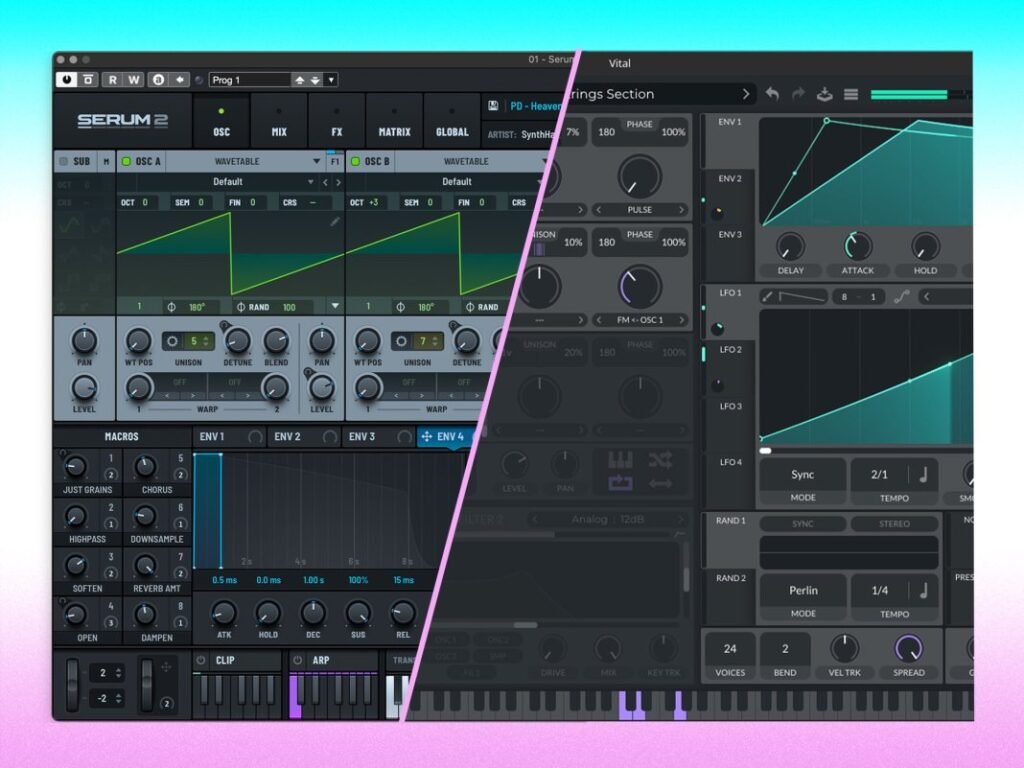
Xfer Records released Steve Duda’s Serum plugin 12 years ago. It was an instant classic that went on to become the synth of choice for many producers due to its ease of use, flexibility and complex, upfront sound
Then in 2020, developer Matt Tytel released Vital, a spectral warping wavetable plug-in that shared many design traits with Serum but—most importantly—had a fully functioning free version. It had a level of complexity and polish that you don’t normally see in free software, so it quickly became known as a free alternative to Serum. Although they share many similarities, features such as an additional oscillator and unique modulation options arguably made Vital superior for certain tasks.
But Xfer came through with Serum 2 in 2025, boasting a wealth of new features that took its sound design credentials to a whole new level. There’s no doubt that you get a lot more synth with Serum 2, but at $249, do you really need it all, and is it worth it over the features available in Vital?

Oscillators: Serum 2 vs Vital
To get a better idea of what each synth offers so you can decide which is best for you, we’ll take a look at each section and compare how they stack up, starting with the oscillators.
Serum 2 includes three main wavetable oscillators, plus a sub oscillator and noise oscillator that can be used to load texture layers or transient samples. Vital also has three wavetable oscillators plus a sample oscillator, but no separate sub. Given the often rich nature of wavetables, both synths offer plenty to generate complex-sounding patches. Both also have built-in wavetable editors.


Serum includes two Warp engines that can be used to dramatically shape your waves, with 32 warp, filter and distortion options alongside FM, PD, AM and Ring Mod that can be fed from any of the other oscillators. Vital can’t compete with those numbers, but it does have 15 spectral morph modes, six wave morph modes, plus FM and Ring Mod options.
Both have flexible unison controls for creating thicker-sounding patches, alongside options to stack and add subtle variations to each voice. When it comes to wavetable synthesis, they’re both very capable synths, and assuming you load the same wavetables, both offer a crisp, high-quality sound, with options for oversampling if your computer can handle it. You might want to consider that Serum 2 comes with 288 wavetables, while the free version of Vital only comes with 25. This is easily expandable with free or paid-for wavetables from the Internet.
In terms of overall flexibility, the gap starts to appear when you consider Serum 2’s four new oscillator types. You can now load multisamples, which gives access to more organic-sounding, multi-layered sample patches. There’s a new dedicated Sample oscillator that can do looping and slicing, a flexible Granular oscillator, and a Spectral oscillator that can do realtime resynthesis. This dramatically opens up the sound design potential, but you may not need these extras if you already have other synths or samplers that fill these roles.
Filters: Serum 2 vs Vital
Both synths have two flexible filters alongside the ability to route the signal from any of the oscillators, and to do parallel or serial routing.
Serum 2 has a ridiculous number of filter modes, including comb, phase, flange, formant, scream, ladder and more. There’s even an option that lets you draw in four variations of complex notches then blend between them using an XY pad. Perfect for creating those highly modulated neuro basslines.
Vital is no slouch either, with 32 filter options, each of which can be morphed into different shapes using a slider. If we were to split hairs, then we’d say the sound of Serum’s filters has a tiny bit more clarity, but both sound fantastic and can be used to dramatically shape the character of the oscillators.
Effects: Serum 2 vs Vital
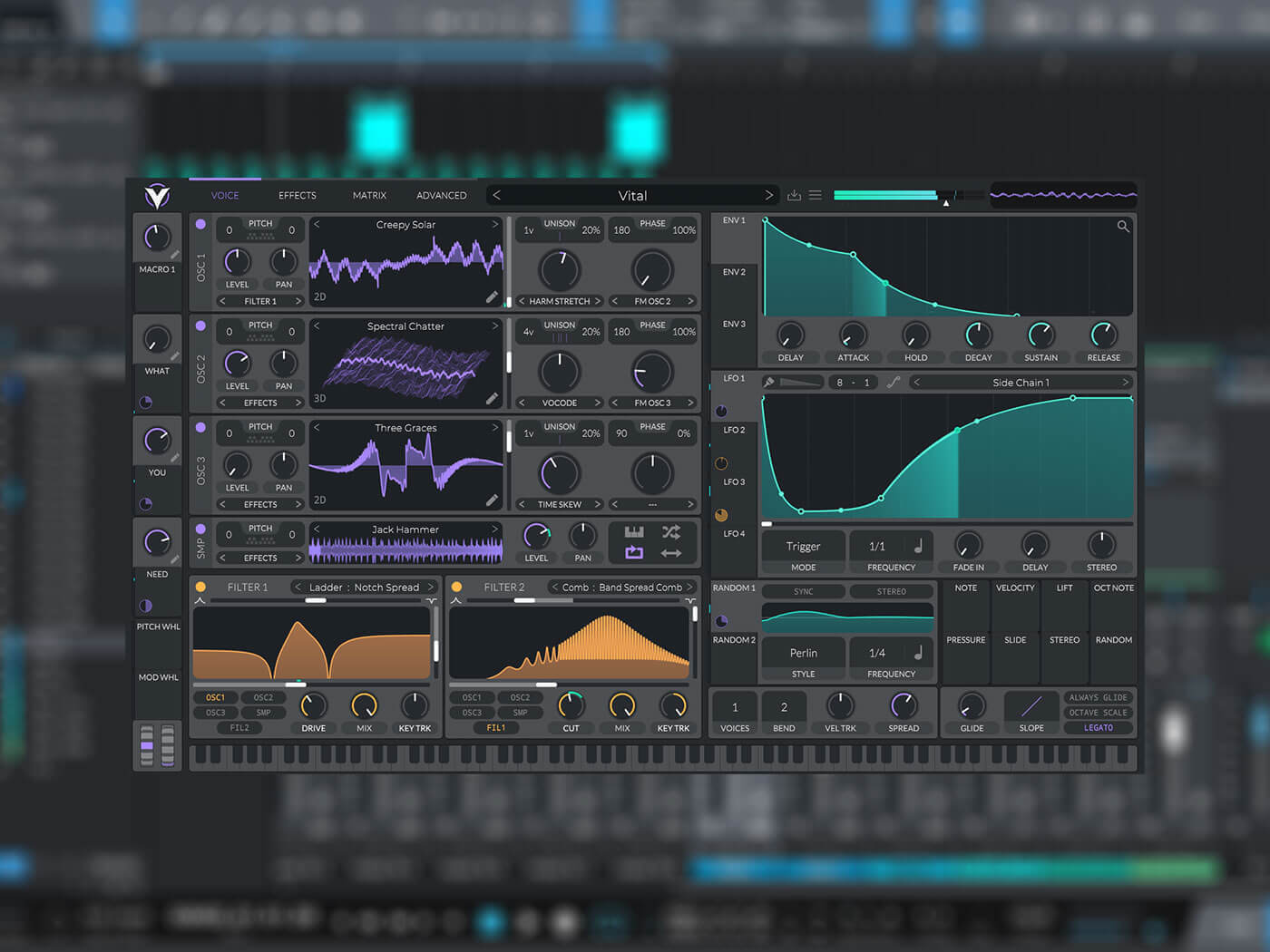
Both synths do well here as they have a decent collection of the usual effects like distortion, chorus, flange, phase, delay, compression and reverb, all of which can be reordered as you see fit. Vital has nine, whereas Serum 2 has 12, including new convolution reverb and frequency shifter effects.
Vital actually does a little better visually, as some of its effects have extra graphical displays that help show what some of the controls are doing. Serum 2 wins overall, not least because the sound quality is noticeably crisper and more detailed, but also because it lets you split the signal so you can process the lows and highs differently, and it also includes two Bus effects, making it easier to do things like adding some delay to a single oscillator.
Modulation: Serum 2 vs Vital
Modulation is an area where Vital really shines. You can have up to six envelopes and eight LFOs, with very clear and crisp graphics that make things easy to follow. There are also two Random oscillators and a powerful mod remap function.
Serum has a similar setup, albeit with fewer envelopes but more LFOs. The random options built into the LFOs are a little more advanced and include an XY path-tracing feature, and it too has a mod remap function on the modulation matrix page.


Vital has a few unique mod features that are lacking in Serum, though. The LFOs have a stereo offset so you can easily have different modulation signals going to the left and right sides. This is great on things like the filter, as it can add some additional width to your sounds. When you drag a mod source over a parameter, you get a preview of the result before committing, which lets you quickly experiment on different controls. There’s also a scale lock on the oscillators so you can create wild, in-key arpeggios and runs by feeding the LFO into the oscillator pitch.
Extras: Serum 2 vs Vital
This covers the fundamentals of each synth, but there are a few other points to mention. Serum also includes a mixer page to help you with balancing each oscillator and understanding the signal flow. It also has a comprehensive arpeggiator that lets you save up to 12 different arp settings on different keys, plus a fantastic MIDI clip launcher that can turn your keyboard into a riff performance machine.
We’ve been comparing Serum 2 to the free version of Vital, but there are also a few other versions available, including Vital Pro for $80, which includes 400+ presets, 150 wavetables, a text-to-wavetable feature, and a few extra skins and perks.
Serum 2 vs Vital: do you need to pay?
Up until the release of Serum 2, the gap between the two synths was much smaller, but with the update, Serum 2 has leapfrogged Vital in nearly all areas. But this is to be expected as it’s an expensive synth developed by a whole team, rather than a one-man product.
With thousands of preset packs available for both synths, there’s no denying their popularity. One thing to note, though: although Vital has had several updates over the years, there’s no guarantee that it will be developed much further, as it is created and maintained by a single dev. (Although technically it’s open source, so who knows where it might go in the future). Compare that with Serum, which has a more robust user base, website and company behind it.
There’s no denying that Serum is the better synth overall, but it’s also expensive and much more complex. Having so many choices can sometimes be a negative when you want to get to a finished sound quickly, so Vital is arguably an easier synth to program (albeit one that still has buckets of depth). If you’re in the market for a one-to-rule-them-all kind of synth, though, then Serum is a worthy investment.


Alex has been writing freelance for MusicTech since 2009. He got his first copy of Micro Logic and a Roland Sound Canvas 30 years ago and has never looked back. Since then, he has released music on some of the worlds biggest dance labels, done countless major label remixes, composed music for Sync library’s, and even performed in a pod on the London Eye.