


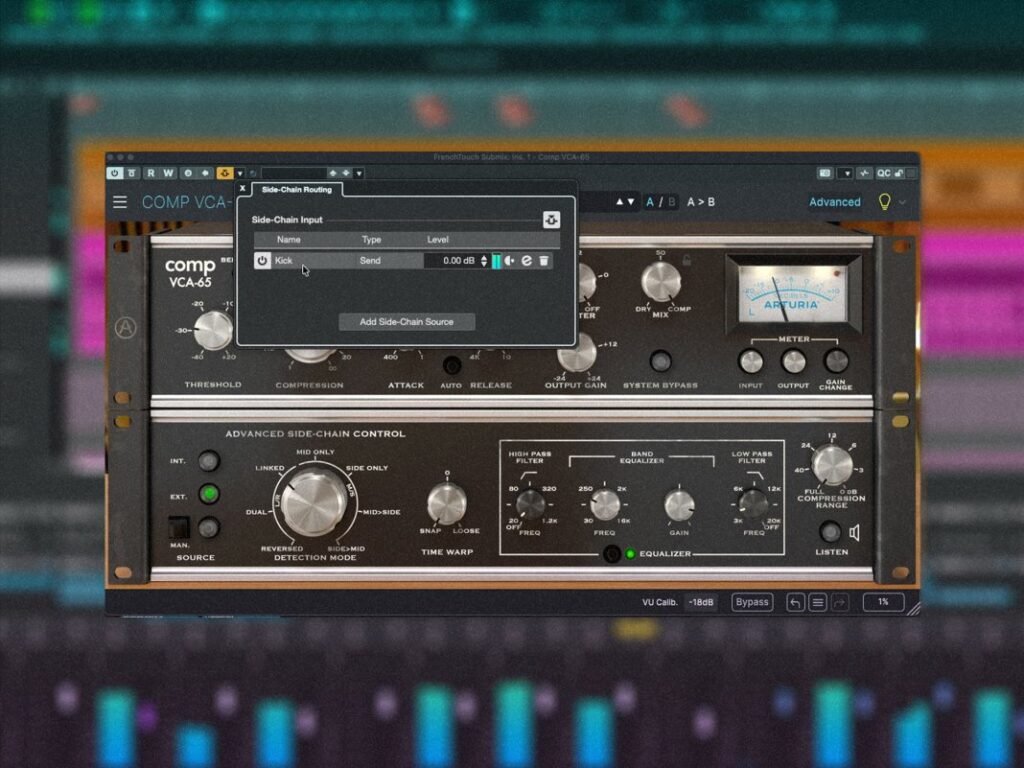
Sidechain compression is a music production technique in which a compressor turns down an audio signal in response to another audio signal.
Most commonly, it’s used to ‘duck’ pads, bass and other instruments in time with a kick drum, but it was popularised as a tool in broadcasting to dip background music whenever a presenter speaks.
How does sidechain compression work?
Most compressors split their input signal into two. One copy is routed to the processor itself, while the other feeds sensors that measure the signal’s changing dynamics and drive the processor’s response.
In the 1930s, in an effort to reduce the harshness of sibilant ‘S’ sounds, cinema sound designer and recording director Douglas Shearer came up with the idea of providing an external input to a compressor’s sensor signal path — something he referred to as a ‘side’ input. By boosting high frequencies in the signal fed to this side input, Shearer made the compressor more sensitive to the sibilant sounds he was trying to deal with. This is how de-essing was invented, and it gave us the concept of a side signal processing chain, or ‘sidechain’ for short.
Shearer’s innovation has become a standard feature on most compressors, unlocking a new family of compression techniques known collectively as sidechain compression.
How can sidechain compression be used?
Tuning compressor response
The same de-essing technique developed by Shearer can be repurposed as a general means of making a compressor more or less sensitive to certain frequencies. For example, boosting low frequencies will give a de-plosive effect that reduces the prominence of mic pops and bumps.
Nowadays, most compressors have a built-in facility to apply some filtering to the internal sidechain, and this is often sufficient to tune the compressor’s response. When greater precision is required, the classic external sidechain technique can still be employed.
Ducking
The ability to feed separate signals to a compressor’s main and sidechain inputs makes it possible to process one signal with the dynamics of another. A very common use for this is ‘ducking’, which reduces the volume of the processed signal in response to the signal present in the sidechain. This has many applications, such as:
• Reducing the volume of background music and/or sound effects during dialogue,
• Reducing mic bleed in a multi-miked drum kit or other recording featuring multiple sound sources and mics.
• Reducing reverb prominence while the sound seeding the reverb is present. This allows big, washy reverbs that don’t get in the way of the source part (vocal, lead guitar, etc.).
Pumping, pulsing, and the French Touch
Ducking lies at the heart of the so-called French Touch pumping/pulsing effect popularised by the likes of Daft Punk. In this case, a percussive part – typically a kick drum – is fed to the sidechain input of a compressor that’s applied across a mix/submix carrying the parts to be affected. The compressor itself should be configured with a low threshold, high ratio and fast attack, and the release value can be adjusted for a shorter or longer pulse duration. Tweak the settings until you get the amount of French Touch you’re looking for.
Related terms
Get the MusicTech newsletter
Get the latest news, reviews and tutorials to your inbox.