


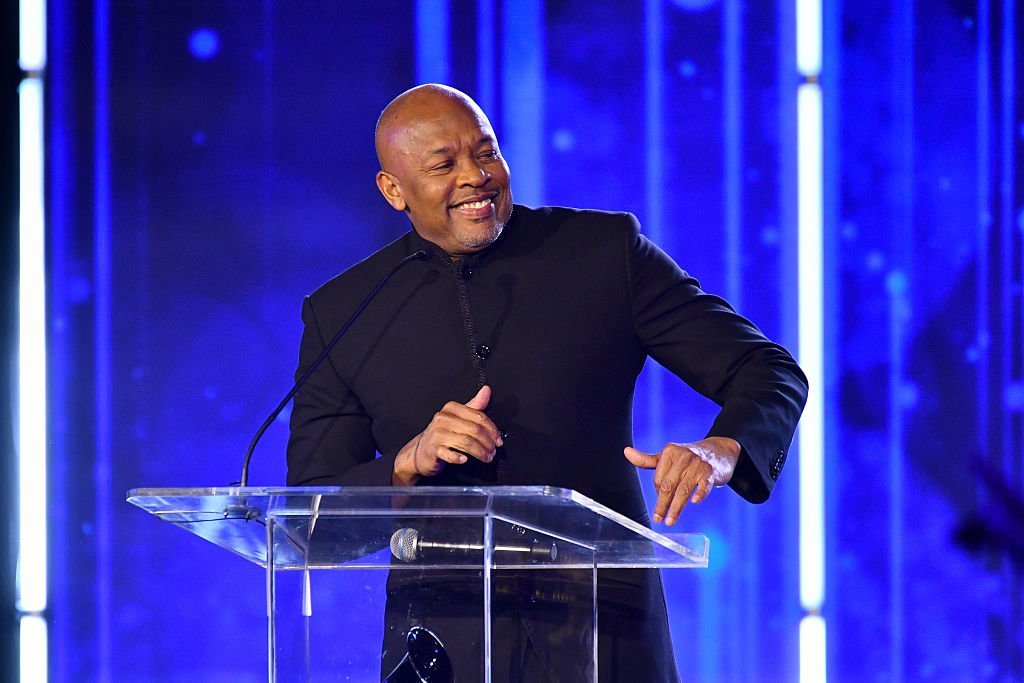
Dr. Dre is not losing any sleep over artificial intelligence taking over the music industry. In fact, the legendary producer thinks the people most afraid of the technology might have a creativity problem.
As spotted on Variety, Dre recently sat down with his longtime business partner Jimmy Iovine for an interview with the New York Times, where the pair discussed artificial intelligence and its growing presence in music.
When asked whether he views AI as a threat, the Aftermath Entertainment founder made his stance very clear. “I think the only people that see it as a threat are the people who have trouble creating,” Dre said.
The producer went on to compare the current resistance to AI to the skepticism that once surrounded other technologies that eventually became standard tools in music production, including drum machines and synthesizers. “It’s a new tool for creativity,” Dre added.
According to Dre, he has already experimented with AI in his own creative process, using the technology to see what it can do with music he has already made rather than relying on it to generate an idea from scratch.
Iovine also name-dropped another legendary producer who has been much more public about embracing the technology: Timbaland.
Timbo has arguably become Hip-Hop’s biggest AI evangelist. In 2025, he launched Stage Zero, an AI-focused entertainment company, and introduced TaTa, a virtual artist created with the help of generative music platform Suno.
The move did not go over well with everyone. Engineer and longtime Jay-Z collaborator Young Guru publicly criticized Timbaland over the project, telling his fellow producer, “Human expression can never be reduced to this.”
Timbaland has continued to defend his use of the technology despite the backlash. The conversation has only gotten louder in Hip-Hop this summer.
Shoreline Mafia rapper Fenix Flexin faced weeks of questions over whether his viral single “Rubberz” was made using artificial intelligence. After initially pushing back against the speculation, Fenix eventually acknowledged that AI technology had been involved in the song’s creation, while maintaining it was not used to record his vocals.
Tyga faced similar questions over his ’80s-inspired album $tarface before confirming that AI played a role in the project. He compared the criticism to the early backlash against Auto-Tune and made it clear that he wasn’t particularly bothered by how people felt about it.
Those situations also exposed what may be the bigger issue surrounding AI music: transparency. There is a significant difference between a musician using artificial intelligence as another production tool and presenting listeners with an entirely fabricated artist without making that distinction clear.
Spotify is already attempting to address the latter. Earlier this month, the streaming giant announced that it will begin labeling certain profiles with an “AI Persona” badge starting in mid-September. The designation will identify artists whose public identities appear to represent AI-generated people rather than actual human performers.
Spotify also says music from those AI Personas will not automatically appear in its editorial or algorithmic recommendations unless users intentionally engage with them. Separately, its AI Credits feature allows artists to disclose how artificial intelligence was used during the creation of individual songs.
That suggests Dre may be correct that AI itself isn’t going anywhere. The more complicated debate will likely be over where the technology belongs in the creative process, how much of that process it should replace and whether listeners deserve to know exactly what they are hearing.
For Dre, though, the emergence of another piece of technology apparently isn’t a reason to panic. It’s another tool to figure out.