


Bloomer Free, from the developer Freequency, is a MIDI chord progression generator driven by emotion.
When I say driven by emotion, I mean you don’t need to know lots of music theory to generate a beautiful progression; you just need to know which emotion you want to evoke.
Right now, Bloomer Free is available in VST3 and AU(beta) formats for macOS and Windows (early beta).

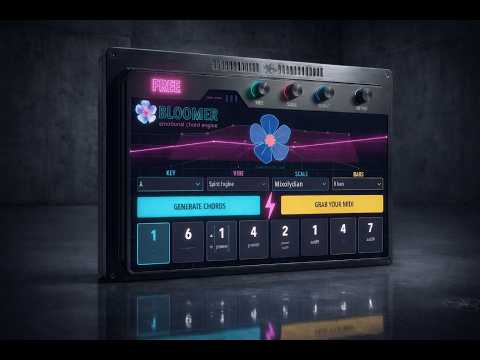
Before you generate a chord progression, you have to set four parameters: Key, Scale, Vibe, and Bars.
Once you choose a key, you can select from seven scales:
- Major (Ionian)
- Minor (Aeolian)
- Dorian
- Phrygian
- Harmonic Minor
- Mixolydian
- Lydian
It’s the seven modes of the major scale, with the harmonic minor scale replacing the locrian mode.
The harmonic minor adds the leading tone (the raised seventh degree), which provides different harmonic choices from the natural minor scale and offers a different sort of resolution to the tonic (the one chord).
Vibe is the all-important emotional direction parameter, and you have 35 vibe profiles to choose from.
The fourth parameter, Bars, specifies the progression length, with a maximum of eight bars. Bloomer Full offers longer progressions, up to 32 bars, and various extended features.
The next step is to hit the Generate Chords button, then drag and drop your MIDI when you’re happy with the progression.
If you like the general feel and mood of a progression, but it’s not quite perfect, you can tweak individual chords, whether that’s replacing the chord completely or changing the chord quality.
You also have a random button for quickfire progressions.
The Vibe list includes Light, Dark, Lonely, Hero of Time, and many more sad, pensive, or triumphant profiles.
There’s even a Thom Yorke selection, and we know how emotional he gets.
Like any generated content, you won’t always get the perfect progression immediately, but I’ve had some lovely results, especially when going for a more ambient, tension-free progression.
One of the things I found interesting is that Sus2(Add9) chords appear often, and while we commonly see Sus2 or Add9 chords all over popular music, it’s more unusual to see them in combination. But, it’s sometimes nice to have the 9 mirror the 2 an octave higher; it changes the tone.
There are a couple of things I’d love to see the developer change/update.
Whenever we see a 7 chord, it’s always relative to the selected scale, and that’s fine in this context. But I like the idea that people can learn from progression generators, and I’d like to see the plugin distinguish between major, minor, diminished, and dominant 7 chords.
It’s not a big issue, but if a user takes a progression into a real-world environment, and the same progression is written on paper, anyone reading C7 (for example) will always play a dominant chord, when the plugin is really saying maj7, etc.
The other thing I’d like to see is better chord voicings. I often found basic chords repeat the root note far too many times.
For example, an Emin chord (E-G-B) in Bloomer Free often uses an octave on the bottom (two E notes) with another E note at the top of the chord. There’s always a time and place for octaves, but repeating notes too much in one voicing just adds mud after a point.
I should note that you can change the voicings by moving notes around in your piano roll, but I’ve mentioned it because many of the intended users might not yet be comfortable doing so, and stick with muddy voicings.
I have one last note on music theory, and I waited till the end, so you have the option of walking out while I’m mid-speech.
There’s still a misconception, for some, that learning music theory is complex nonsense for making complex music.
Some musicians write ridiculous chord progressions, happy in the belief that complexity shows people that they have a deep understanding of music theory and are therefore on some higher ground.
The reality is that all harmonic choices should be driven by emotion, and not by how many chord extensions you can fit on the chart. If simple sounds and feels right, then simple is best, always.
But there’s a balance to be gained by understanding music theory, and Jimi Hendrix is a great example.
Hendrix loved an E7#9 chord; it’s not overly complex, but it’s a slight variation on the standard E7. He didn’t like the sharp 9 because he was an incredible virtuoso; he liked it because it felt right.
Try playing Purple Haze with E7 chords, replacing every E7#9, and it will sound like Florence Foster Jenkins fighting with a cat (it will sound worse, but you get the idea).
Many of you (if anyone is left in the room) won’t need to hear any of that, and I’m stating the obvious to you. However, for any beginners out there, I just want to say that not requiring music theory knowledge never means you are better off without it.
So, use Bloomer Free and similar tools to get speedy results and learn more as you go.
More:
Last Updated on April 22, 2026 by Tomislav Zlatic.