


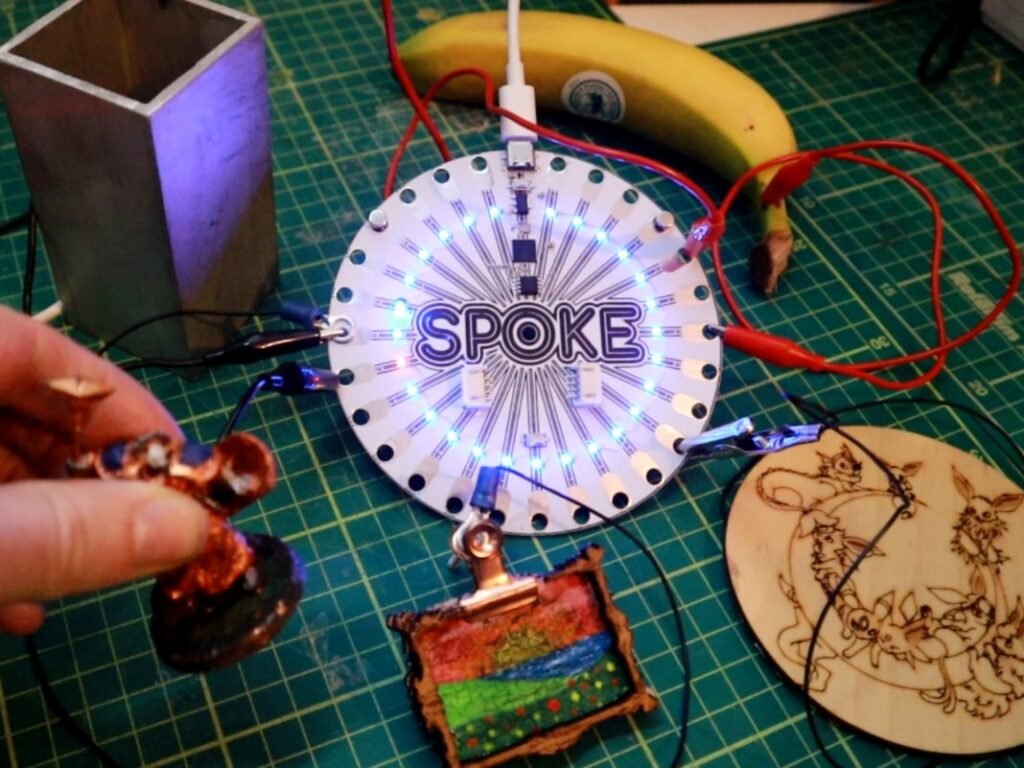
Need a MIDI controller but only have a banana, a spoon and a handful of crocodile clips? Well, good news, because that’s apparently enough.
Introducing SPOKE, a new plug-and-play “capacitive touch controller board” that turns any conductive material or object you own into a computer input.
Whether you’re making a DIY instrument, triggering samples, controlling visuals or building a gloriously over-engineered macro pad, SPOKE is designed to make the process as simple as possible.
Built around the Raspberry Pi RP2040, SPOKE connects to a computer via USB-C and shows up instantly as a MIDI controller straight out of the box. It can also be reconfigured to function as a keyboard, mouse, serial device or OSC controller, making it suitable for everything from music production and lighting control to games and interactive installations.
The board features 27 capacitive touch inputs, allowing users to connect objects using crocodile clips, nuts and bolts, or simply play it as a stand-alone device. There’s also Polyphonic MIDI support, with notes, scales, and modes all fully customisable.
If it isn’t already obvious, one of SPOKE’s biggest selling points is how little setup it requires. With “no drivers, no setup, no faff” needed, there’s no requirement for a DAW, coding environment or specialist software to get started. Instead, the company provides a suite of browser-based tools for music creation, sound recording and code editing, allowing users to start experimenting directly from a web browser.
Under the hood, SPOKE runs CircuitPython and is fully open-source, making it easy for more adventurous customisations. The board also includes programmable NeoPixel RGB LEDs, JST connectors for expanded wiring projects, and support for USB-MIDI, HID keyboard and mouse emulation, OSC and serial communication.
As for what you can actually touch? Pretty much anything conductive – or, as the company puts it, anything with “capacitive potential”
Metal objects such as keys, coins, pipes, spoons and jewellery all work, as do conductive 3D-printed parts. Fruit, vegetables and even mushrooms can also be used as touch sensors, while thick graphite pencil drawings can become playable inputs in their own right.
If the full-sized board feels like overkill, there’s also a smaller DIY version called SPOKE-mini designed for permanent installation inside custom projects.
SPOKE is priced at £40, while the SPOKE-mini costs £25.

Learn more at Spokeboard.
Get the MusicTech newsletter
Get the latest news, reviews and tutorials to your inbox.