


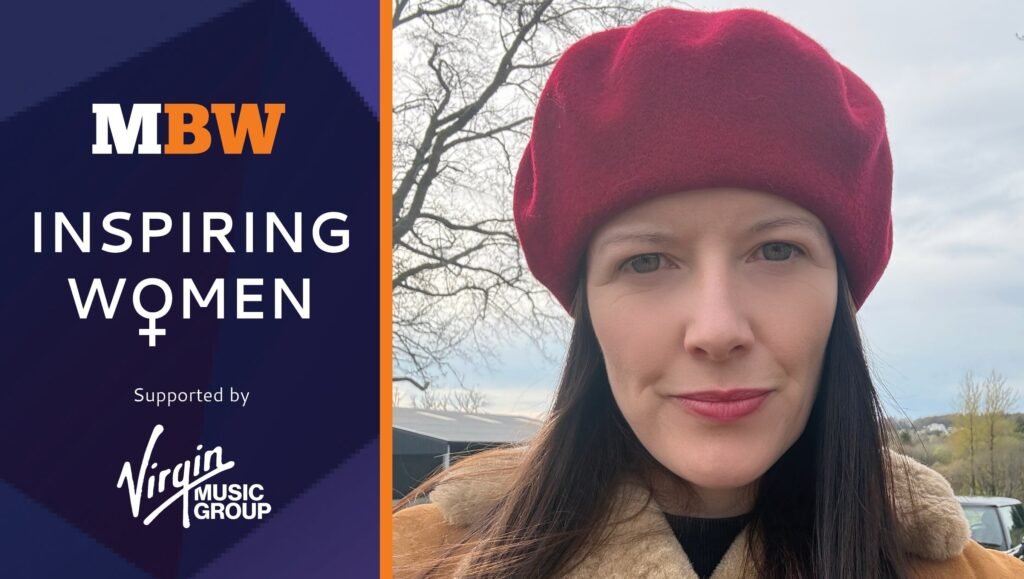
MBW’s Inspiring Women series profiles female executives who have risen through the ranks of the business, highlighting their career journey – from their professional breakthrough to the senior responsibilities they now fulfill. Inspiring Women is supported by Virgin Music Group.
Delphine Seddon was at the height of her career as Chief Operating Officer of September Management (home of superstar Adele) when she decided to quit it all.
With 20 years of experience in the music business, the exec moved to a sleepy village in West Wales to pursue a career as an author.
Seddon’s first novel, Darkening Song – out now via Saturday Books/Macmillan in the US and Blue Neon Books in the UK – is about the music industry, and tells the story of a young female artist (Alora) and an inexperienced manager (Eva) navigating mental health, trauma, and the fallout of fame. It provides a pretty ugly reflection of the most shallow and callous aspects of the music business.
Seddon started her career in music law, a tough gig to get due to her lack of contacts at the time. Still, she managed to secure a meeting with a senior executive at Sony Music via a solicitor her dad knew.
They met at the (now closed) Dogstar pub in London’s Brixton to watch a gig, and Seddon stayed up all night drinking with him in the hopes of making a positive and lasting impression.
That connection led to a recommendation for a job as a music and entertainment lawyer at the law firm Statham Gill Davies, which eventually led to Seddon joining Warner Bros Records in the UK. There, she became Head of Business Affairs, working with artists such as Dua Lipa, Foals, Muse, Biffy Clyro, and Enya.
After leaving Warner, and following a stint as an artist manager, Seddon joined September and stayed there for six years before making the big decision to prioritize her career as an author in January 2025.
Seddon mapped out the basic premise for Darkening Song while she was at Warner, and wrote it while she was still working at September. After completing a novel-writing course with Faber & Faber, Seddon challenged herself to write a novel in six months.
That novel ended up being scrapped in its entirety — “as soon as I finished it I was like, this actually is shit because it was and then I just got rid of it,” she says — but that process laid the groundwork for what came next.
Just before Adele’s 30 campaign took over the world (and, presumably, Seddon’s life), she took a week off and smashed out what became Darkening Song (which is 362 pages long) during that time.
“I wrote like a woman possessed,” Seddon remembers. “I probably wasn’t working in what you would describe as a healthy way; I was just very determined to do it.” She’s now working on her second novel.
Here, we chat to Seddon about her career transition, Darkening Song, lessons learned from working in the music business, and much more.
You made a big change last year, leaving your job at September Management to pursue a career as an author. What was that transition like when you first stepped away?
Jonathan [Dickins], who is the owner of September, was always so supportive of my writing. If I said to him, ‘I need to take two weeks off and write intensely,’ he would always say yes. But the COO role was still a big job, and it took up most of my time. So initially, it felt very freeing to leave because I suddenly had this enormous amount of time open up to me that I’d never had before.
It felt like an incredible luxury. I expected to have days where I would wake up in a blind panic thinking, ‘What the fuck have I done?’ But I didn’t actually have that. In many ways, I’m a cautious person, but then I’ve often made these life decisions where people have been like, ‘Oh my god, I can’t believe you’ve done that’ – another one being moving to a 14-acre smallholding in West Wales. But even though they technically are big decisions, they don’t feel like big decisions to me; they feel like necessary decisions.
Who are you now that you weren’t able to be while you were working your big music business jobs?
Even when I was working those big jobs, I wasn’t the person I presented in a boardroom in my private life. So it’s not like I had to go around being that person 24/7, but I’m obviously not in the same situations where I’m having to make myself heard in a room full of men, which I suppose allows me to be a softer, more vulnerable version of myself, more regularly.
Onto the book… how would you describe Darkening Song?
Darkening Song follows the relationship between two young women – a teenage artist from Manchester who gets discovered by the intern underdog at the record label, and the intern underdog herself, who, when the artist becomes very famous very quickly, is flung into this crazy world of power, money, and success, which impacts each of them in very different ways.
It’s a coming-of-age story, it’s about mental health and female camaraderie. It’s not a romance by any stretch of the imagination, although there is a love story element for both of the girls. It’s a lot about learning who we are, what we want, and how to exist in this very intense modern world, which hopefully is relatable beyond the book’s music-business setting. I’d describe it as feminist and dark, but ultimately hopeful.
Where did the first spark for the book come from?
It came from a feeling that I wanted to say something about lots of things I’d been thinking about; there wasn’t one eureka moment. I was obviously immersed in this environment, which was, in many ways, a harmony and a conflict between business and creativity. The relationship between those two things is really interesting to me. I feel it in the context of [book] publishing, and I felt it in the context of music.
It’s not always a smooth ride. I’d been thinking about power and ego and about how people are sometimes input into the machine of a big business and become something else. I was thinking about youth, mental health and fame. The culmination of these topics made me want to turn them into a fictional story as a way to express some of what I was feeling.
Fairly early on in the process, I decided I wanted to put these two young women into this very male-dominated scenario and see them win on their own terms. But it’s not a simple case of they win and that’s the end. It’s about the complexities of what’s driving them to be in the positions that they’re in.
What truths about the music industry were you most interested in unpacking through the novel?
This isn’t just about the music industry but how power changes people was something I was very interested in unpacking. I was interested in exploring where the desire to share our creativity comes from, or the desire to get up on stage, even if an artist, like Alora in the story, has terrible stage fright. I was interested in exploring how self-interest can sometimes get in the way of doing the right thing.
Where’s the balance in your writing process for this book between fiction and lived experience?
I drew on life because I have worked in the music industry for a long time. I have worked with artists, managed artists (even though that was a small part of my career), and worked in big business environments. I did not and could not, for legal reasons, base any of my characters on real people. I also had to be very careful not to tell other people’s stories for them.
There’s a thread of the storyline that is, sadly, very reflective of the experience some female artists have had in the industry. You hear stories firsthand; stories circulate, and it was incredibly important, because they’re not my stories, to make sure that whilst that thread [addresses] something that has been an issue, it isn’t relaying other people’s experiences directly.
Darkening Song outlines some of the most soulless and dangerous aspects of the music business. Is it possible for artists to be protected from that, and if so, how?
I don’t wish to convey that everyone in the music industry is bad, appalling, ruthless, or backstabbing, but there is an element of that. That’s not exactly a secret. I don’t think the experience of Alora has to be any artist’s experience, and there are elements of pressure and negative forces that are not solely coming from the music business, like the society we live in, the nature of fame, and a public expectation as to what a famous person is required to share. Social media can have a hugely negative impact on mental health.
But ultimately, part of the music industry’s job, be that managers, agents, record labels, or publishers, has to be to recognize that the nature of the landscape in which creativity is now being put out into the world is a lot more complicated than it was 50 or even 20 years ago. There has to be a different level of support, understanding, and sensitivity to what an artist needs to be able to have a successful career but also not implode.
What does that support look like in practice?
Helping educate the artist, allowing them to set boundaries, and teaching them how to navigate the music business and the wider fandom and societal aspects of it. It’s really hard. I don’t think there’s an easy answer. To create from a genuine place, you have to be extremely open, vulnerable, and sensitive, and when you put the music out, you need to be the opposite.
You need to be tough, thick-skinned. It’s almost impossible. It’s good advice not to read reviews, but young people are so deeply entrenched in what’s going on online that it’s almost impossible for them not to engage with it in some way.
Mental health in the music business is a central theme to the book and one which has been explored in various ways by the industry over recent years. Where do you feel that there is more work to be done?
There is more of an understanding now. I’ve seen management companies helping with counseling and therapy sessions, and record labels have started to have schemes in place to give artists more support. That is brilliant but I do think that in certain situations, there will be a friction between what is best for the artist and what is best for business. Where that situation arises, it has to be what’s best for the artist.
As much as I absolutely hate to say this, most artists who are signed to major record deals do not go on to have ginormous careers. When I was working as an artist lawyer, the more common scenario, very sadly, is that a lot of the record deals you ended up signing an artist to, at some point in the not-so-distant future, you’d find yourself having to deal with labels dropping those artists. That is really hard. I always used to say to my clients, ‘The record deal is step one, you haven’t made it’. The devastation that comes with being dropped from your dream is something that definitely needs more support around.
What would you like to achieve with the book?
I would love it to be widely read by the music industry and for it to raise questions that require thought. There’s an element of the music industry that operates within its own cosmos. There was that parliamentary report on misogyny and music, which, as far as I can tell, was pretty much ignored by the music industry. I hope people read and enjoy the book, but I also hope it’s a conversation starter, in some respects, and an opportunity for [self-reflection].
Beyond the music industry, I hope that readers take something from the wider principles, the nature of the human relationships that I’ve tried to portray, and the idea that a person can go on to lead a happy life despite past trauma. Every situation and person is, of course, different, but Alora in the book finds a way to work through her negative experiences, and I would like that to be a hopeful message for readers.
Can you pinpoint the biggest lessons that you’ve learned across your career?
Don’t let other people define what you’re capable of. If I had let other people do that, I would never have even gotten into the music business. The second one is to believe in yourself. I think women tend to self-limit more than men.
That’s just my perception. I’ve seen it in business. I can be guilty of self-limiting, but I try to push myself through it. It’s really important for us as women not to self-limit because we’re amazing.
What’s the best career-related advice that you’ve been given, and who did it come from?
I was given a piece of advice by a male lawyer when I was in my early twenties that stuck with me so deeply, but it’s not necessarily good advice, which is that nobody wants a lawyer who cries.
It’s awful, but also, it’s kind of true. We’re allowed to bang our fist on the table and shout, that typical masculine, acceptable but not acceptable, behavior, whereas bursting into tears is deemed weakness.
I have been a lawyer who’s cried, but I’ve cried in the toilets. I’ve never sat in a client meeting and cried, thank God, but it means that you put yourself into this straitjacket where there are emotions you’re allowed to express and others you aren’t. I think that’s problematic.
It is. And it’s one of the remaining issues in the bid for gender diversity in the workplace. There may be more space for women, especially in leadership positions, but there sometimes isn’t space for a more ‘female’ demeanor and leadership style.
It’s also problematic for the men because it’s reinforcing gender stereotypes around them, too. Not all men want to bang their fist and shout.
No, no one wins. What advice would you give to emerging artists or executives looking to start a career in the music business today?
What I saw when I was working at a major record company was that if you were an artist who signed to a major at the very beginning of your career, and you didn’t have a strong sense of who you were creatively, you could find yourself being pulled in directions that weren’t necessarily true to you or the right one for you. The world we live in now allows artists to have this period of evolution outside of majors.
I’m not saying it’s easy, because if you’re self-funding, there’s a cost that comes with that. But you can build an audience directly, without relying on this other machine, and that gives you the space and freedom to experiment creatively, evolve, and work out who you are. Then, if you wish to put yourself into any kind of major label situation, you’re in a very different position going in.
For executives, something that was very important to me was how to get the best out of our people. Has the way the music industry traditionally operated been the best way of creating a happy, passionate, and connected workforce? The principles at the core of my business model in September were kindness and community, and they weren’t necessarily words you heard bandied about frequently in music.
I had a really interesting conversation once with Zena White, who is COO at Partisan. She said the game-changer for Partisan is when they stopped asking people who worked for them, What can you do for me? and instead asked, What can we do for you to make you the best you can be in your position? That is what I think all executives [in leadership positions] should be doing. It’s not about grinding these people into the ground for the profits. It’s about making this a really buoyant, happy workforce where success is the knock-on effect.
If you could go back to the beginning of your career and tell yourself one thing, what would it be?
I might say to myself, allow yourself to celebrate your successes more. I’m always about achieving the next thing.
If you could change one aspect of the music industry tomorrow, what would it be and why?
I don’t think I can limit it to one! I’d like to see more women in leadership roles. That would change a lot about the bigger picture and everything that filters down from that. We’re getting there, but it’s a slow process. I’d like to see songwriters fairly remunerated, more balanced gender representation in festival headliners and for all women working in the live scene (and in general) to feel safe in their working environments. I’d like to see artists fully supported in their mental health during the highs and lows of their careers.
But one area I feel very passionate about is gender balance in music production. We don’t have enough women producers by a long shot. I’ve been involved in various initiatives to try and raise awareness of this previously, including hosting panels at festivals and an all-female songwriting and production camp I helped organize for the recording artist RAYE.
We held it at the Church Studios, which is an amazing space, and the energy in the studios filled with these brilliant, creative, talented women was so incredible, you could actually feel it.
It’s hard to fully understand the root of the problem because, even at the university and college level, most of the producers coming through are still blokes. But there are many absolutely brilliant female music producers out there – Ellie Mason, Chloe Kraemer, Kito, Marta Salogni, to name just a few – and I think record label executives need to not keep giving the work to the same boys (their mates) and give other people (women) a chance. I’d also love to see more female artists of profile openly supporting female producers. In my experience, women supporting other women is a very powerful thing.
What are your future plans and ambitions?
In the immediate future, my plan is to finish book two and to have created something I’m happy with. I would love to continue writing books professionally but, without wishing to be negative, I’m also realistic about the prospects of success in a very busy market and lots of other aspects of the uncertainty of relying on creativity for money.
To be totally honest, what I would really like to achieve is a life of balance. If that means I’m not writing full-time but working in a job that isn’t swallowing me and that allows me to write, that’s probably my ambition. Feeling that I’ve got balance in my life and that I have time to do the things that are important to me.
Virgin Music Group is the global independent music division of Universal Music Group, which brings together UMG’s label and artist service businesses including Virgin and Ingrooves.Music Business Worldwide