


“AI works so well that now our internal sound designers can build products in two days that would have taken our entire dev team a whole year. It’s unbelievable.”
Casey Kolb, CEO of Lunacy Audio, had no plans to use AI in the company’s forthcoming plugin release. But while most of the music industry has been focused on deepfakes and full song generators, in the last six months something arguably even more impactful is happening in the world of music software. Lunacy is one of many developers just trying to keep up.
“We’re trying to navigate this. It’s very weird; we weren’t even planning for it. It threw everything up in the air, and it was like ‘oh my god, maybe this is the future.’”
AI-assisted software development, or ‘vibe coding’, has the capacity to shortcut old practices, open the doors to complete novices, and have a foundational impact on the field of programming writ large. But what does this mean for audio development? In the case of Lunacy, that meant taking their human-made code and using AI to experiment and iterate on their designs at an astounding rate.
Kolb spent years building his team of human engineers. Talented audio developers are rare in his experience, and refining the development workflow took time. Before AI came onto the scene, the team at Lunacy manually coded CUBE, a sample-based virtual instrument and BEAM, a multi-effects plugin.
Lunacy’s next project, dubbed NOVA, invites people to build, share and remix plugins “like Google Docs for audio”. It never originally involved AI at all, but with the codebase already built, Kolb and his team took the chance to see what more AI could do with it.


“We had already built by hand a custom audio engine to make our product work. AI already has access to our algorithms and infrastructure paradigms, so all it is doing is coding – putting together the Lego blocks that we’ve handed it.”
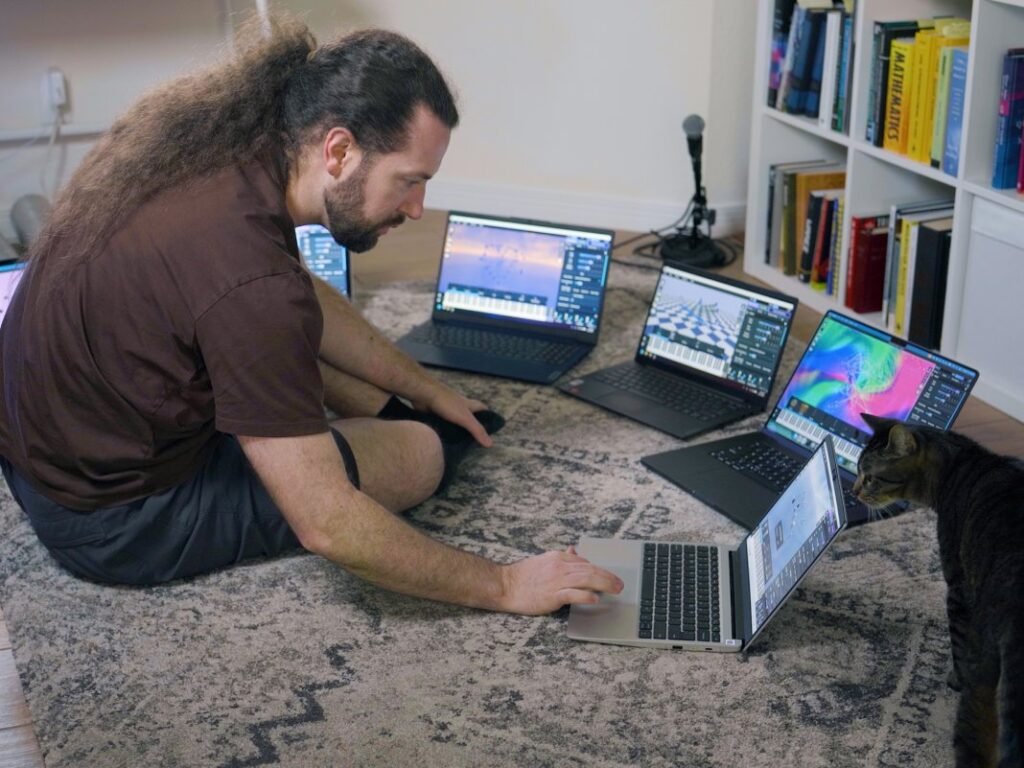
If AI is having an impact for companies, it’s an even bigger shift for solo developers. As a former tech lead at Google and first-time plugin developer, Evan Mezeske wanted to combine his love of music with his background in programming. The result is Anukari, a weird and wonderful physics-based synth that takes inspiration from the 3D modelling environments usually found in video games.
At first, AI was simply a curiosity, and he did the first couple of years’ work the old-fashioned way. When Mezeske finally got round to seeing what AI could do, his initial reaction was mixed. “I was seeing it do things that I’ve spent my whole life getting good at […] and now there’s a robot that does my job. I went through a period where I was shocked and disoriented.”
“But at some point I realised I had to come to terms with the fact that this is how the world is now. I was like, okay, well, what does this mean for me? It means that I, as a solo entrepreneur, can’t afford to get help programming. But I can afford Claude.”
The allure of Large Language Models such as Claude, ChatGPT and Gemini is that you can talk to them in natural language and ask them to execute entire development cycles from design to testing to executing code. Experienced programmers might use it to bridge between languages they’re not familiar with, but people who have never written a line of code can also get AI to build their idea.
The danger here is that this paradigm might result in low-quality, buggy and uninspiring music software, as a consequence of developers not fully understanding the code being produced. This is something Kolb is aware of: “We don’t want everyone and their grandmother to come in and build awful things and share them. We’re trying to really curate the system such that it’s tasteful.”


Vibe coding might seem easy, but the reality is music software requires dedication and hard work to orchestrate something that not only operates, but performs well and sounds great too. Vibe coding might be a gateway to a new generation of plugin makers, but for Mezeske, the quality of new software will be determined by how much detail, direction and effort goes into the AI and Human working process.
“If vibe coding means I say ‘build Anukari’, it’s going to go off and do something awful. But in terms of the prompts that I gave Claude for the 3D renderer, it was something like a thousand chat interactions, starting with a huge thousand-line design essay and then a thousand iterations on that where I gave it feedback and provided direction. Is that vibe coding? I’m not sure. Personally, I think of vibe coding as somebody providing a lot less direction, in which case I think the results are going to be pretty poor.”
Furthermore, audio development comes with challenges that are highly unique to the industry. As Mezeske found out, audio software has to run on multiple operating systems, a long list of different DAWs, and there are all sorts of features worth considering from MPE to multichannel to microtunning and MIDI 2.0. “There’s just this vast surface area of contact points with other parts of software that are complex. It has to be in real-time, and on top of that it can’t crash. I mean, that’s insane, right?”


At Lunacy, the secret recipe that goes into their DSP development is not something Kolb is ready for AI to cook with just yet. “It’s not perfect. Earlier this year, we were trying to figure out how Claude Code would fit into our workflow. If you used it on certain deep-level things like DSP algorithms or something, it would often fail or mess something up. It’s gotten better, but we kind of avoid using it on anything that’s too delicate.”
Nonetheless, AI has suddenly made music plugin and software creation exponentially more accessible, allowing musicians and producers to build bespoke tools that fit their needs exactly.
For Scott Young—a producer by night and a former front-end developer—AI helped him overcome personal learning difficulties to build his first plugin. Based in Hong Kong, he couldn’t find many local studios that were developing audio software, and so “found the courage to do it” himself. The result was Acetate, born from a need to create quick club-ready masters for the venues he was performing at.

Although Young’s project began as a means to solve his own problem, ultimately he’s determined to create a high-quality tool that others find useful too. “I wanted to make a statement that this could be done,” says Young. “That it could be done at studio-quality output. Just because I couldn’t do it on day one doesn’t mean that I can’t do it a year later.”
As the barrier to plugin development lowers, we might see a renaissance of plugins that are niche, esoteric, and unique — just as we did at the turn of the millennium with the introduction of the VST standard. On the other hand, we might be hit with a wave of bad plugins, poorly optimised or full of bugs, with bad actors hoping to make a quick buck.
In the current AI-sceptic landscape, getting the balance right for both users and plugin makers is difficult but necessary. For Kolb, it’s a matter of seizing the tools before they are co-opted by others.

“If you’re in the camp of ‘let’s never touch it, it’s only evil’, I think that’s wrong. We’re going to get swallowed alive by the evil tech giants if we do that. We need to find out how to harness this superpower in a way that feels creative so we can beat companies that are trying to bypass the creative process.”
At a time when the plugin and software market is arguably over-saturated, AI might—in the right hands— have a surprisingly positive impact on music software.
As Mezeske puts it: “To me, the cool thing about music is the human creative process and the way that that connects to other people. I like the idea of superhuman cyborg people realising ever more of their creative dream in more detail. If the AI tools are amplifying a human being’s creative process and the agent is helping realise that much more rapidly than they could on their own, I think that’s very cool.”


Garling is a composer, sound artist, and contributing writer for MusicTech, with over a decade of experience making music. Endlessly fascinated by the possibilities of sound, she grabs whatever tech suits the moment, switching between hardwiring electronics, programming audio in Max and digging into plugins and synths.