


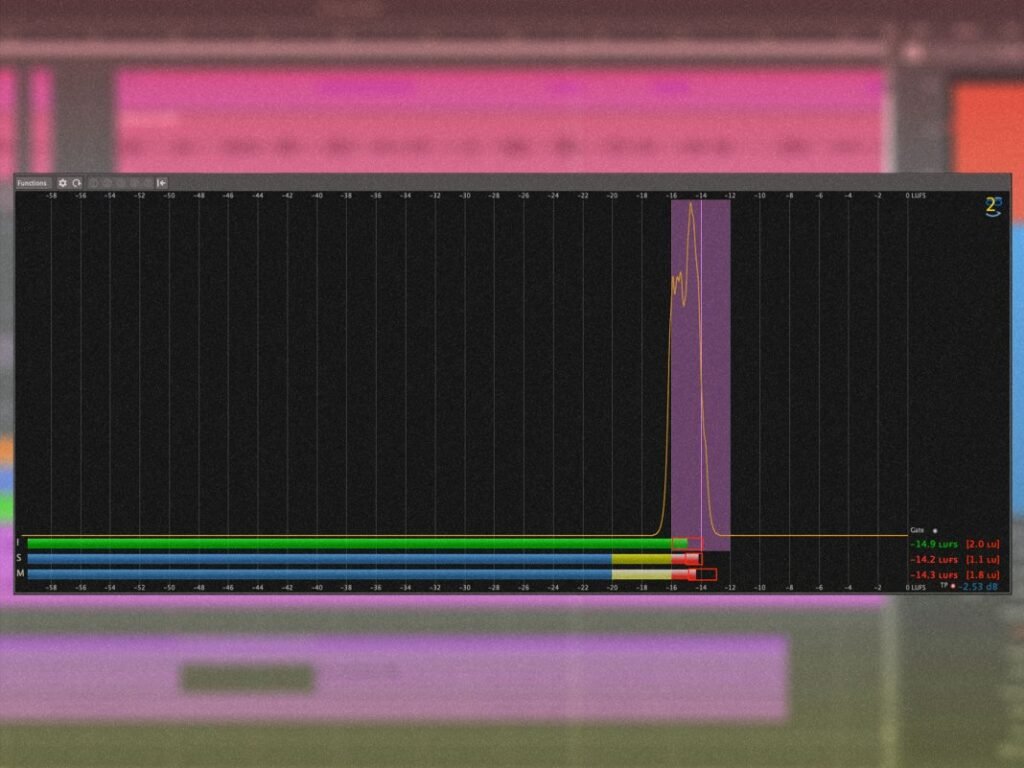
LUFS is an acronym for Loudness Units Full Scale and is a standardised way to measure audio loudness. It’s most commonly referred to in the mastering phase of music production.
In this context, ‘loudness’ is not the same as ‘volume level’, but rather a measure of how we perceive the loudness of a sound. The maximum possible loudness a system can reproduce is referred to as 0 LUFS, and measurements are expressed in terms of how many LU (Loudness Units) they are below this full scale point. For example, -12 LUFS is 12 LU below the 0 LUFS maximum.
Why do we need LUFS?
Our hearing isn’t sensitive to short, sudden transients, and so peak level meters don’t match our perception. Instead, we perceive loudness from a more averaged-out volume level, and that perception varies across the (roughly) 20Hz to 20kHz frequency range that we can hear.
LUFS takes all of this into account in order to create a system that closely tallies with our aural perception, and which therefore allows the loudness of completely different recordings to be compared and standardised in a meaningful and consistent way.


Why are there different types of LUFS measurement?
A single loudness measurement cannot tell the entire story of how loud a recording is. Many songs, for example, contain quieter and louder passages, and even the most aggressive death metal track may contain areas of serenity. We therefore measure four different types of loudness.
Momentary Loudness: Averages the measured loudness over a 400ms window, showing what the loudness is at any given moment. Similar to RMS volume level measurement.
Short-Term Loudness: Averages the measured loudness over a 3s window. This is generally the most helpful readout for meaningfully judging and comparing loudness, and when aiming for a target LUFS during mixing.
Integrated Loudness: Averages the measured loudness over an entire mix or passage of audio. This is the measurement used by streaming platforms, etc., when checking your audio matches their standards.
True Peak Level: The peak reconstructed signal level, in decibels, this being the peak level once the digital stream has been converted to an analogue signal.
Working with streaming platform loudness specifications
In order to present content at a consistent loudness, streaming platforms set standards for integrated loudness and true peak level, and will apply normalisation processing to any audio that does not match those standards. If you wish to avoid such processing from wrecking your carefully crafted mixes, ensure the audio you submit matches the platform’s specifications.
Loudness meters and tools
Your DAW: Many DAWs have built-in loudness metering, and this is often all you need to get a reliable readout.
Steinberg WaveLab 12: Steinberg’s audio editing and mastering suite features an intuitive loudness meter. It can also analyse passages of audio and overlay the resulting loudness measurement traces.
iZotope RX 12: iZotope RX 12’s Loudness Control and Loudness Optimise modules can provide detailed readouts of your audio’s loudness. The Streaming Preview module can then be used to preview and apply different platforms’ requirements to your audio.
Process Audio Decibel: This loudness and level meter runs standalone or as a plugin in your DAW, and can be linked to an app running on your phone or tablet to display loudness readouts wherever you need them.
Learn more audio and music production terms in our Glossary
Get the MusicTech newsletter
Get the latest news, reviews and tutorials to your inbox.