


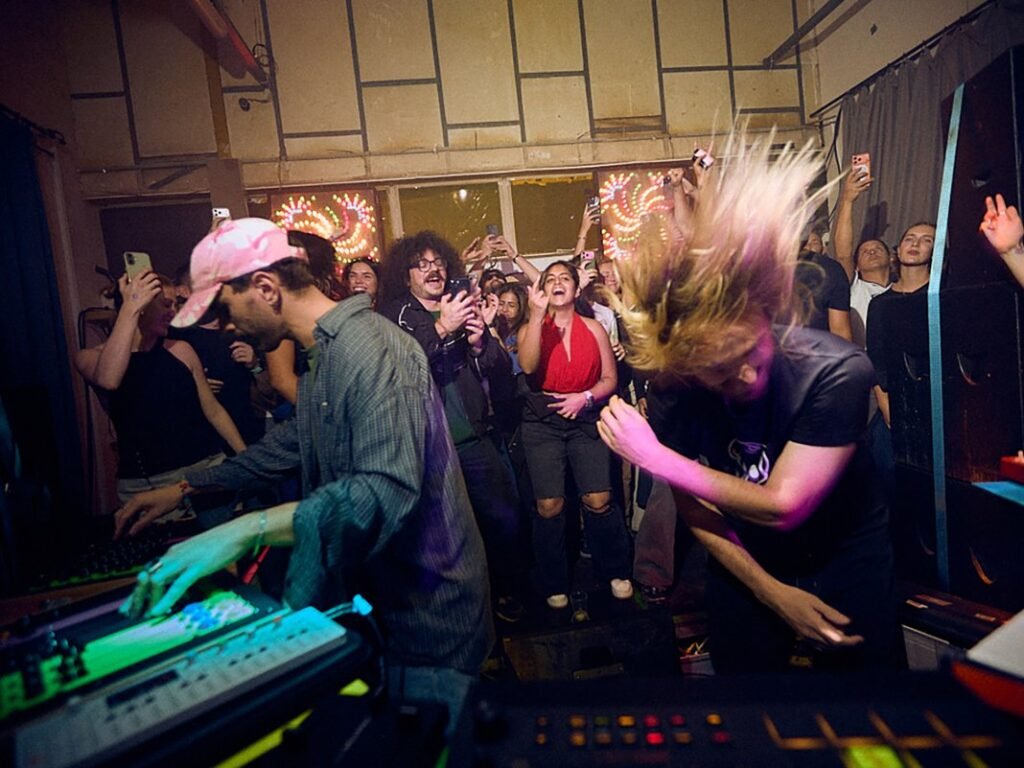
It’s 9 pm at London’s Avalon Cafe, a tiny backroom sweatbox in Bermondsey, and several tables full of audio gear sit at the centre of the 250-person venue. Surrounded by a young, uninhibited audience who await the arrival of Jersey, the sheer amount of kit that the fast-rising electronic duo brings to the intimate party is astounding.
There’s a RME Fireface UFX III, OTO Machines BAM, Behringer’s MS-1 MKII synthesizer, a Traktor Z1 MK2 DJ mixer controller, Novation’s FLkey 37 MIDI keyboard, Dreadbox’s Disorder Fuzz, a Teenage Engineering OP-1, a Mooer Baby Tuner, Bastl’s Kastle 2 FX Wizard, and an Akai MPC Live II. Finally, to complete the collection, there are two Hackintoys custom MIDI controllers and a Shure SM58 microphone.
And, no, there is no DAW or laptop onstage.
When the pair – French brothers Carl and Renaud Amiard – casually weave their way through the crowd, the energy is at fever pitch. The Normandy-born siblings waste no time in capitalising on the electric atmosphere, triggering their synths and sequencers with precision as their fans clamour for a closer look.
Their 360-degree setup, which really puts Jersey at the heart of the action, is something they have become celebrated for over the past few years. Many of their parties have also gone viral on social media and amassed millions of views on YouTube. Now I’ve experienced one in real life, it’s easy to see why.
Forming a bridge between the worlds of indie and hyperpop, their genre-mashing edits of Phoenix, MGMT and Skrillex sit seamlessly alongside their own tracks Talk Tonight and The World I’m Searching For. Across their hour-long performance, which culminates with a double encore, older fan favourites like I Want You go down a storm, as do teasers from their then-unreleased debut album NOTHING’S FAKE.


“We created the record with the idea of playing it live,” Carl says when MusicTech catches up with the duo in the venue’s unlit outside alcove. The pair had studied and made music for 15 years and started out as a rock band, so the decision to play live during their studio sessions felt natural. “There are some echoes that we already did in the studio, and a few synths,” Carl explains.
The crucial element when it comes to Jersey, he adds, is “to have access to something very random, but very playful”. Renaud continues: “Not too many knobs to get the right sound… It’s great to have instruments that are really intuitive, where you can play around with every feature in a spontaneous way.”
Carl expands further: “We like letting ourselves get surprised by the sounds we create, then shaping them and using those textures as raw material to build something from. We love tweaking knobs live and seeing what happens while the other person records.”
Though NOTHING’S FAKE evolved from sessions at professional studios, friends’ apartments and Airbnb rentals in London and Los Angeles, it was mostly just the two of them in Paris “playing with instruments”, as Carl puts it. Similarly, they experiment during their live show: “We create a lot of new effects and, after trying them at a live session, if it’s good, we keep it”.
The whole album process took almost two years to complete. “It was a way for us to connect with our main inspirations,” Renaud shares, citing indie-rock and pop as well as electronic music. One musical group they’ve always loved, Gorillaz, proved particularly influential, especially when it comes to Jersey’s use of vocals on their own songs: “not in a classic club way, but this is our first step into the electronic-pop world”, Renaud says.

“Gorillaz is a band that uses vocals in a very pop-oriented way while having a really distinctive approach to sound and texture,” adds Carl. “Daft Punk have done something similar, and we love how instantly recognisable and personal their sound is,” he continues, adding Justice, The Prodigy and Skrillex to the duo’s list of inspirations.
To achieve a similar level of distinction within the sonic universe of Jersey, the pair use text-to-speech AI. “We approached it as the journey of half robot and half human,” Carl explains. He and Renaud speak openly about how they incorporate it within their artistry: “We don’t hide it because it’s not generating the music at all. It’s just for the vocals, and it is closer to a vocoder.”
Renaud expands on how exactly they use the function: “We made a model of our voice, then we use the model to do text-to-speech, then we tune every note after, and we cut samples to add entire sentences. This is the only use of AI we do within our music.” Carl chimes in to make clear that “we don’t like to erase the process of making music”.
They do, however, find the audible artefacts that come from the AI model fascinating. “We want our vocals to sound a little bit like AI and like a real human voice,” Renaud considers. To this end, the brothers enjoy the ambiguity: “We want to have this little play with the notion of fake,” Carl adds. “We purposefully didn’t make the vocals too high because we want people to wonder whether a certain part is AI or not. We are actively looking for this effect.”

In a live setting, he argues, humans cannot be replaced. “If you go to see an artist perform, you can’t have a robot in front of you,” he says.
This is why they relish playing live and prefer it to DJing. “We take so much pleasure from trying to perform as well as we can with synths and our gear,” Carl says, adding that DJing is “not for this project,” though the pair respect the artform.
Renaud agrees. “We don’t feel good when we DJ. We need to have something to do with our hands, and it’s easier for us to feel the music and connect with the crowd.”


Ben is a freelance music journalist based in Cambridgeshire, UK, with 10 years of experience and an interest in all genres. He spends most of his time at gigs and festivals, and regularly writes features, profiles and reviews for MusicTech, Guitar.com, NME, Mixmag, Rolling Stone UK and Beatportal.