


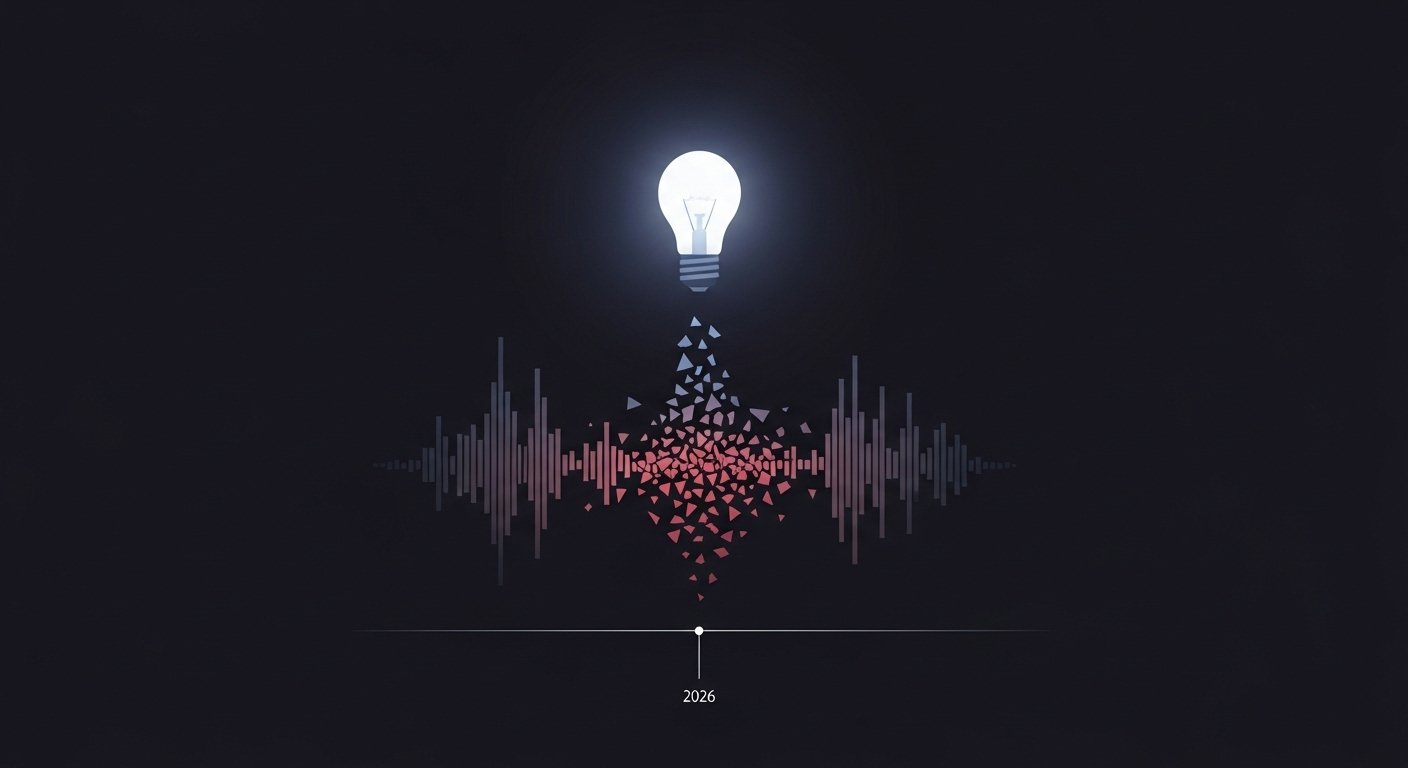
More layers. More plugins. More polish — and less impact.
For years, producers were told that bigger meant better: more layers, more processing, more complexity.
In 2026, that mindset is quietly failing.
Listeners are overwhelmed. Algorithms reward clarity. And tracks that feel simple but intentional are outperforming those that sound overworked.
This isn’t about going lo-fi or cutting corners.
It’s about understanding why clean, focused production now wins — and how to stop overproducing your own music.
Listener Fatigue & Cognitive Overload
Modern listeners consume more music than ever — often passively, through playlists, shorts, and background listening. Their brains are constantly filtering sound.
When a track contains:
- Too many layers competing for attention
- Constant movement in every frequency range
- No clear focal point
…the brain gets tired quickly.
This is known as cognitive overload. Instead of feeling impressed, the listener disengages.
What fatigue sounds like:
- “It’s good, but I don’t want to hear it again.”
- Skips after 20–30 seconds
- No emotional connection, despite technical quality
In 2026, comfort and clarity matter more than complexity.
💡 If everything is happening all the time, nothing feels important.
Why Fewer Tracks Often Sound Bigger
This feels counterintuitive, but it’s one of the biggest production truths today:
A mix with fewer, well-defined elements often sounds larger than a dense one.
Why?
- Each sound has more space to breathe
- Transients hit harder without competition
- The stereo image becomes clearer
- The listener can easily identify what matters
Overproduced tracks often sound “small” because:
- Energy is spread across too many elements
- Phase and masking reduce impact
- Dynamics get flattened trying to control everything
A focused arrangement creates contrast, and contrast creates impact.
💡 Big sound doesn’t come from stacking — it comes from intention.
The “Everything Is Moving” Problem
One of the most common overproduction traps is constant modulation:
- Every synth has LFOs
- Every sound is automated
- Every channel has effects
Individually, these choices seem creative. Together, they create chaos.
In 2026, tracks that perform well usually have:
- One or two elements in motion
- A stable foundation underneath
- Clear hierarchy: lead, support, background
Movement works best when it’s selective, not universal.
💡 If everything moves, the ear has nothing to lock onto.
Knowing When a Track Is Actually “Done”
Overproduction often comes from insecurity, not creativity.
Common signs you’ve gone too far:
- You keep adding layers “just in case”
- Muting a track doesn’t change the song much
- You’re EQ’ing just to make things fit, not because they’re needed
- The mix sounds impressive but emotionally flat
A useful test:
Mute one element. Does the track feel clearer or worse?
If it feels clearer — that element wasn’t helping.
Another rule for 2026:
If your track works at low volume, it’s finished.
If it only works loud, it’s overproduced.
Why Simplicity Wins with Algorithms
Algorithms don’t analyze creativity — they analyze behavior.
Tracks that perform better tend to:
- Feel comfortable at consistent volume
- Translate well on phones and small speakers
- Maintain energy without overwhelming the listener
- Encourage repeat listens
Overproduced music often:
- Sounds impressive once
- Becomes tiring quickly
- Loses replay value
In an algorithm-driven ecosystem, repeatability beats complexity.
Final Takeaway
Overproduction isn’t a skill problem.
It’s a decision problem.
In 2026, the most effective producers are not the ones who do the most — but the ones who:
- Choose fewer sounds
- Make clearer decisions
- Trust space and contrast
- Know when to stop
If your track feels busy but not memorable, the solution usually isn’t adding more.
It’s removing what doesn’t matter.