


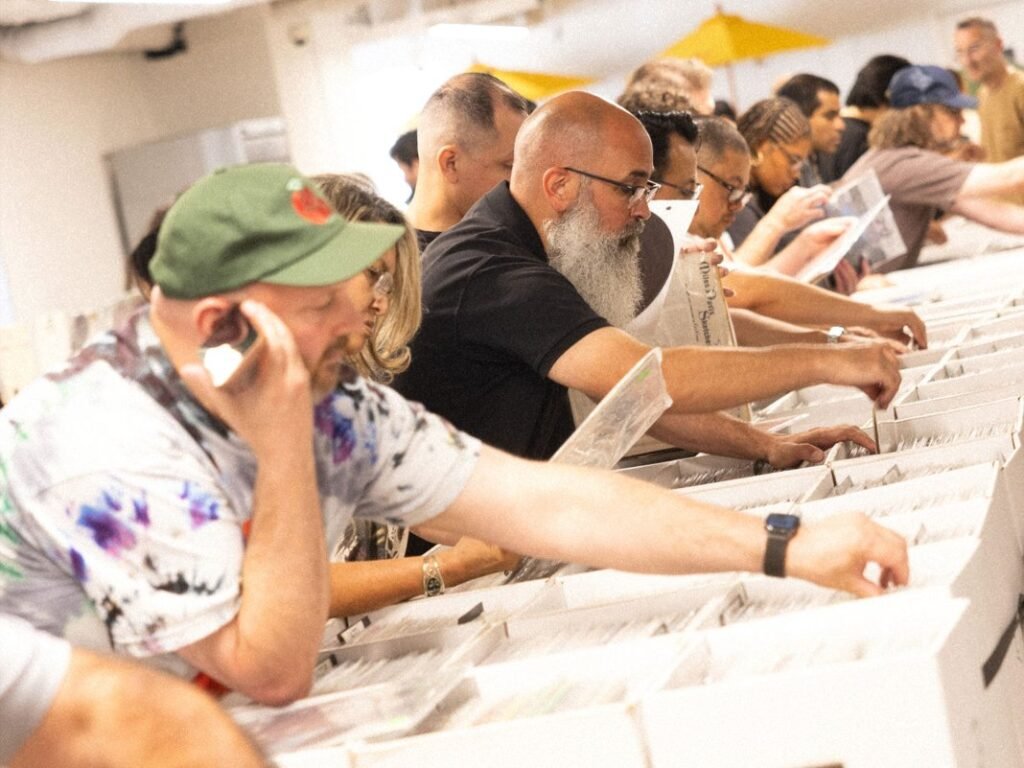
At the latest edition of VinylCon in Los Angeles in late August, over 150,000 records were on sale throughout the convention floor. Doug Day had one of the largest booths, with five tables full of bins, flaunting every genre, style, and era imaginable. Day will make similar hauls to shows in Denver and Austin, and he has over 8,000 records for sale on eBay, but he doesn’t even have a turntable plugged in at home.
He is interested in collecting, not listening. When he was 12, he collected sci-fi toys. Decades later he’s moved on to vinyl:
“It’s no different, really. Collectables are collectables. It depends on figuring out what it is that people want and having it for them,” Day tells me.
I encounter this same sentiment throughout the convention. Alex Rodriguez runs the LA record store Record Safari (he also curates the record store at Coachella every year). The shop has 25,000 records in stock, and he has 25,000 more in his personal reserves from collecting and selling since 1995. Back then, without Napster, PirateBay, or Spotify, the best and cheapest way to discover a surfeit of new music was by purchasing vinyl.

But he’s totally happy listening to music through an iPhone speaker.
“I’m not an audiophile. I just wanted to learn as much as I could about music. It had nothing to do with the physical format,” Rodriguez says. He does have a rather impressive hi-fi system for listening: Technics SL-1200 turntables, a McIntosh amplifier, and Tannoy speakers from the 80s, but he didn’t set out to purchase any of it.
The speakers came into his orbit when a widow sold them to him at an enormous bargain as she downsized following her husband’s death. Rodriguez told her that she could net three times what she was offering, but she just wanted them out of the house.
“I lucked into them. I would not have normally paid what they go for,” Rodriguez adds.
These perspectives highlight the different cultures around vinyl as more and more people build their collections. According to the RIAA, vinyl sales hit $1 billion in 2025. With brands like Technics, Crosley, Pro-Ject and Rega currently manufacturing consumer- and prosumer-friendly turntables, modern hi-fi systems can accommodate all manner of vinyl libraries. You can put a record on whether your entire collection is pressed within the last year, it’s filled with heady, vintage one-of-a-kind records sourced from VinylCon, or it’s a family heirloom, as is the case with VinylCon attendee Mimi Price.


She has computer speakers that her turntable plugs directly into, but for her, vinyl is another bastion of physical ownership. She also collects CDs, cassettes, VHSs, and DVDs.
“Physical media is the interest rather than just vinyl. I’ve started to like it more because of the artistry itself and not necessarily the industry,” Price says.
We talk about how the PlayStation community organised a boycott (by not turning on their PlayStation consoles for a week) to protest the announcement that Sony would no longer sell discs starting January 2028. Without that physical element, Sony, or any of the other powers that be, could alter the games.
“They can change it. They can edit it. With streaming services, you see it with movies more than music,” Price says. “You don’t have the original anymore, and with a CD or vinyl that can’t happen. It’s proper ownership, and it’s proper preservation.”
That’s not to say the convention is absent of audiophiles. In fact, Vinycon was founded by one. Kobi Waldfogel currently has a Thorens TD 124 turntable, an HH Scott Tube Amp, and Klipsch Forte speakers. That system sells for roughly $19,500 online: $12,000 for the turntable, $2,500 for the amp, and $5,500 for the speakers.
“People start with something entry-level. Then they realise it isn’t the right thing for them, and they invest in something a little nicer; they do a little more research,” Waldfogel says. This is his fifth turntable upgrade since he started collecting 15 years ago. “As long as you keep collecting and keep getting new stuff, you’re going to want something new to listen to.”

In general, after his years collecting personally and now five years of running VinylCon—first in Denver, then Philadelphia, and now Los Angeles—Waldfogel has noticed the demand for hi-fi systems is growing alongside the demand for vinyl. Not as quickly, but it is growing.
Michael Palermo, who is working behind the table for the iconic California record chain Amoeba Music, says he’s noticed it, too. Amoeba is one of the few record stores large enough to offer regular stock of turntables and speaker systems from respected brands such as Pioneer, Audio-Technica, and Crosley.
“People come to us because it’s hard to know what stores sell audio equipment reliably,” Palermo says. He has a pair of Bowers & Wilkins speakers that were a college graduation present from his uncles, who are both audiophiles, and he mentions the growing interest in hi-fi bars as a means of sparking an interest in a more intricate listening experience. “I’m from the generation of the suitcase record players from Target and Urban Outfitters. People are taking further interest in vinyl, aside from having your favourite album and putting it on your wall.”
Coincidentally, that’s exactly how Caneatra Wilson started her collection. She decorated her dorm room with five records, but they ended up taunting her.
“I actually need to play these records!” she says with enthusiasm. “So then I invested in an actual record player, and the collection took off from there.”
13 years later, she has one of the biggest bags full of purchases that I see at VinylCon. When we speak, she had just invested in a full Sony system with two bookshelf speakers and a receiver. Next on the list is a second turntable to start DJing.

Carlos Rojas, another attendee with quite the big bag, has over 1,100 records after four years of collecting. He bought the first few without having a turntable. Now he has a Technics SL-1200 MK2, a Marantz 2226 receiver, and Klipsch speakers. Right now, he doesn’t have room for anything bigger, but as he looks for a new house with his wife, he’s hoping to have a separate room just for music. At first, it was the physical and discovery element that attracted him. Not sound quality:
“The fact that I could hold the record and read the liner notes—it wasn’t just about the famous person. It’s the whole band,” Rojas says. “A band that I was really into early on was Parliament-Funkadelic. I started learning about Maceo Parker, Fred Wesley, Bootsy Collins, Eddie Hazel. I started going into all the rabbit holes. Now I have records from Ethiopia, Sierra Leone, and Nigeria. It expanded my view of music.”
Rojas describes a similar dynamic to Rodriguez, except Rojas is also dabbling in the audiophile world.
Back when Rojas started collecting, there was less of an expectation that those two worlds would come together. Vinyl was the best way to learn new music en masse, whether anyone cared about quality or not. Plus, hi-fi systems were far less accessible. VinylCon represents how, slowly but surely, the quality potential of records is inspiring investment in a system that can bring out the best in them.
Learn more about VinylCon and how to catch the next pop-up.


Harry Levin is a freelance journalist with credits in SPIN, Billboard, MusicTech, Grammy.com, Los Angeles Magazine, and more. His musical journey began 20 years ago with a Led Zeppelin CD. He played jazz trombone through college, produced large-scale electronic music events, and now spends his professional time writing and editing.