



Photo: Tsunami Green
Digital formats have been around for decades. So why is the music industry still struggling with sluggish payouts, metadata mismatches, and the accumulation of enormous unpaid tranches? According to mass payments processing innovators like Tipalti, most companies still struggle to shift from painfully slow processes to strategic automation, despite the enormous upsides.
It’s a sobering reality. But decades since the dawn of digital, the music industry never quite wrapped its arms around problems like metadata mismatches and lagging artist payouts.
Billions have been thrown at the problem, laws have been passed, lawsuits have been litigated, and startups have crashed trying to resolve issues with metadata matching, ownership splits, and royalty payments. Sadly, the complexity and enormity of the issue are only growing, especially with AI slop entering the picture.
“Payouts are still too often slowed by manual work, fragmented systems, limited localization, and back-office processes that weren’t built for global scale,” Tipalti, a DMN partner company, reported after conducting a global payments research initiative to investigate the problem.
“This creates friction in one of the most important parts of the relationship: how partners, creators, affiliates, and contractors get paid.”
So if you’re feeling glum about accounts overload and metadata malaise, you’re not alone. But Tipalti’s survey, which canvassed far beyond music, unearthed another interesting reality: most digital execs can see the upsides of a well-oiled mass-payout machine, but few are zealously pursuing it as a strategic differentiator.
Interestingly, Tipalti discovered that 81% of surveyed leaders felt that strong partner, creator, and affiliate networks are essential to revenue and growth, viewing them as important or critical. But only 33% of surveyed organizations viewed their payout infrastructure as a growth-enabling strategic asset.

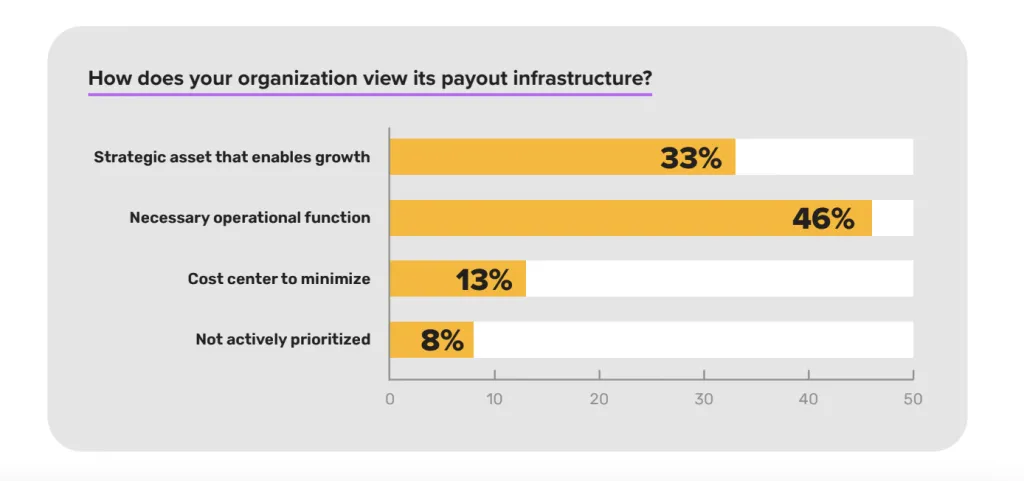
A finding from Tipalti’s recent survey of 714 leaders in finance, operations, and technology roles at digitally driven businesses with mass-payment demands.
Accordingly, few are devoting their attention to payout infrastructure, which often shifts the discussion back to the frustrating problems plaguing the industry. All of which suggests that a shift in attitude from ‘chore’ to ‘strategic asset’ might be the start of a game-changing change.
“Payouts are no longer just operational. They’re strategic,” the company summed.
Enter AI, which is mostly a gigantic headache for the music industry but could radically reorient finance teams and ease creator payout challenges.
Instead of burnout, network attrition, lengthy payment lags, and crushing manual chores, Tipalti told DMN that companies focused on agentic AI have dramatically simplified their financial stacks. Instead of trudging through the manual mud, those embracing artificial intelligence and automated finance infrastructures seemed to be thriving.
For example, organizations with ‘mature AI integrations’ are 98% more likely to feel that their financial infrastructures enable rather than slow their growth. These same companies are 45% less likely to require manual intervention in payment processes (though in fairness, AI systems come with their own cans of worms).
Further on the AI upside, Tipalti’s survey found that 43% of companies with well-developed, high-functioning AI systems could quickly deliver accurate, data-backed financial information and analyses to higher-ups, including sophisticated financial scenarios within hours of a sudden development or economic shift.
That’s the ‘good AI,’ which is often hard to isolate from the perniciously ‘bad AI’ plaguing major content owners. But can sophisticated AI systems, powered by companies like Tipalti, give the music industry the magical solution it’s been chasing for decades?
If only there were a magic pill, though in theory, AI holds the promise of clearing up millions of lines of bad metadata and matching millions more rights owners to their revenue-generating assets.
On the mass-payment side, there’s also tremendous hope for some big problem-solving ahead. Sluggish or non-existent payments often stem from incompetence rather than malice, with ‘incompetence’ better described as manual or stodgy payout systems. So perhaps the terrain will look very different in the near future.
Already, we’re seeing some nice success stories. Independent publisher Minds on Fire, for example, recently told Digital Music News that a shift in their payouts and royalties flow gave them the ability to pay a global roster of songwriters quickly, accurately, and with minimal administrative overhead. It wasn’t just an operational nice-to-have, but a real competitive edge.
And what about the dauntingly complex world of walled-garden, licensed AI platforms being created by companies like Universal Music Group?
‘AI Music 2.0’ is still in its very early days, but the future music industry could feature licensed, walled-garden platforms that draw upon vast pools of intellectual property. As these platforms scale, they face the unprecedented challenge of compensating an entirely new wave of stakeholders at a level of complexity never witnessed before.
According to Rob Israch, Tipalti’s President, “The music industry has been wrestling with rightsholder payouts for decades, and AI Music 2.0 is going to raise the stakes considerably. What our research and discussions with business leaders keep showing us is that the companies thriving in complex payout environments are the ones that made a deliberate decision to invest in the infrastructure early as a future enabler for the business. That lesson applies directly to where the music industry is headed.”
Sounds like that’s an achievable challenge, at least for companies and execs with the right strategic, AI-driven outlook.