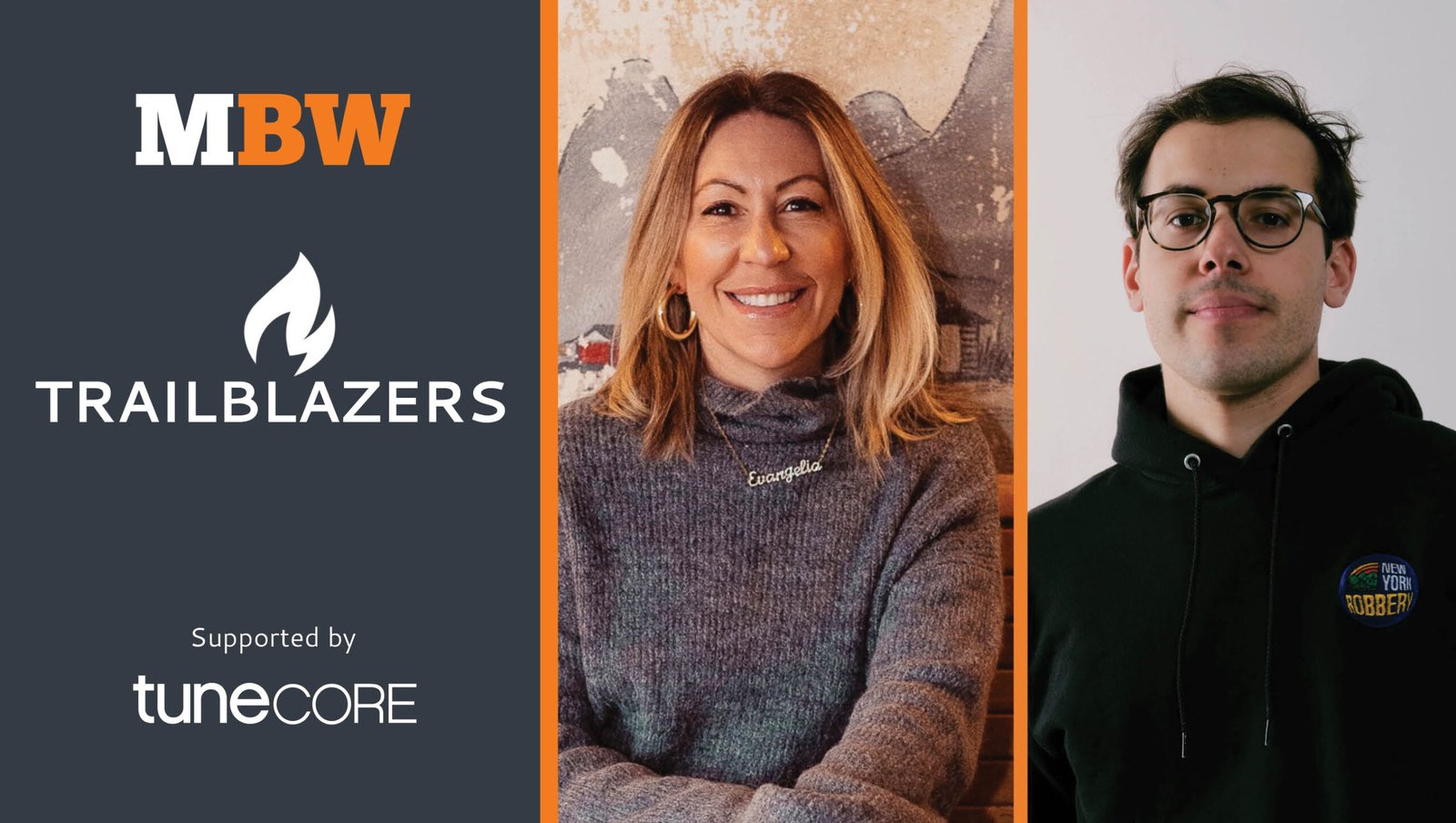
Trailblazers is an MBW interview series that turns the spotlight on music entrepreneurs with the potential to become the global business power players of tomorrow. This time, we meet Alternate Side Management founders Evange Livanos and Zack Zarrillo. Trailblazers is supported by TuneCore.
Alternate Side Management, which represents a string of acts in the alternative/rock space, is enjoying a purple patch as it closes in on a decade in business.
Michigan emo band Hot Mulligan have a busy summer playing many of this year’s major festivals, including Coachella, Governors Ball, and Bonnaroo; rock act Citizen are about to announce their biggest capacity show yet; and Cavetown recently co-headlined the 9,500-plus-capacity Red Rocks venue in Colorado.
The company has spent the last seven years carefully building out its clients’ careers by putting the grueling groundwork into touring, encouraging catalog ownership, and empowering acts to be the CEO of their businesses, according to founders Evange Livanos and Zack Zarrillo.
During that time, the Alternate Side team has grown to 12 team members in New York and Los Angeles (and in-between), who preside over in-house distribution, publishing, touring, marketing and vinyl production. Today, there are more than 30 clients on the roster, who have multiple platinum and gold singles between them.
The inspiration for Alternate Side originally came from Livanos, who left a job at a bigger management company to have more autonomy over the acts she worked with. “I wanted to represent artists that I believed in and loved, versus stuff that I was just handed,” she says. “This is a stressful job, so if I’m going to be stressed about it, I’d like it to be for stuff that gets me out of bed in the morning.”
After working for a few bands in the metal world at a time when post-hardcore was making a comeback, Livanos met Zarrillo, and the two started a working relationship that eventually led to launching the business.
Zarrillo, who says he never wanted to be a manager, fell into the music business via Chicago rock act Knuckle Puck. The band needed guidance, so a then 20-year-old Zarrillo, who had been running a punk blog and was looking for something to distract him from college, took on the task.
He remembers: “I had no idea what I was doing, but I did know Evange and she needed some help. I needed my band not to be poached from me, especially because they started doing well right away, and it seemed like a good opportunity to learn.”
Other highlights coming up this year and beyond for the Alternate Side roster include the continued development of Californian post-hardcore band Dayseeker; the sixth LP from Citizen; up-and-coming alt-pop duo Daisy Grenade; and the growth of British singer and songwriter Cavetown.
Here, we chat to Livanos and Zarrillo about dos and don’ts of artist management, the evolution of streaming, label deals in 2026, lessons learned across their careers, and much more besides.
WHAT’S YOUR APPROACH TO MANAGEMENT, AND HOW HAS THAT BEEN SHAPED?
Evange Livanos: What makes a good manager is your ability to be flexible, nimble, and bend to what each artist needs, because every artist is completely different. Some want to be signed, some don’t want to be signed. You have to know how to navigate the business.
Also, allowing an artist to be an artist, standing in front of them and taking the shots so they can go be creative and don’t have to know all of the ugly stuff around it. At the same time, we have the mantra of artists being business owners, understanding their business, and educating them.
We don’t believe in the dumb artist vibe where the manager just tells them what to do. We want to educate them to understand that owning their catalog and being a self-sufficient business is the most important thing. Being cheap on the road until you don’t need to be is very important, and we’ve made an entire company and living off of being scrappy from touring, to the point now where our bands are touring in buses, but they’re still very frugal and careful because we instill that in them very early on in their careers.
“We don’t believe in the dumb artist vibe where the manager just tells them what to do. We want to educate them to understand that owning their catalog and being a self-sufficient business is the most important thing.”
Evange Livanos
Zack Zarrillo: We’re a fiercely independent company. When Evange and I started doing this, the type of artists we were managing were never going to be on a major label. So we had to build up our core competencies as managers and as a company.
Our artists at the time could only make money if they were touring. Knuckle Puck, the first band I truly managed, got paid $150 a night for their first 30-day tour. They slept on floors, in Walmart parking lots, and made a ton of money. So I actually made money for the first-ever tour a client did, which is unheard of, because we were very resourceful and our clients are very resourceful.
We tend to struggle when we start managing an artist who is not willing to also roll up their sleeves to do the work. We want to find artists who want managers not to just make their life easier, which is partially what we should be doing, but who want to go that much further. That’s how we find success. We always tell artists that, at the end of the day, no one can care more than you. We also have to bring that same mentality to the job we do every day.
ACROSS THE EVOLUTION OF YOUR COMPANY, STREAMING HAS HUGELY INCREASED IN IMPORTANCE. IS THAT A BLESSING OR A CURSE FOR YOUR ROSTER, THE MAJORITY OF WHICH EXISTS IN THE ALTERNATIVE ROCK SPACE?
ZZ: It has completely reshaped our company, and we’re really proud of it. Our artists combined make seven figures a year from owning their own catalog or from owning chunks of their own catalog. We really believe that artists should own as much of their catalog as possible, but that’s not where the job ends; that’s where the job starts. We have to then make sure we are working for that catalog to be valuable for them, too.
I have a separate company called Many Hats that started to make sure we were getting the best distribution rates for our artists possible, so we could make vinyl for them and put it into retail stores, doing the bare minimum a label could do.
There were times when we had artists signed to a 50:50 deal with a label that spent $10,000 one time and then made 50% of the profit forever, which is egregious. We have bands like Hot Mulligan, who got their catalog back from a label that was delinquent in paying royalties.
The catalog for that band had been severely under-managed at retail in terms of vinyl, and now, the band’s catalog has sold nearly 100,000 pieces of vinyl.
THE OLD IDEA WAS THAT YOU WOULD SIGN AWAY YOUR CATALOG IN EXCHANGE FOR A MAJOR LABEL DEAL AND ALL THE BELLS AND WHISTLES THAT MIGHT COME AS PART OF THAT. WHAT IS THE ROLE OF A LABEL IN 2026? WHERE’S THE VALUE THERE?
EL: Financially, first and foremost. If you’re a developing act that doesn’t have the money to make the record they want to make, the label is going to be helpful with that. We’re pro-independent and pro-label, depending on the label’s effectiveness.
“We’re pro-independent and pro-label, depending on the label’s effectiveness.”
Evange Livanos
They can be a really useful partner and provide extra brains and ideas in the room when needed, but we don’t put all our weight on the label. We almost pretend that they don’t exist at certain times, go to them with our ideas, and do it collaboratively.
The label could be helpful if you want to go to the radio and take those bigger swings, but you have to be at a certain level to do that. I don’t think a label is extremely necessary for certain developing acts at this time, when it’s really just based on touring.
WHAT DOES A FAIR LABEL DEAL LOOK LIKE TO YOU?
EL: You get your masters back like a licensing deal, a decent amount up-front to make the record that you want, some marketing budget to do all the things you need to do to market that album. No 360 and allow the artist to be creative. We will refuse to do deals if we have to do the catalog, and we’ve actually just done that with an artist. We will never do master ownership deals ever again.
HOW OPEN ARE LABELS TO DOING DEALS LIKE THAT THESE DAYS?
ZZ: The funny thing is, the major labels are much more open to it than indie labels. Obviously, the major labels are never going to give up their Bruce Springsteen or Bob Dylan catalogs, so they always have money to hit. As someone who owns a label, I’m quite sympathetic to the desire to own masters, but I believe that it’s just not in the service of a good partnership.
We very much push for [licensing deals], but sometimes we have to recognize that we have to meet artists where they are and what’s important to them. If it is the most critical thing in the world for them to sign to indie label X and the deal is worse than major label Y or indie label Z, that’s okay. We don’t get to make every decision. But like Evange said, once we sign to a label, my desire is that our team works harder.
It isn’t that we let the label do everything. Artists often fail when you give up too much responsibility to others. We have to ultimately own every decision that gets made. Even if someone else messed up, we’re still managing the ship.
CAN YOU recall A FAILURE OR A SETBACK THAT BECAME A TURNING POINT IN HOW YOU OPERATE TODAY?
ZZ: We’ve had a lot of artists who have suffered from really hard mental health problems. There is nothing that will humble you quicker than some of those problems. The bullshit of the job often just stops mattering at that moment.
But it’s always the hardest, to me anyway, when an artist is doing really well, and something pops up that is not their fault, and it derails things. It’s tough because you don’t know when the train is going to get back on the tracks and you have tours, timelines, labels and investments.
HOW DO YOU NAVIGATE THAT AS A MANAGER? HOW DO YOU BEST SUPPORT YOUR ARTISTS THROUGH THAT WHILE KEEPING AN EYE ON THE BUSINESS?
ZZ: You have to stand in front of them in those moments. If there’s pressure from labels, booking agents, publishers, they never know about it. You take the shots, you deal with it, you help. Many artists find therapists, counseling, support, and rehab.
“HOPEFULLY, ALL MANAGERS REALLY CARE ABOUT THE PEOPLE, NOT JUST THE ARTIST AND THE BUSINESS.”
Hopefully, all managers really care about the people, not just the artist and the business. Our job does start and stop somewhere but, for better and maybe sometimes for worse, we are very invested in the people behind these bands and careers as well and are doing whatever we can to help get them right.
THERE ARE A LOT OF STRUCTURAL CHANGES HAPPENING ACROSS THE MUSIC BUSINESS AT THE MOMENT. WHAT IMPACT DO YOU SEE THAT HAVING, IF ANY, ON THE WIDER BUSINESS?
ZZ: There’s a lot of consolidation right now. If BMG does buy Concord [BMG and Concord have since confirmed their merger on April 28, 2026], they would essentially be a fourth major label, and I would like that. I would like there to be more competition against Warner, Sony, and Universal. To me, that’s exciting. It’s an interesting time right now. I’m not that pessimistic about it. There are a lot of smaller distributors that are offering really great deals for artists. Depending on the type of artist you are, there are more options than you’ve ever had before. I also think deals for majors have never been better.
HOW DO YOU SEE THE ROLE OF A MANAGER CONTINUING TO CHANGE OVER THE NEXT FIVE TO 10 YEARS?
EL: We’re going to become more and more needed. We do the job of a lot of facets of the business. We have to think like a label, a publisher, a booking agent, and we have to make sure all of those people are doing what they need to be doing. That’s just going to continue, especially if labels are consolidating and there’s no more street team or touring department, and you have to outsource everything. We have databases of videographers, photographers, and crew; we no longer rely on anyone for anything. More of the infrastructure is going to be reliant on the manager and a management company than the labels, as things start to change around.
EVANGE, YOU’VE SPOKEN BEFORE ABOUT THE IMPORTANCE OF TELLING ARTISTS NO. HOW DO YOU BALANCE THAT WITH RESPECTING THEIR AUTONOMY AND CREATIVE VISION?
EL: You have to explain the reasons why something is a no. It’s never, ‘You can’t do this’, it’s, ‘I don’t think this is a good move, and this is why, this is what can happen, let’s try something else instead’. When I was younger, I never went against what the artist wanted to do; the artist knew best because I was terrified of getting fired. But I’ve been fired plenty of times so I’m now at the point where I’m going to tell an artist exactly what they should and shouldn’t be doing for their business. It’s up to them if they want to listen.
WHAT ARE THE MOST COMMON MISTAKES THAT YOU SEE YOUNG MANAGERS MAKING?
ZZ: Good managers do research, try to solve a problem, and if they get stuck or want advice, they ask for help. Bad managers are arrogant, they don’t ask for help, and they can burn a lot of bridges quickly. It’s tough to have bad relationships in this business because people tend to stick around for a long time. It is shocking sometimes how someone will come back around that you haven’t spoken to for seven years and is now doing really well. Keeping good relationships is critical because having bad relationships affects your artists. If you’re compromised as a manager, they’re compromised as an artist.
WHAT ARE THE MOST IMPORTANT ELEMENTS OF SUCCESSFUL ARTIST DEVELOPMENT IN 2026?
EL: An artist really needs to know their identity, audience, and brand. They have to know how to speak to their fans. Part of artist development is knowing how to work social media to their advantage, to show off their songs, their personalities, and they have to be willing to grind, which didn’t change. You still have to get in the van, play the shows for low guarantees and not necessarily make a profit. It’s also important for artists to be determined, be smart about their business, and educate themselves about the industry.
YOU’VE SPOKEN A LOT ABOUT THE IMPORTANCE OF TOURING. IS THAT HOW YOU’RE SEEING YOUR NEW ARTISTS CONNECT WITH AUDIENCES IN A CROWDED MARKET?
ZZ: Touring becomes sustainable when artists can forge a direct connection with their audience. We’ve worked with artists who have had bright streaming/viral moments, but ultimately aren’t able to connect to an audience. If that can’t happen, you lose momentum.
We did quite well coming out of Covid because we were saying, ‘We’re only going to manage you if you’re going to go on the road and put the work in there. If you aren’t, we’re probably not the right person for you’.
A lot of younger managers who are new at this and working with someone whose song is going viral on TikTok often don’t know how to, or don’t want to, push their artists to get on the road. It almost always falls apart because there isn’t an actual connection. Fans are not wearing your merch; they’re not seeing other people feel and go through the same experience as them in a live environment. Touring is where our foundation lies, and that’s where the magic happens.
HAVING BUILT THAT INITIAL FOUNDATION, WHAT ARE THE FACTORS THAT THEN GO INTO BUILDING A SUSTAINABLE, LONG-TERM CAREER FOR AN ARTIST TODAY?
Evange: It starts and ends with the music, first and foremost. Touring and connecting with the fans, not just playing the show and leaving. When an artist is small, when they stay behind and meet every single fan that comes to a show, like in a 250 capacity room, those kids remember, and they come back.
I have an artist who has such a rabid fan base. It’s not large but he makes a great living because when he was starting out, he would meet every single fan at the end of the night. The venues hated us because we would constantly hit the curfew. Because of that, they stuck with him through all the different types of genre changes.
At the end of the day, how many one-hit wonders or fluffy songs do you hear? When I go to the gym, I’ll hear a song that’s super catchy, but who is this person, and who are they in five years? An important question we tend to ask ourselves is, ‘Does this artist we’re talking to or interested in have a future? Does it have staying power? Are we chasing it because everybody else is and it’s viral or does it really have stickiness?’ Songs that have meaning, that express anguish or a situation they’ve gone through, connect to an audience a lot more than a fluffy, fun dancing song, and are going to keep kids sticking around. It’s really important for artists to have substance to [their work].
“It starts and ends with the music.”
Evange Livanos
ZZ: A very boring answer on the other side is that we put a lot of work into making sure our artists, when possible, are in a good financial place. We have worked with artists who have done big deals and, unfortunately, have been irresponsible with their money. That makes it hard when times are maybe less good to get through to the other side. There are cycles in music. There’s a band in our world called Pierce The Veil that has been around for 20 years.
They got popular, the genre they are in got less popular, and they were in a lower place in their career for years. Now they’re playing arenas. Especially in our world, there’s a lot of ups and downs.
Can you ride it out for the up again? I’ve worked with artists since they were 15 or 16, and you’re kind of asking them to live in some version of arrested development forever. So it’s important that you’re educating and have good business managers or financial people around these artists who can help make them stable at home. That all affects the mental health aspect of this too.
HOW DO YOU FEEL ABOUT THE IMPACT OF AI ON THE MUSIC BUSINESS?
ZZ: I don’t have a lot of concern. There are aspects of AI that can help make our tasks better, and there’s definitely going to be bullshit that we have to deal with because of scams of our artists. I’m sure in the next year or two, there will be some very popular viral song that is totally made with AI. But I don’t think that’s ultimately going to take away the connection that a Cavetown, a Hot Mulligan, or a Citizen has to the thousands of people whose lives they’ve affected.
EL: I’m really against AI music taking up any playlisting spaces from a real, live, bleeding heart, creative individual, who is writing in their room at night. You’ve got these AI bots that are creating songs, putting them up online, and they get streams and make money. I hate that, it really makes me angry because it’s a scam. I love AI tools to help simplify our jobs. If an artist can get help with creating through AI, cool, but I’m so anti the AI-formed music that gets released.
IF YOU COULD CHANGE ONE THING ABOUT THE MUSIC INDUSTRY TODAY, WHAT WOULD IT BE AND WHY?
EL: I would have more women presidents running the industry. It’s still, like it or not, very male-dominated. That is just the way this business was built. It’s gotten a lot better, but I would like to see more women in power to change up the regime. We already know what it feels like and acts like when men are in charge. I’m not anti-man; my business partner is a guy, but I do think women see things differently, and the business could be softer.
“A lot of our artists would struggle less and be able to make better art and have a better life if, here in America, they had better support, healthcare, and systems.”
Zack Zarrillo
ZZ: I wish there were some better structure around the music industry, like there is in Hollywood, for example. The great thing about this industry is that you can start as an artist in your bedroom and have an amazing career, but the tough side is there are so many people, and we know many of them and have worked with many of them, who sleep on floors, cross the country or the world to get paid $200 to $400 a night with two to five people in the van or more. It’s quite grueling, and there’s no backstop.
A lot of our artists would struggle less and be able to make better art and have a better life if, here in America, they had better support, healthcare, and systems. It’s always funny to me when the Hollywood strikes are happening, which happen for good reasons that I’m totally sympathetic to, but at the same time, man, anything is better than what’s happening here, where there’s nothing.
Trailblazers is supported by TuneCore. TuneCore provides self-releasing artists with technology and services across distribution, publishing administration, and a range of promotional services. TuneCore is part of Believe.Music Business Worldwide