

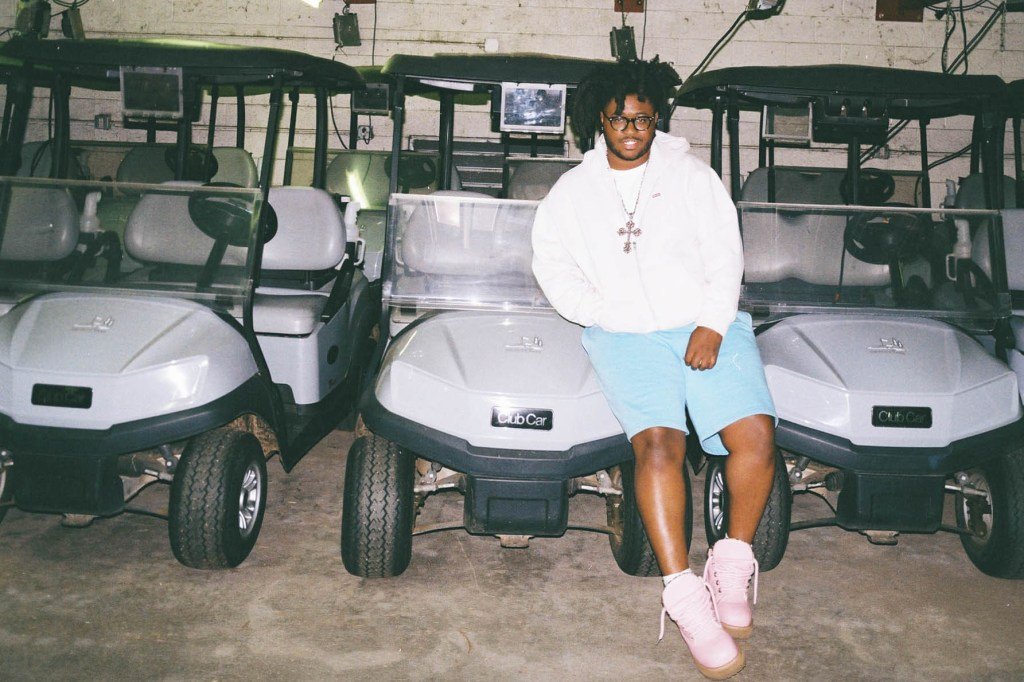
From the outside, it can look like BBYKOBE arrived overnight—a producer with a golden ear for basslines, a melodic instinct sharpened to a fine edge, and credits orbiting some of the biggest names in Hip-Hop. But the reality is far less sudden.
His story is rooted in persistence and an unshakable belief in sound as identity, and it’s one that’s carried the budding artist from sleeping on floors to shaping records at the highest level. Now, with his forthcoming mixtape Pussy Pink, BBYKOBE stands at a pivotal threshold: no longer emerging, but not yet fully crowned.
Originally born and raised in Detroit, his artistic DNA was shaped early in life. “I just always had a love for music. Everything that inspires me isn’t like an aesthetic, or it wasn’t like… some Pinterest board of Ideas of who I felt like I should be is all things that I actually have a love for.”
Despite calling Los Angeles home, BBYKOBE’s lyrical flair speaks to the flavor and influence of his birthplace. “We’re really punchline oriented because the way we talk, a lot of the time we talk more in the rap community than in the indie community because that’s how we rap,” he says. “We don’t really rap, it’s more like shit talking, but we make it rhyme.”
Graduating from high school after moving to Arizona, he forged a collaborative relationship with singer Trinidad Cardona, resulting in early production credits on the viral hits “Up + Down” and “Love Me Back.” In the wake of that success, it was Cardona who convinced the budding hitmaker to relocate to L.A.. It’s a decision he says paid off tenfold.
“I still wake up every day, and I’m so thankful that I get to do this. I get to make music. I was coming out here, and I was sleeping on the couch. I was sleeping on people’s floor ’cause of how bad I wanted this,” he shares. “Now, when I wake up in the morning, I’m in a house that I pay for, and I’ve got all the clothes that I want. I used to have one pair of shoes. One fucking pair of bum ass Air Force 1’s that I wore every single day. I haven’t worn Air Forces in like two years. Not because I don’t fuck with them, but I wore them so long, I never want to put them on again.”
That authenticity carries through his work—be it punchline-driven wordplay, producing for heavyweights like Kanye West, Travis Scott, The Weeknd, Don Toliver, and Playboi Carti, or lending his talent to chart-topping anthems, including Future & Metro Boomin’s “Like That.”
His technical identity is just as defined. “I feel like, as a producer, my trademark is my 808s and basslines. That’s one of the most important parts of the song. I’m not even going to use or finish the beat until I feel like that’s right.”
That duality—precision and vulnerability—anchors his next chapter. His Pussy Pink mixtape is an examination of taking the bitter with the sweet in life, an exchange he compares to toxic romantic relationships. “It’s the good and the bad of it, man. It’s like sometimes, you might want something so bad, and everything that comes with it is exactly what you wanted, but it also comes with a hell of a shit that you didn’t know came with it. That’s been like the whole ethos of the project. It’s the good and the bad of everything. I have had some of the best nights I’ve had in my entire life recently, but I’ve also had some of the worst. It’s just keeping them even.”
Recorded in Los Angeles, the Turks and Caicos, and France, KOBE credits the ambiance of each setting with dictating the mixtape’s production. “I was at the studio called Miraval, it’s Brad Pitt’s Studio. Benjamin Paulin (and Damien Quintard) did the interior design for it.”
That intention was evident in the creation of Pussy Pink. Led by the single “ERL,” inspired by fashion designer Eli Russell Linnetz, KOBE hopes the album keeps its luster decades from now. “I want it to be like a capsule of time, like a time capsule of my life right now. So that when I’m 40, 50 years old, I can look back and be like, ‘damn.’”
After getting a taste of fame and fortune, BBYKOBE is clear about his mission to build his following to stadium status. “The first concert I ever went to in my life was 22. I can’t go to anybody’s show now without this real deep sense of, ‘I really want to be on stage.’ I can’t wait until this is my show and I’ve got the crowd singing word for word. Like, that part was just… It’s like a driving force seeing it.”
For an artist who once waited for his number to be called, the game has changed. Now, BBYKOBE isn’t waiting. He’s building momentum and stepping into the spotlight he’s long envisioned.