


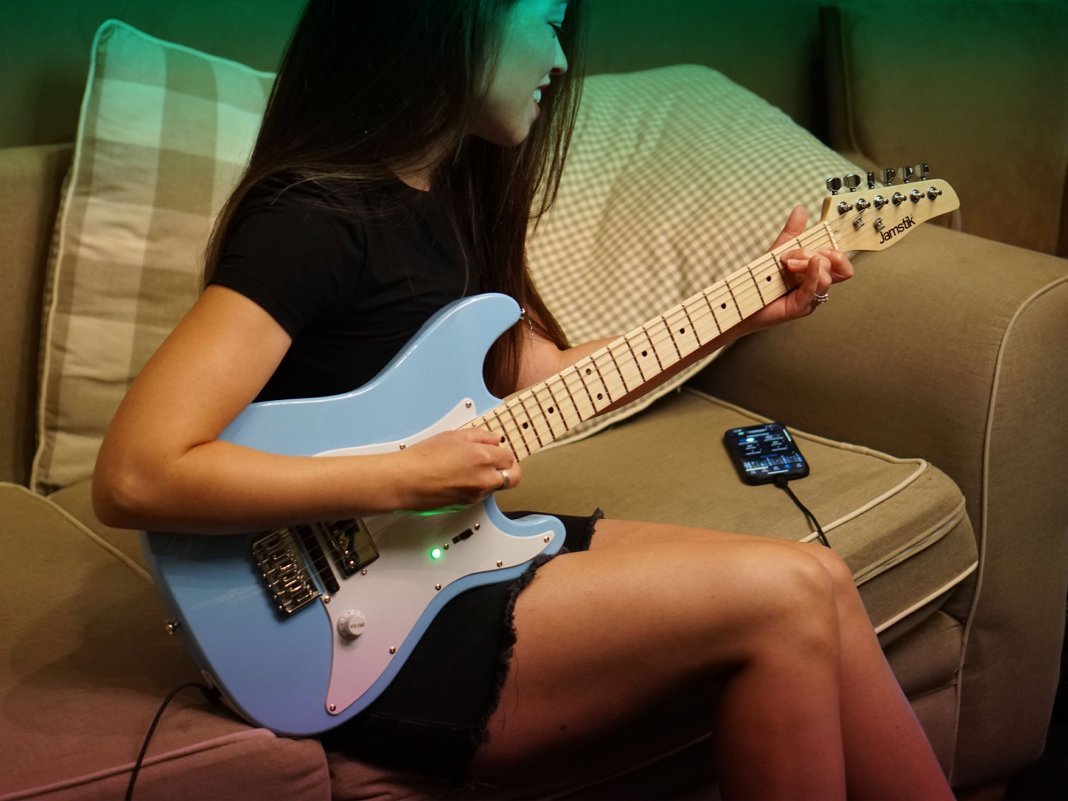
Ah, MIDI guitar. The promised land of unlimited six-string expression, but one that never quite delivered. From the space-age Roland G-707 to modern approaches like Fishman’s TriplePlay, many manufacturers have tried to translate the guitar’s familiar physical language into something a synth can understand. Few, however, have managed to deliver a solution convincing enough to stick.
Jamstik thinks the answer is integration. The Minneapolis company builds MIDI control into full-size guitars that still feel, play, and function like familiar six-strings. Except now, those strings can speak to synths, samplers, and DAWs.
Its latest model, the three-quarter-scale Jamstik Core, is its most affordable yet, but the bigger story is how Jamstik got here. To trace the company’s past, present, and future, I’m speaking with Meredith Gaslin, director of marketing, and Jon Keller, senior engineer.
Both play guitar, though they’re quick to decline the label of ‘shredder’. Meredith even learned her first few chords on the five-fret Jamstik+, a device that smashed its $50,000 Kickstarter goal with over $800,000 in backing in 2015.
Three years later, Jamstik crowdfunded seven-fret and 12-fret versions, but its ambitions were already outgrowing the compact controller: “It worked well for the original concept,” explains Meredith, “but it couldn’t fully capture the kinds of expression that experienced players expect from a professional instrument; things like vibrato, natural string decay, and the nuances of a real guitar performance.”

When Jon arrived in 2018 with a background in digital signal processing, the company’s focus shifted towards proprietary tracking algorithms that detected notes using an onboard hexaphonic pickup that output six discrete signals for independent processing — one from each guitar string.
Naturally, a new question arose: why keep building a controller that imitates a guitar when you could simply build the real thing instead? Two years later, the Jamstik Studio appeared: a compact, headless, MIDI-enabled guitar that unlocked the limitless world of synthesis by convincingly translating its fretted notes into ones and zeros.
The Jamstik Classic followed, a more traditional headstocked guitar with a Strat-style body incorporating the same detection tech as the Studio. In 2024, the lineup was refreshed again with the Standard and Deluxe models — though the team knew that getting more players on board would require a lower price of admission.
Enter the Jamstik Core, another crowdfunded success: “[The Core] is making the entire experience more affordable without compromising on the algorithms,” says Jon. “The tech inside is all the same [as the Standard and Deluxe], minus the battery and the Bluetooth because it helps cut the cost.”
At the other end of the spectrum is the Strandberg x Jamstik Chameleon, unveiled at NAMM 2026. Jon speaks enthusiastically about the sold-out collaboration: “It’s the best guitar we’ve put our tech into to date, by a long shot. Not only is the guitar itself better, but because the intonation is better and the action is better, it reflects in the tracking as well.”
The joint venture felt like a natural fit: “[Strandberg] are really innovative in the guitar community, and we felt we were innovators on the MIDI side of things,” explains Meredith. “It kind of came authentically when we met, from both sides.”
Through its ergonomic headless guitars, Strandberg has built a strong cachet with virtuosic players. Alongside the improved build quality of Jamstik’s newer models, the collaboration undoubtedly gave the platform more weight. Meredith smiles: “We’ve been able to turn a lot of the sceptics into supporters. The guitar community has vastly turned around from seeing Jamstik as a gimmick.”
MIDI guitar has been available for years, however, via Roland’s GK hex pickup and Fishman’s TriplePlay tech, both of which augment existing guitars. So what, exactly, is Jamstik’s pitch?
“It’s a fully integrated instrument from the ground up, so everything is optimised — the pickup placement, the electronics, the firmware, the processing,” says Meredith. “It results in more accurate tracking, lower latency, and a more natural playing experience.”
Jon puts it more simply: “Our algorithms are better at translating what you’re playing and tracking your pitch bends.” I ask him how it works, and he laughs: “It’s a lot of math.”
But accurate tracking only gets Jamstik to the starting line. Like a keyboard controller or MPC-style pad grid, it needs somewhere to send that data. The instrument may be a fully-fledged guitar — complete with humbuckers and a jack output for your amplifier — but its MIDI power depends on how easily it connects to the rest of your setup.
“Every Jamstik has a TRS MIDI out. There’s no proprietary 13-pin cable,” says Meredith. “We supply a TRS to five-pin adapter [with each guitar], and you can control any analogue hardware. We wanted it to be a plug-and-play experience that works with any gear you have.” Software is no trickier: “If you plug in via USB, you’ll see the Jamstik connected as you would any other controller.”
It goes deeper than pitch and velocity, too: “We’re the first MIDI guitar system that incorporates MPE,” Meredith continues. “Jon had some cool breakthroughs with his performance tracking, and we actually mapped the physical decay of the string to expression.”
The company has also built its own companion software for the instrument. Originally called Jamstik Creator, the app has now been reincarnated as Loon, a more fully-featured synthesizer that Jon describes as “a whole new sound engine, pretty much rewritten from the ground up.” It adds three layers per patch, multitimbral capabilities, and modular-style ‘blocks’ for more complex routing.
Meredith explains the name: “The loon is actually the state bird of Minnesota. We thought that was a nice callback to where we’re from, and the call of the loon is very widely known as resonant and eerie, reminiscent of soundscapes that a synth might produce.”
Loon’s arrival should draw fresh attention to Jamstik, but perhaps the most persuasive endorsement is seeing the instrument in the wild. The appetite for guitar-synth hybrids has grown substantially in recent years, helped along by players like Mk.gee and Dijon. While the former leans on a vintage Roland VG-8, the latter currently tours with an all-black Jamstik — a serious vote of confidence for the brand.
With musician uptake increasing and Loon now available, the company is already planning past the current lineup.
“We’re looking at a bass,” Meredith says, before adding, with an even balance of humour and sincerity: “We could probably do a MIDI ukulele. I don’t know how popular or needed that is, but stringed instruments with MIDI compatibility are in our wheelhouse.”
What about a hybrid synth/effects pedal that accepts both MIDI and jack input? A tentative smile appears on Meredith’s face: “It’s a fun idea, and it’s one that we often get requests for, especially from touring players.”
For now, Jamstik’s company size keeps its ambition tempered. “We’re about eight people full time,” Meredith says. “If one of those cool pedal makers said, ‘Hey, we should do something,’ we’ll take it into consideration.”
Meredith takes a moment to celebrate Jamstik’s decade-plus journey: “It’s always been our hope that we would put our tech into a premium guitar … We’re proud of how far we’ve come. I’m really proud of the build quality that we’ve been able to achieve with these newer models.”
And maybe that’s the point. MIDI guitar can offer all the sonic possibilities in the world, but guitarists will only embrace the technology if the instrument still feels immediate, familiar, and worth playing. The math can happen under the hood — but the guitar still has to feel like a guitar.

James is a freelance writer for MusicTech. You’ll often find him pushing plugins to their limits, skimming through the latest sample packs, or obsessively watching Rig Rundowns. With a background in live music, he also loves finding elegant solutions to complex problems — especially when it comes to gear.