


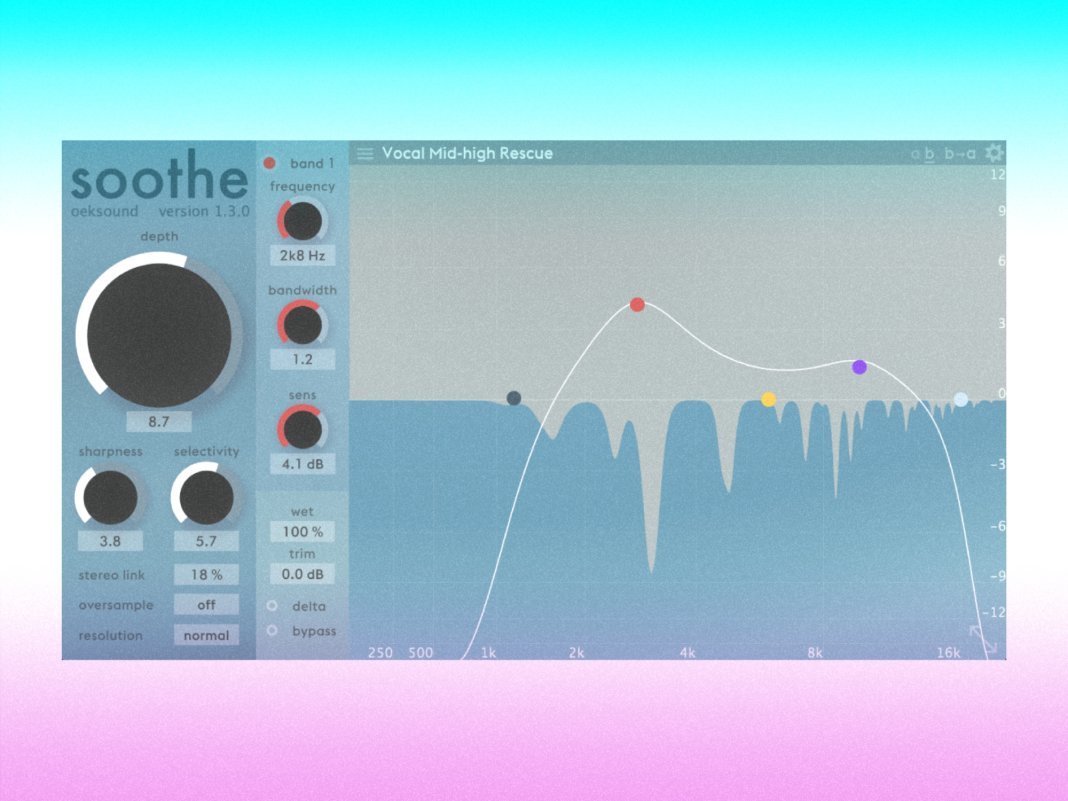
oeksound Soothe – a plugin that Skrillex once described as “so simple yet dynamic” – turns 10 this year. In that time, it’s gone from a niche problem-solver posted on Gearspace to a near-ubiquitous fixture in vocal chains, guitar buses and mastering sessions alike.
Originally developed by Finnish engineer and programmer Olli Keskinen, Soothe was born out of a desire to automate the painstaking, syllable-by-syllable EQ moves used by top mixing engineers.
Drawing on his background in digital signal processing, Keskinen designed Soothe as a dynamic resonance suppressor – similar to a de-esser or dynamic EQ, but far more adaptive in practice. Instead of applying static cuts, the plugin identifies problematic frequencies in real time and reduces them without flattening the surrounding tone, maintaining clarity.
As Keskinen explained in a 2017 interview, “Due to the chaotic radiation patterns of the instruments, and multiplied by the pickup patterns of the microphones, nastiness is likely to be present when sticking a microphone a few inches from a sound source. Soothe is at its best when used as the first line of defence to treat these problematic sound sources, saving the mixing engineer a lot of time and frustration trying to get the stuff to sit in the mix, especially with the lead parts.”
After gaining early traction on Gearspace, Soothe’s momentum accelerated when Grammy-winning producer Greg Wells – whose credits include Timbaland, Adele, and Katy Perry – publicly championed it.
“If the person praising you has clout, many people in our industry will start to believe in the product,” Keskinen later observed. “Wells did exactly what I developed the product for.”
For engineers deep in surgical EQ work, the appeal was obvious. Metal producer Dave Otero puts it bluntly: “I was already tackling this problem before Soothe came out, and spending too long doing these surgical cuts. And it’s just so much harder to do that when that task takes an hour. With Soothe, you can get there in the first one or two minutes.”
The 2020 release of Soothe2 refined the concept further, adding expanded controls while optimising CPU usage and latency. Mastering engineer Heba Kadry calls Soothe2 her “golden solution” because it “attenuates the issues while self-adjusting to whatever else is going on in the same frequency range sounds so natural” – even when working without access to stems or a multitrack.
Today, Soothe sits alongside pitch correction as one of those tools that has quietly embedded itself into modern workflows. And despite its near-ubiquity, oeksound says its focus hasn’t changed.
“Our mission is still the same as it was when oeksound was founded, even if our team is now bigger,” says Atte Karm, Marketing Director at oeksound. “We aim to create tools that solve real problems for audio professionals. Reliably good-sounding algorithms and an intuitive user interface are a must so that pros can work quickly, so they are deeply ingrained in our work.”
The company has since released other plugins including Soothe Live, which adapts the resonance suppression concept for live use; Bloom, an “adaptive tone shaper”; and Spiff, an “adaptive transient processor” that lets you cut or boost transients with great detail.
Learn more at oeksound.
Get the MusicTech newsletter
Get the latest news, reviews and tutorials to your inbox.