

£70 / £100, gforcesoftware.com
In 1978, an upstart American company called Sequential Circuits surprised the industry with the Prophet-5, a five-voice analogue polyphonic synthesizer that managed something no one had up to that point: programmable memory. Because of this, the instrument was soon on everyone’s radar. And thanks to an incredible sound that could magically fit into any mix, it found its way onto hit records by artists such as The Cars, Phil Collins, Michael Jackson, and many more.
The stature of Dave Smith’s Prophet-5 has only grown with time, graduating from coveted instrument of the day to bona fide classic. Like the Moog Minimoog, it’s become a synthesizer standard, a yardstick by which other instruments are measured. Because of this, it’s unsurprisingly been emulated in software many times, with big-name companies like Arturia and u-he all producing impressive takes on it. Now, you can add GForce Software to that list — with a twist. They’ve partnered with Sequential to create the first-ever official plugin version of the legendary instrument.
Does it live up to the Prophet name? Yes, and then some.

A Sequential Prophet-5 through and through
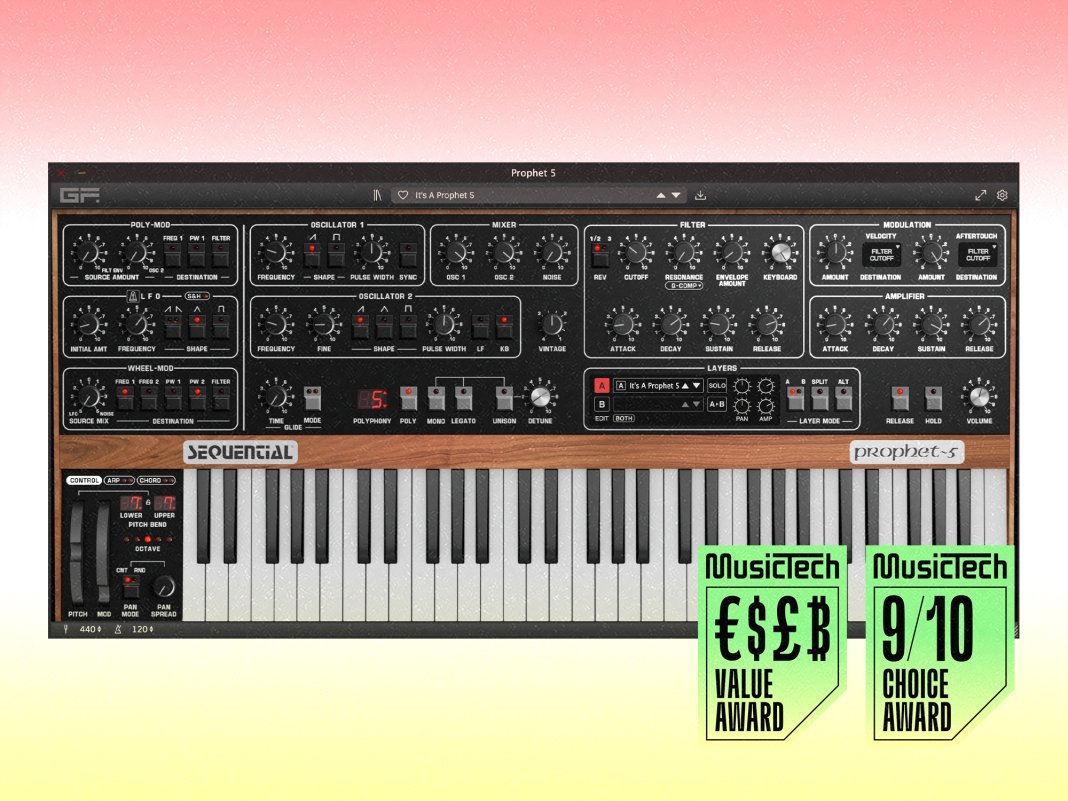
GForce Software’s Sequential Prophet-5 (to use the full name) doesn’t try to reinvent the wheel. It aims for authenticity, but with a few nods towards modern workflows.
All of the features of the 1978 original are present, such as the dual oscillators with simultaneous waveform selection, the ability to use Oscillator 2 as an additional LFO, and the Poly-Mod section, which lets you apply filter and frequency modulation to a variety of destinations. This can result in some pretty clangorous sounds, something put to excellent use by the band Japan on their Tin Drum album.
The Prophet-5 famously went through three revisions in its original run from 1978 to 1984, with Rev1 and Rev2 having SSM chips handling the 4-pole low-pass filter and envelopes, and Rev3 passing those duties over to more stable Curtis chips. Rather than choose one or the other, GForce has done what Sequential did when it re-released the Prophet-5 in 2020 and gone with both, with a Rev select button in the filter section. Both are powerful in their own way, with the SSM on the more analogue side and the Curtis a tad sharper.

What’s new in Sequential Prophet-5?
Although it seems the goal was not to go wild with new features — like with an Arturia emulation — GForce does provide enough new features to make the new Prophet emulation useful in a modern context.
While the original hardware only had five voices, this new take generously doles out 10 voices per layer. Yes, per layer. That’s the other big addition: this Prophet can do layers and splits, giving you essentially two Prophets in one go. Each layer is a unique instrument with its own presets, meaning you can use different revision settings on each layer.
Other new features include an arpeggiator, a chord generator with a lovely strum option, an effects section, full MPE compatibility, and GForce’s excellent X-Modifier section, which provides additional modulation control with an added visual component.

How does Sequential Prophet-5 sound?
Given GForce’s track record in making emulations of classic synths (including official Oberheim ones, which are also part of the Focusrite family), it’s no surprise that Prophet-5 sounds unbelievably good.
There’s a depth and richness to the sonics that will have you gasping with delight, and wondering how this can really be software. And, if it’s still not analogue enough for you, crank up the Vintage knob for extra smush and smear.
Although this new Prophet sounds amazing across most styles, it’s particularly bold in the bass department. There’s a reason that the monophonic Pro-One spin-off became one of the biggest bass synths of the early 80s, and all that low-end power is on full display here too. Set the voice mode to Mono, dial in the new Q-Comp on the filter resonance to preserve low frequencies, and get funkin’.

Do you really need another Prophet-5 emulation?
Chances are, your plugin folder already has a Prophet-5 emulation or two in it. Do you really need another one then? The short answer is yes, just because this new take sounds so bloody good.
The long answer is also yes, but with a few caveats. There’s very little that’s wrong with the software, although we would like to see a few small issues addressed. The arpeggiator and chord mode controls, for one, are minuscule, and with the grey text on black background, they’re almost impossible to see. The graphics displaying the different chorus and reverb modes could be easier to see as well. These are small points, though, and definitely things that could be addressed in future updates.
GForce Software’s Sequential Prophet-5 is a worthy emulation of the hardware original and a triumph of a software instrument. It’s also extremely affordable. A real winner.
Key features
- Officially developed in partnership with Sequential
- Both Rev1 & Rev2 SSM and Rev3 Curtis filter and envelope characteristic models are available
- Dual-layer architecture with Layer, Split and Alternate modes
- Up to 10 voices per layer
- Redesigned GForce Software X-Modifiers
- Two selectable effects slots with Chorus, Phaser, Filter, Distortion,
- Tremolo and Compressor, plus dedicated Delay, Reverb and Pan
- Spread effects
- Over 460 presets, including the original 1978 factory patches
- Independent arpeggiator and chord modes for each layer
- Full MPE compatibility
Get the MusicTech newsletter
Get the latest news, reviews and tutorials to your inbox.