

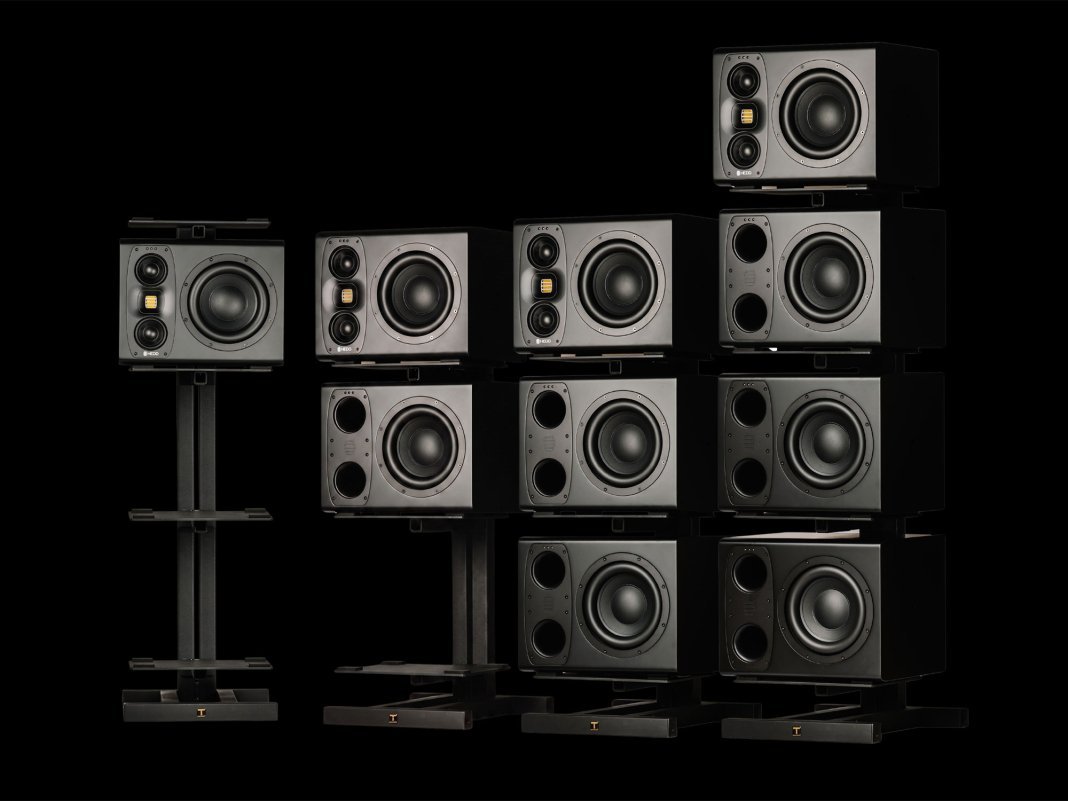
HEDD Audio has launched the TYPE 40 Main, a compact sealed three-way active monitor and the TYPE 40 System, a modular platform that lets studios add bass output and directional control by stacking XTD modules beneath it.
Aimed at mixing and mastering suites, post-production facilities and larger control rooms, the TYPE 40 is designed to offer full-range reference monitoring from a single cabinet, with no separate subwoofer. HEDD says its high-excursion woofer and sealed enclosure take the response down to 20 Hz and the Class D amplification delivers peak output of up to 123 dB SPL.
The company positions the system for studios that need more level, low-end reach and listening distance than nearfields can offer, but don’t have room for a traditional large-format main system.
Expandable bass
Each XTD module houses a 10 3⁄4-inch high-excursion woofer and a 700W Class D amplifier. Up to three can be installed under each Main. According to HEDD, three XTDs in Frontfire Ported mode raise the maximum SPL at 50 Hz by up to 15 dB compared with the Main alone.
The XTDs can be switched between Ported and Closed operation by fitting a special port cover. Ported mode favours efficiency and maximum output, while Closed mode prioritises low-frequency control, definition and resolution.
Cardioid control
Selectable Cardioid configurations are intended to cut energy radiating behind the speakers, reducing the rear-wall reflections that can muddy low end frequencies. HEDD says rearward radiation can be reduced by up to approximately 10 dB, depending on configuration.
A single Cardioid closed XTD provides directional control from roughly 20 to 200 Hz. In larger systems, Frontfire modules can be combined with a Cardioid module, adding output while controlling where the bass energy goes.
Design and control

The Main pairs two four-inch midrange drivers with HEDD’s hand-built Air Motion Transformer in a symmetrical D’Appolito MTM layout. The company says this gives a focused acoustic centre, an even horizontal listening window and a controlled vertical dispersion.
The Main and all connected XTDs operate as one time-aligned system. HEDD Lineariser offers three modes: ZERO PHASE, which corrects amplitude and phase response and aligns the system in time; FLAT, which keeps the frequency-response correction without phase linearisation and OFF, which gives the lowest latency for tracking and real-time performance.
Everything is managed through HEDD CTRL, which controls every Main and XTD over Ethernet. Once the physical configuration and XTD modes are chosen, the software applies the correct LF Range and Extension Qty settings automatically. Users can fine-tune the room with a 12-band parametric EQ at group and individual speaker level and save presets for different workflows, formats, clients or listening positions. HEDD says the software can handle anything from a stereo pair to an immersive installation of up to 250 speakers.
The Main can be placed horizontally on stands, built into soffits or installed with compatible mounting hardware. XTDs stack vertically beneath it, so the system can be fitted around consoles, screens and room architecture.
Pricing and availability
Both are available now through selected HEDD partners. The Main costs £5,999/$7,499/€6,999 per unit and the XTD £5,699/$6,999/€6,499 per unit.
For more information, visit hedd.audio.
Get the MusicTech newsletter
Get the latest news, reviews and tutorials to your inbox.