

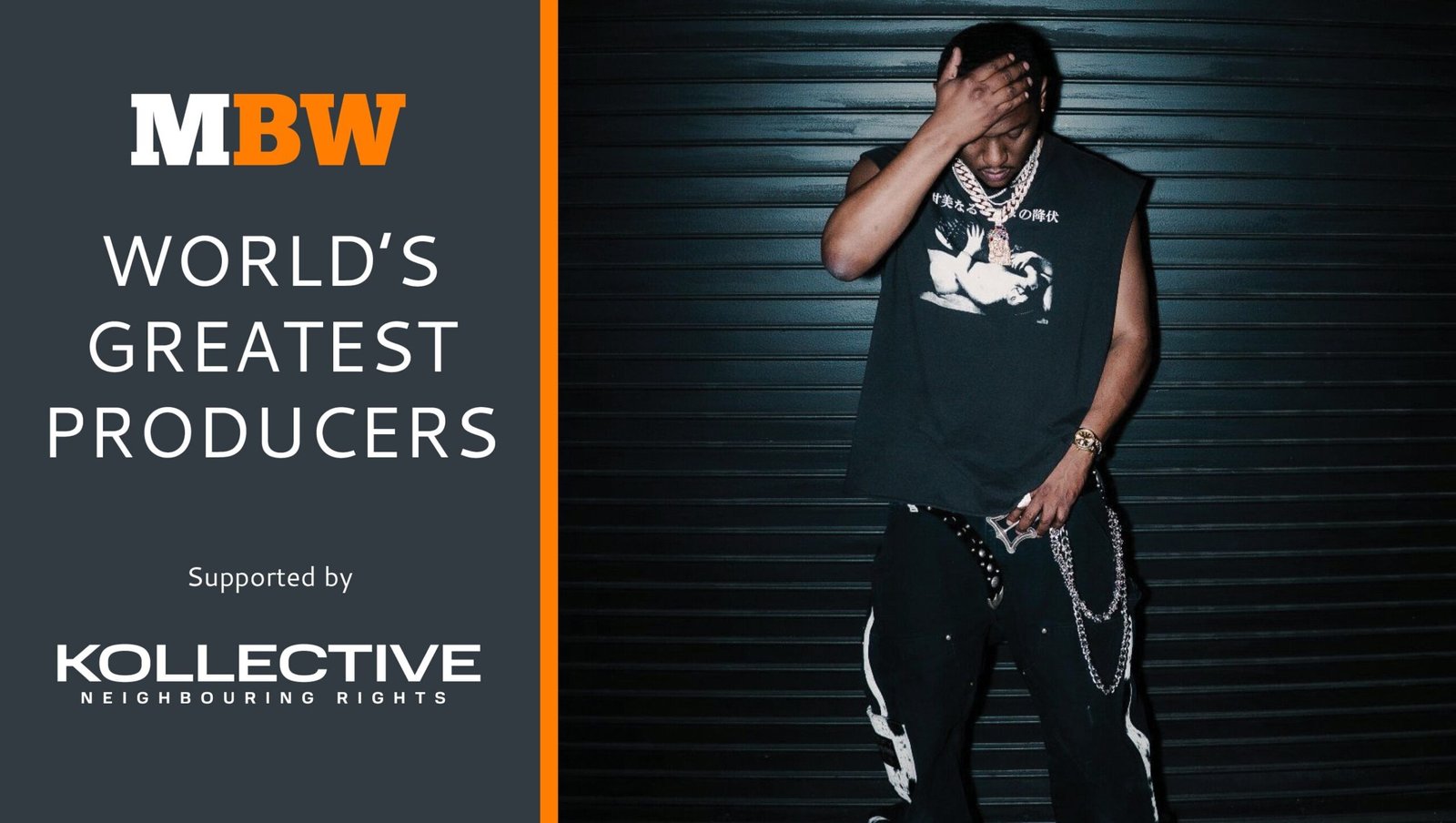
MBW’s World’s Greatest Producers series sees us interview – and celebrate – some of the outstanding talents working in studios across the decades. This time out, we meet Chauncey Alexander Hollis Jr., aka Hit-Boy, who has worked with hip-hop’s biggest superstars, from Travis Scott and Drake, to Jay Z & Kanye West, Beyoncé, Lil Wayne & Eminem, Kendrick Lamar, Nas and more. World’s Greatest Producers is supported by Kollective Neighbouring Rights, the neighbouring rights agent that empowers and equips clients with knowledge to fully maximise their earnings.

If you call yourself Hit-Boy, you’d better not miss.
And, thankfully, that has not been a problem of late for Chauncey Alexander Hollis Jr, now much better known by his ubiquitous producer name.
Hit-Boy has rewritten rap’s coding multiple times. And, while hip-hop innovation and chart success don’t always go hand-in-hand, he has also been on a generational run as a hitmaker.
From Travis Scott & Drake’s Sicko Mode to Jay Z & Kanye West’s Ni**as In Paris via Beyoncé’s Texas Hold ‘Em, Lil Wayne & Eminem’s Drop The World, Kendrick Lamar’s Backseat Freestyle, multiple classic Nas albums and songs by everyone from Ariana Grande to Doechii, Hit-Boy has always been nominative determinism in excelsis.
“I probably manifested that run with the name alone,” he chuckles. “I’m always excited to do this shit, especially when I’m truly inspired. Every time I throw, I’m like, ‘Damn, I’ve got new codes’. I feel like a new artist every day.”
“This is the new version of me, the free version. I’m thinking way clearer now.”
And, indeed, as well as his stellar production work, Hit-Boy’s next target is to conquer the rap world as an artist in his own right.
Young Chauncey actually started as a rapper growing up in Fontana, California, following in the footsteps of his uncle Rodney Benford (who had a successful music career in R&B group Troop) and father Big Hit (whose rap career was derailed by a lengthy jail term, then revived when he cut multiple projects with his son on release, although Hit Senior is now sadly back in jail).
Pretty soon, however, Hit-Boy “took so much liking to the beats” that he moved into production. After putting his work on MySpace, he was signed up by producer Polow Da Don, relocated to Atlanta and then moved to work in-house at Kanye West’s G.O.O.D Music, on his way to his current status as hip-hop’s hitmaker-in-chief.
Now, he’s spreading his own artistic wings. After stepping back from social media for the first half of 2025, he’s now everywhere: releasing both his collaborative high-concept Goldfish project with fellow super-producer The Alchemist (“We’ve been tapped in with each other for years, and we eventually knew we had to do a full-length together”) and the Yeast Talkin’ album with his long-time musical foil, Spank Nitti James (“We’ve done a lot of collaborations together, so it was only right that we united for a full tape”).
His much-touted solo album proper, SFTWRE UPDTE, is imminent.
“These projects showcase a different side of my artistry, as I continue to embrace my new creative freedom,” he says. “This is going to be the new version of me, the free version. I’m thinking way clearer right now, there’s so much that can be done still. Let’s get it started!”
And, indeed, while Hit-Boy’s interview technique is generally laidback to the point of almost being horizontal, he fizzes with enthusiasm at finally being able to fully embrace those future plans, even as a general distrust of the wider music industry simmers below the surface: on Goldfish’s God Is Great, he seems to take aim at being passed over – twice – for the Producer Of The Year Grammy (although he has won three times in rap categories), rapping: “I be on the cusp every fucking year/But my black skin won’t let me in the clear/Homie said I need to work with white artists to win at the Grammys”.
Despite such frustrations, however, the Hit-Boy just keeps on coming.
And today, basking in the sun in LA’s Toluca Lake neighborhood, the vibes are nothing but positive as he sits down with Music Business Worldwide to talk AI, Beyoncé, and the current state of hip-hop…
Why is your forthcoming solo record called SFTWRE UPDTE?
Because it’s updating my mind frame, my style, the way I move, everything I do, me being a parent, just trying to be a better dad.
Everything in my life, I want to do it the right way and, just like a computer, you’ve got to update yourself, get stronger and smarter, you’ve got to move better. That’s what the whole thing is about. And still improving the tech, even with the AI stuff.
Where do you stand on using AI?
It’s a new day, you’ve got to embrace it. It’s a tool, just something to have in the Rolodex that you can pull out when you need to use it.
I started making music through tech, using FL Studio, that’s the program I made all my hits on, I still use it to this day. That was frowned upon at first, people was like, ‘Yo FruityLoops, that’s like some little kids’ stuff’. But that turned into people like Boi-1da and myself making Top 10 and No.1 hits off of FL.
You’re not worried about AI stealing your sound?
It’s already here! So, I might as well see how I can utilize it and take my stuff to the next level.
Is making your own record very different to producing someone else’s?
Not really. I’m just looking for that feeling. Like, ‘Man, this shit feels great’. Whether I’m writing, producing, rapping, whatever, I just want to be excited about what I’m working on. I’m chasing that feeling more than anything.
Can your own records become as big as some of the records you’ve produced?
I’m not looking at it from that perspective. I used to have that perspective, but that messes with you mentally.
“I’m not pop, hip-hop, R&B or whatever; I just make beats. However they land, they land.”
I didn’t understand how this whole thing worked at first but now, I’m just doing straight art. If I can do this, I can just keep getting better. Wherever this shit goes, it’s a stepping stone to the next project.
So, will you do both production and artist stuff from now on?
I always have. I was never not recording my own music, there might just have been times where I didn’t have a whole thing together to put an album out.
I’m glad I was able to get around Kanye, Jay-Z, Beyoncé, all these people, and learn the type of artist I need to be and the level of greatness you’ve got to strive for and push for every single day. Every detail needs to be thought out – that’s what I didn’t realize at first but now I understand that.
Your first placement was with Jennifer Lopez. You must have thought being a producer was easy…
For sure. I always had confidence but, once I started getting in the game, I realized I had a lot more to learn. That made me be like, ‘I’ve got to stay level-headed and locked in’.
J-Lo was great, because those were the days when they made CDs. I used to go to Best Buy and open up the CD to show my Mom: ‘Look, it’s Jennifer Lopez with my name right here’ – that was the shit for me back in the day.
What did producing Ni**as In Paris do for your career?
That took me to that level where people had to respect what I had going. I ended up doing stuff for Kendrick Lamar, A$AP Rocky, they all reached out off of Paris, like, ‘We need some shit like that’.
I gave Rocky his first single, Goldie, the song he put out on his first major label album and then I did Backseat Freestyle for Kendrick – he [was] performing it on the GNX tour [last year], that shit still is the moment. The same with the Beyoncé songs. I give people exciting moments in their concerts.
But Ni**as In Paris – I’ve still never seen nothing where you could perform it 12 times in a row [as Jay-Z and Kanye West did at a gig in Paris in 2012] and nobody gets bored, people only get more excited. Paris was a different monster. Every time the song played back, they got more excited.
What was it like working with Jay-Z and Kanye on Watch The Throne?
That was something I never really saw coming. Before I was even making beats, I had a little radio and a shoebox full of CDs and I would play their music over and over, studying that shit, listening to it.
But I’ve got so much game, so much information and so much high-level intelligence, if I apply that shit, I’m going to go to that same stratosphere.
What did you learn from working in-house with Kanye?
Man, just how intense this shit can be, how you’ve got to go extra hard. He’s going too hard now, but, back then, when he was really focused and doing his thing, when he applies that same intensity in a proper manner, that’s why you get those great albums and great songs and stuff that pushes the envelope. You’ve got to really dial in.
Are you still in touch?
Nah, man. And it’s crazy because we used to bump heads a lot and I’d be taking it mad personal thinking like, ‘Damn, what’s wrong with me?’ While now, this guy doesn’t get along with too many people at all! I thought it was personal to me, but nah, he is just a certain type of guy.
I don’t talk to him, but I don’t have nothing against him. Shit, he gave me great opportunities, I was able to take it to new heights, so it’s all love on my side.
You also worked with both Kendrick and Drake. Where do you stand on the beef?
I watched both of them come up, I met Drake in ‘07 and Kendrick maybe in 2009, 2010. I watched both of them become superstars. It is what it is. I ride for Kendrick for sure, and I’ll just leave it at that.
You have a reputation for constantly updating your sound – how do you keep that up?
Just reinventing myself all the time. People are always looking for fresh sounds and that’s what I’m always trying to push myself towards, so they gravitate to me.
I had a moment where I tried to make stuff in that same Ni**as In Paris vein. I ended up making Bow Down/I Been On for Beyoncé and that was in that vein, just a little wackier, but she’s still performing that joint, it’s an exciting moment in her concert.
So I dabbled in it, but I realized that’s not what I do. I’m an originator, I’ve got to come fresh every time.
Do you always know when you’ve made a game-changing record?
Not really. I just cook. If it’s exciting to me and it sparks with the artist, that’s a W already – wherever it goes from there, let’s get it.
But you can never really call it – there’ll be songs you think are going to blow up and they don’t, and then the ones where you think, ‘This is whatever’ – and it goes crazy.
Is it very different working with a hip-hop legend like Nas versus a pop artist like Ariana?
It’s different, but it’s similar, it’s just getting ideas down and dialling in what the sound needs to be. It’s all just creating at the end of the day.
I started with J-Lo man, I always just look at it as music. I’m not pop, hip-hop, R&B or whatever, I just make beats. However they land, they land.
A lot of people have talked about hip-hop becoming less dominant on the charts. Where do you think it’s at as a genre?
It’s in a place where whoever does something out of the box and it connects, it’s going to be a good time for them.
There’s a lot of good music out there too, but the excitement hasn’t been there for a minute, where there’s something unbelievably undeniable. Somebody’s got to come up with it, so that’s an opportunity.
Are there other genres you’d like to work in?
Yeah, I’m down. I worked on Texas Hold ‘Em, so I’m locked in with the country already, I’m down to have more.
I’ve been on Beyoncé’s last few albums. She always includes me in some type of way – she’s dope as hell for that, and I’m appreciative. I tell people that shit is like hitting the lottery because [she does] every genre – rock, country, R&B, rap; every producer in the world is trying to get her beats. You’ve got to beat out every genre when you’re working with her.
How was it making a record with your dad when he got out of jail?
Truly emotional. He’s a real street dude – people say that [about other people], but his picture should be right there in the dictionary. He’s a serious guy in the streets.
I wanted to help break that mould and it was going good, but he couldn’t get out of his [own] ways, he got caught up in some stuff that was out of my control at that point.

It’s deep for real, but the music aspect was a good moment – I’ve been thinking about that since I was a kid like, ‘When my pops gets out, we’re going to make music, travel the world and do all this shit’ – and it really was happening, we were everywhere.
He was in the Not Like Us video with Kendrick, YG, all these West Coast legends showing respect to him and really rocking with my Dad. That was a moment man; it was an uphill battle but it was dope and he really started to cut through.
How do you feel about the music industry?
Overall, the game, the industry, is progressed. You see a lot of people getting money that wasn’t available back in the day, like kids streaming like crazy.
But producers don’t get the recognition and respect that we deserve a lot of the time. We’re literally half of the song, you can’t just remove the beat and play the acapella on the radio. We get disregarded in a lot of ways.
Kollective Neighbouring Rights is one of the largest and most efficient neighbouring rights agents in the world. KNR navigates a complex and detailed income stream whilst providing clients with unmatched transparency, monthly accounting and flexible statement solutions.
Music Business Worldwide