


Remute doesn’t make it easy for his listeners.
While the experienced German electronic producer has a few records out on streaming, he’s invested much of his output into classic gaming cartridges such as Nintendo 64, Sega Genesis, Atari Jaguar, and Game Boy. That means to hear the music, listeners need to track down one of these old systems.
He doesn’t make it easy on himself either, though. Every time he made music for these apparatuses, he had to learn a new tracker software, which he plainly describes as “absolutely not easy to use.” His expertise in Ableton Live and other DAWs wasn’t much help either.
“The philosophy of a tracker and the philosophy of a digital audio workstation are two worlds. They’re two languages,” Remute, real name Denis Karimani, says. “Everything has to be pre-planned, and every step has to be noted into the tracker.”
A tracker is akin to musical coding. Every piece of audio has to be placed in the exact right order for the music to sound as intended because the system is playing it in real time. Not playing back a recording. One offbeat element disrupts the entire piece.
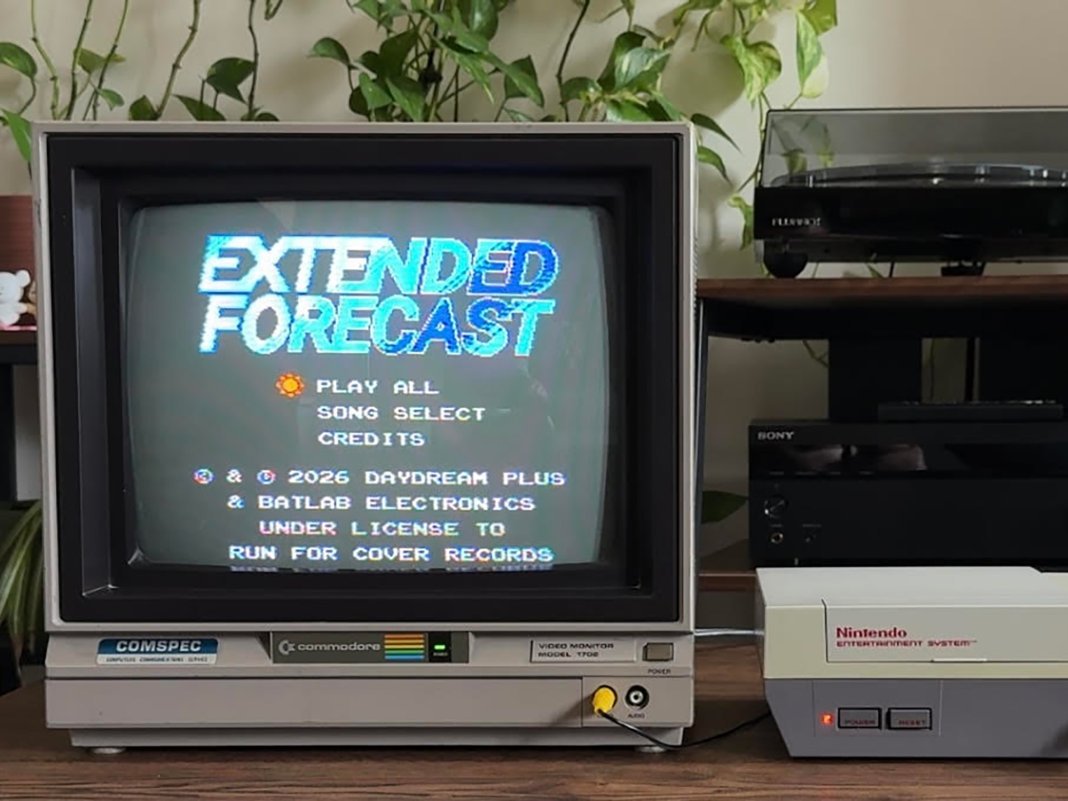
Payson Power, guitarist for the math rock band Daydream Plus, programmed a Nintendo Entertainment System (NES) cartridge version of their new album Second to Last Day of Summer alongside bassist Kevin Sia. The NES version is called Extended Forecast.

NES uses FamiTracker, which only has four monophonic channels, plus a fifth for samples. So, to emulate a guitar strum playing chords requires precise placement of each note and string.
He also had to apply different volume envelopes to all of the notes in the chord to get that descending quality, which meant six different instruments. One for each note. If a note is supposed to have an effect like an arpeggio or an envelope, users have to create a separate instrument with that instruction built in, which applies it to any root note.
So, if a user forgets to change the instrument and puts in a whole series of notes, all of them would have the same effect, and if that’s not what they wanted from the song, they would have to delete them all and replace them with the proper programming.
As a math rock band, Daydream Plus songs feature virtuosic solos with bass, drums, and guitar flexing technical skill all over each other. Of the five channels available on FamiTracker, the first two, pulse 1 and pulse 2, are lead and rhythm guitars, respectively. When the album had another treble instrument, like a trumpet or saxophone, Power used the pulse channels as well because they have four built-in pulse widths, V00-V03. The higher the width, the thicker the sound. He kept the guitar as thin as possible on V00 for clarity in the fast-moving passages. The horns were width V02 so they could have their own warmer timbre.
Sia took care of programming the bass, which was on the third channel, triangle. It is a triangle wave an octave below pulses 1 and 2. For the drums, Power either made the sounds himself or grabbed them from somewhere else. He sampled a snare from the first game in the stealth action franchise, Metal Gear, which he then mixed to fit in the wider soundscape.
In order to make sure everything was correct, Power wrote out every single instrument and note on lined paper, and then copied everything, line by line, into the FamiTracker. Furthermore, because the cartridge itself is old technology, any mistakes or unused commands could actually affect its ability to play back.
“It’s gotta flow perfectly, and if there’s any dead space, or if you don’t have enough space, there are hacks to get around it, but they can mess up the cartridge,” Power says. Those kinds of glitches weren’t an option. He wanted to put the cartridge in his NES and have it run like one of his old games. “It had to be 100% perfect. It was horrifying, but it was fun.”
Karimani shares the same sense of pride in being able to work with these different trackers.
“It’s totally not live music. It’s scripted music, and it’s a very different approach. These limitations really force you to think about your music in another way, because you have to simplify everything. When you simplify your idea, and it still sounds cool, then it’s interesting,” Karimani says. “When you finally learn to speak the language of a tracker, you have full control of everything. That made it quite interesting for me, because it’s always the thrill of learning something new.”
Both Power and Karimani developed their affection for video game soundtracks in their youth. Power grew up with now-legendary games on multiple systems such as Final Fantasy VII (PlayStation 1), Earthbound (Super Nintendo Entertainment System), and DuckTales (NES).

The title of the Daydream Plus album refers to the schooling years when he spent summers immersed in those digital worlds (and digital soundtracks). The second-to-last day was the last day of freedom before he had to start thinking about going back to school.
“I played DuckTales on NES every summer,” Power says. “The songs are just there in the background, going on loop, and man, [they’re] so good. I never get tired of them.”
Karimani discovered electronic music through the tunes in Sega Genesis games. One key reason for this is that the sound chip in the Genesis is a Yamaha FM synthesizer, and now FM is his favourite kind of synthesis to use in his own work.
“Everything sounded very digital. Very electronic. Like early techno music,” Karimani says. “The Sega Genesis really inspired me to be an electronic music artist.”
Karimani’s Genesis cartridge album, Technoptimistic (2019), used a tracker called DefleMask, which he calls the most advanced of all the trackers he’s used. It’s versatile because it can shift the UI to trackers for various systems, including the NES.
Within the Genesis editor, DefleMask is capable of polyphony on a single channel, and it captures the FM synthesis workflow within the software. When adding a new instrument, users can select from eight algorithms to direct the sound through different signal paths for four different oscillators, just like any other FM synthesizer.
Then, because each instrument can have four voices, there can be polyphony from two to four voices. Algorithm seven shifts from FM to additive synthesis because that algorithm has all four voices outputting together.
There is a certain level of irony in putting all this work into making these gaming cartridge releases. In the world of social media, where most people broadcast their creative efforts, the expected intention is to want more praise for what they built. However, by nature, only a very small number of people can truly enjoy these cartridges simply because so few of the systems remain functional.
And still, whenever Karimani puts out a new gaming release, he gets messages from fans who are seeking out one of the increasingly rare old-school gaming consoles because they want to hear his music in this unique presentation.
“This makes me really happy,” Karimani admits. “It’s an interesting path to hunt for the hardware to be able to listen to music. It makes the whole listening process more thrilling and more like an adventure.”

Harry Levin is a freelance journalist with credits in SPIN, Billboard, MusicTech, Grammy.com, Los Angeles Magazine, and more. His musical journey began 20 years ago with a Led Zeppelin CD. He played jazz trombone through college, produced large-scale electronic music events, and now spends his professional time writing and editing.