

There is a scene in the big-budget biopic Michael that perfectly encapsulates Michael Jackson’s historically unfathomable fame and crushing, fragile psyche. The Jacksons’ iron-fisted patriarch and personal manager, Joe Jackson, played by two-time Oscar nominee Colman Domingo, has just been faxed a termination letter from his soon-to-be King of Pop son. Papa Joe is beyond livid… like the get the belt!!! livid. As a viewer, your mind instantly jumps back to the pre-Jackson 5 brothers practicing in their living room in Gary, Indiana, in the 1960s. The same dedicated fire that pushes the ambitious steel mill worker to will his kids to superstardom (Hello, Encino, California mansion!) is disturbingly weaponized against a young Michael. Joe beats him.
“I own his ass from 9 to 5,” later says a dismissive Joe to the suits after he is informed that his gifted boy wants to go solo. Yet by late 1979, Michael (we will get to the transformative performance of MJ’s nephew-turned-a-star-is-born-actor Jaafar Jackson a bit later), who is now being mentored by a new, more supportive, hipper father figure, legendary producer Quincy Jones (Kendrick Sampson), is on a multiplatinum joy ride entitled Off The Wall and has already moved on. Papa Joe still thinks he’s in control. But he is suddenly hit with a dose of sobering reality. Joe looks outside the window and sees the resident giraffe, part of Michael’s wild menagerie of exotic pets, casually strolling by, and realizes he’s lost all power to a genius, Thriller-bound, sensitive 21-year-old. Yet Michael—the same young man who is so traumatized by the suffocating confines of childhood superstardom—is only able to make friends with animals.
But not even severe childhood trauma can stop Bubbles the Chimp’s eccentric ride-or-die supernova from becoming bigger than U.S. Steel. “You’re confident, you’re strong, you’re beautiful, you’re the greatest of all time,” a self-affirming Michael tells himself as if he’s preparing for war. Indeed, the level of global acclaim Jackson, who tragically died in 2009 at the untimely age of 50 due to acute propofol intoxication, achieves is unprecedented. Hell, not only is he one of the best-selling music acts ever with over 500 million albums sold and counting, Jackson is arguably the most famous person in modern history to ever walk the earth (sorry, Swifties).
And therein lies screenwriter John Logan’s and director Antoine Fuqua’s damn near insurmountable hurdle. Michael Joseph Jackson is biopic proof.

Lionsgate
The problem is, we all know the world-beating songs. We all know the iconic moves he unleashed during his landmark March 1983 performance of “Billie Jean” on the Motown 25 TV special by heart—glorious moonwalk and all (yes, MJ’s spectacular coronation as pop’s G.O.A.T. entertainer is re-enacted in the movie). We have obsessively memorized every frame of the “Beat It” video, down to our silver zipper, leather red jacket-clad hero uniting Crips and Bloods gang members in a show of peace, one of Michael’s standout sequences. We’ve all seen videos of the record-breaking Bad stadium tour, which was, at the time, the largest-grossing concert trek in history, pulling in $125 million in front of an unheard of 4.4 million screaming, fainting fans. Michael is already on pace to surpass Straight Outta Compton ($60.2 million) and Bohemian Rhapsody ($51 million) for the best opening by a biopic, with a projected domestic take of $75 to $95 million and a global haul of $150 million. MJ is a business, man.
So how do you make a can’t-miss box office smash about a universally well-known figure who is just as recognizable around the world as Mickey Mouse not boring? You take chances. That’s what Spike Lee did with his cinematic masterpiece Malcom X (1992), a film anchored by fearless, documentary-styled ferocity. Taylor Hackford’s Ray (2004) humanized the blind, loveable, perpetually smiling OG R&B giant Ray Charles (Jamie Foxx earned every inch of his gold statue) as a womanizing, heroin-abusing asshole who nearly loses his soul and family as he struggles to get clean. And Baz Luhrmann’s Elvis (2022) dropped its kitschy, hip-swiveling subject into a delirious fever dream that at the very least made its messy screenplay interesting.
Unlike Tina Turner’s enthralling, apex music biopic What’s Love Got to Do With It (1993), watching Michael is like witnessing a daredevil walk a tightrope while wearing a harness over a mammoth, inflatable bounce house. There’s never much to lose. Hollywood’s graveyard is filled with embarrassing biographical films that have turned great, intriguing talents into cardboard caricatures worthy of a laughably-scathing Walk Hard satire (thank you, Dewey Cox): Great Balls of Fire (Jerry Lee Lewis); Nina (Nina Simone); Back to Black (Amy Winhouse); All Eyez On Me(Tupac Shakur); and Jersey Boys (The Four Seasons), just to name a few.
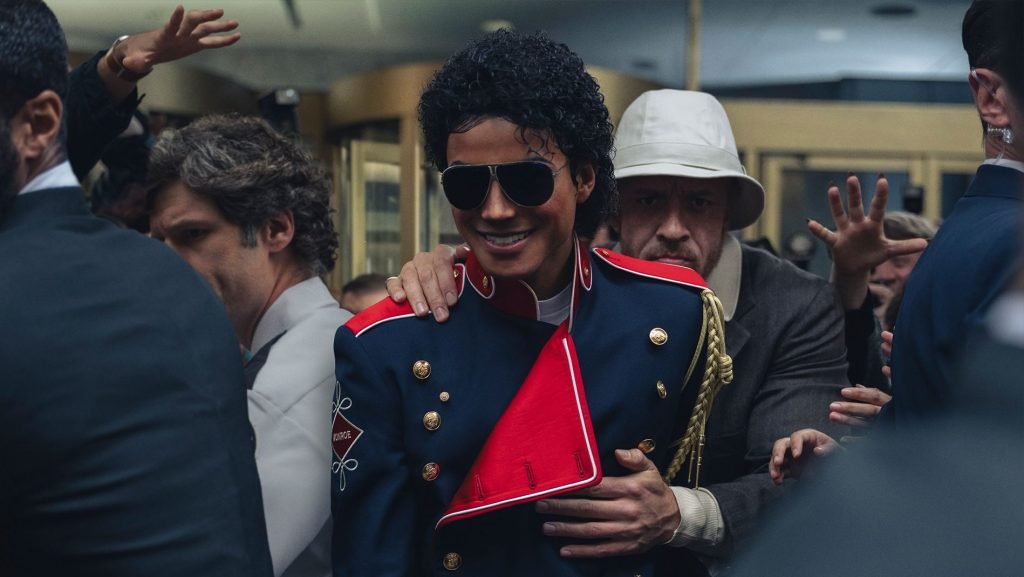
Yet while Michael thankfully doesn’t sink to those film’s atrocious depths, it struggles to fill its larger-than-life icon’s black Florsheim Como Imperial penny loafers. Don’t, however, blame Michael’s spinning dynamo, Jaafar Jackson, who gives a HOLY SHIT!!! performance that deserves Academy Awards consideration. Jaafar effortlessly channels his uncle’s speaking voice, dance moves, mannerisms, and childlike wonder.
Director Antoine Fuqua and Juliano Valdi as a young Michael Jackson.
Lionsgate
The best compliment you can pay to the 29-year-old Jackson is that you don’t know exactly where his singing begins and where it ends. And the same can be said for Juliano Valdi, who plays the 10-year-old, J5-era Mike (Michael music supervisor John Warhurst seamlessly blended both Jaafar’s and Valdi’s vocals with MJ’s original vocals). They both should be on Hollywood’s call sheet for the next 15 years.
And the criminally underrated Nia Long delivers a heart-on-the-sleeve performance as Jackson matriarch Katherine. Her quiet scenes with Jaafar bring much-needed emotional weight to Michael’s cliché-riddled script. The usually reliable Domingo, however, swings for the fences and hits a foul ball. At times, he’s so cartoonishly abhorrent as Joe Jackson (When Mike nearly dies from the infamous 1984 Pepsi commercial, pyrotechnic accident, his father is seemingly only concerned if his 3rd degree-burned, hospitalized son will be healthy enough to perform on the upcoming Victory tour) you almost expect him to tie Mike up to a train track and break out in a maniacal laughter as if he’s some over-the-top silent film villain.
Of course, MJ’s dedicated followers will have no issue with Michael’s View-Master “remember this???” highlight career achievement of a film that stands in the towering shadow of 1992’s Emmy-winning The Jacksons: An American Dream miniseries, a layered biography that actually humanizes the brothers and a flawed Joe Jackson, instead of relegating them to background fodder and evil taskmaster, respectively.
With Michael, we get a cinematic drive-by that quickly moves from the Jackson 5’s bubble gum soul ascension as pop chart toppers and MJ writing his infectious breakout solo hit “Don’t Stop ‘til You Get Enough” to the making of the most influential music video of all time, “Thriller,” before ending with the triumphant Bad era.
Janet Jackson (baby sis deserves her own biopic) declined to be included in the film. Scenes featuring the iconic Diana Ross (for years credited for “discovering” the Jackson 5 when it was actually blues legend Bobby Taylor) were ultimately nixed from the film. Eldest sister Rebbie is MIA. And there is no trace of the Jacksons group member Randy Jackson, who is seemingly erased from existence in Michael, possibly due to his complicated, Jerry Springer-like relationship with his older brother, Jaafar’s pops, and the film’s executive producer Jermaine Jackson.
There’s a hilarious (and telling) shoutout to MJ’s rival/peer Prince. And Michael Jackson’s former manager, John Branca, who also serves as co-executive producer, is laughably portrayed as the film’s white savior.
Colman Domingo as Joe Jackson in ‘Michael’ biopic.
As for the dancing, glittery-gloved elephant in the room, yes, Michael steers clear of the early ‘90s child sexual abuse allegations and the 2005 molestation trial in which Jackson was ultimately acquitted. Such a heavy, dark period in his life is better suited for a documentary than a popcorn-munching, two-hour-plus biopic (let’s see if critics who raised hell over the major omission had the same energy for Elvis, which skates over the rock and roll icon’s sexual relationship with 14-year-old future wife Priscilla Presley).
And while there’s talk that a Michael sequel is on the way, you almost want the heavy-handed Jackson estate that seems more concerned with portraying a fascinating, singular, and complicated human being as a saint to leave well enough alone. Michael essentially works as an earnest, PG-13-rated, dancing-in-the-theater-aisle, Rocky Horror Picture Show-esque sing-along amongst the kind of hardcore MJ fans who know that “Remember The Time” is better than “Bad.”
Besides, the true story of Michael Jackson’s game-changing musical journey goes way deeper than the hits. In the film’s most riveting scene, the future King of Pop walks into the offices of CBS Records and defiantly tells a group of white executives that he will not be sent “to the back of the bus,” a reference to the Jim Crow segregation laws in which Black folks were treated as third-class citizens.
Imagine Michael doing a deeper dive on the uncharted journey of a Black artist who conquered a racially rigged music business, which for years deemed Frank Sinatra, the aforementioned Elvis, and the Beatles its unimpeachable white patron saints.
How gangster is that?