

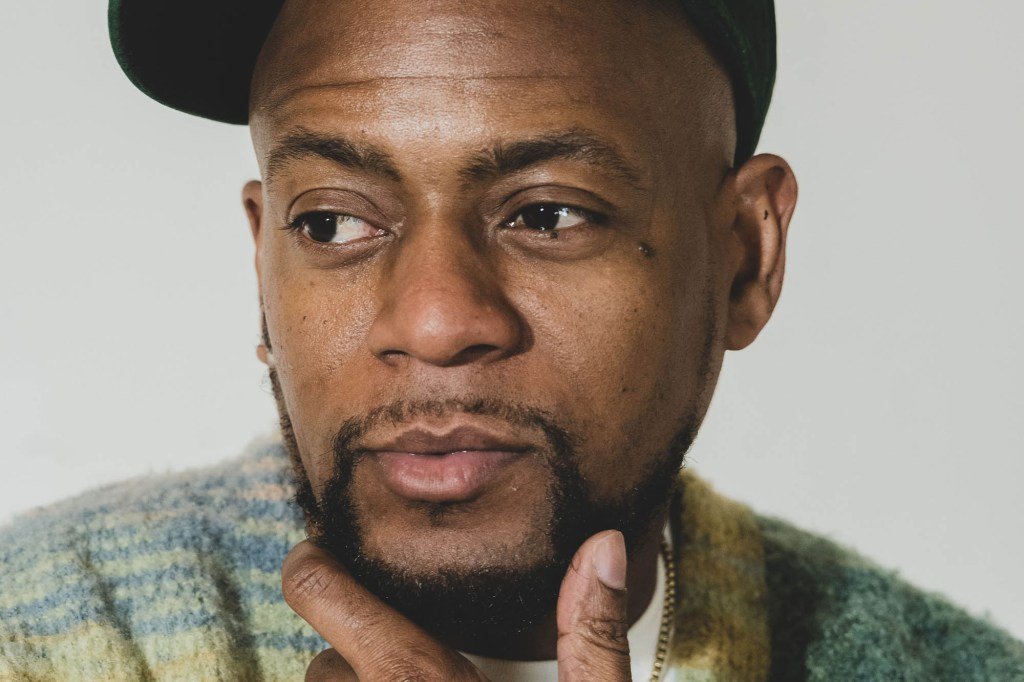
Remember the time Cam’ron nearly got into a fight with Laurence Fishburne at the airport? Or Fat Joe robbed 70 kids in his high school gym? No? Well, don’t worry — Mr. Commodore is here to reenact them for you.
Tyhem Commodore had a rebellious streak that got him in trouble while growing up in Spanish Harlem. Black, Puerto Rican, and Trinidadian,” his heritage and inner-city upbringing immersed him in intersecting cultures, providing a distinct perspective on life, particularly in a neighborhood where varying traditions, sounds, and personalities converge.
“The best of both worlds,” Mr. Commodore says of his ethnic makeup. “Being Black and Puerto Rican is the best thing you could ever experience. Especially in the hood. It’s beautiful.”
Long before comedy became his calling, he was known for a temperament that frequently landed him in trouble. On his Spanish side, he recalls, people called him “Diablo,” a nickname that captured his rebellious streak. “They used to call me Diablo on my Spanish side. Like I was crazy. I was in a lot of trouble. Before I became an actor-comedian, I was in and out of jail. I was in the streets a lot.”
His first arrest came when he was barely a teenager, and scrapes with the law continued into adulthood. “I got locked up when I was 11, 12, 13. I got locked up when I was 16,” he recalls. Education offered another possible route forward, although it proved difficult to separate himself from the street life that had become familiar. After earning his high school diploma, he attended Sullivan Community College in Loch Sheldrake, New York, for one semester. He remembers the experience fondly, even if his academic record was limited. “It was one of my best experiences, but I didn’t do nothing. I got one credit. People were knocking on my classroom door so I could sell them weed.”
When college ended, he returned to the streets, balancing stints in artist management and retail with his illicit dealings. “Even when I sold drugs, I still went to work. Worked in McDonald’s, sold crack. Worked in McDonald’s, sold dope.”
A narcotics trafficking charge forced him to reconsider his path — and redirect all that energy. “After I caught a serious charge, I was done. Probation, all that. Knocked it out, got my papers, I’m good. No more jail for me.” After buying an HD Flip camera in 2011, he began making YouTube videos, drawing on his love of hip-hop—its personalities, language, and storytelling traditions—for material.

He wrote, filmed, and edited his own sketches, frequently working alone and positioning a camera on a tripod to capture performances. Unlike today’s creators, who can record and publish directly from their phones, he had to transfer footage to a hard drive and learn the technical side of production himself. The process demanded patience, resourcefulness, and a willingness to teach himself skills that would later prove invaluable in filmmaking.
Over the years, Facebook, Instagram, YouTube, and the short-lived Vine platform helped him refine his approach. Vine’s six-second format, in particular, taught him to capture attention immediately. “In the first six seconds, make people stay there,” he explains. That discipline continues to inform his comedy, which has evolved from short-form sketches into more elaborate reenactments, layered storytelling, and performances featuring multiple characters.
His first stand-up appearance came in 2012, and he remembers it as a nerve-racking introduction to the stage. “It was horrible. I was scared.” Armed with a wired microphone, he moved around so frantically that the cord wrapped around him. Nevertheless, he managed to make the audience laugh for three of his five minutes, winning them back before his set ended.
The experience taught him that social media popularity does not automatically translate into stagecraft. “If you’re going on stage, always have something to say,” he explains. “You can’t go up there and do what you do on social media. It’s a big difference. You’ve definitely got to have some material.” That distinction reflects his growing understanding of comedy as a discipline rather than simply an extension of his personality.
For years, he balanced that ambition with a career as a special patrolman and security guard, a position he held for approximately 15 or 16 years. The job provided stability, union membership, and benefits, but it also restricted his ability to accept opportunities. While bookings came in from different cities and countries, he repeatedly declined because of his work schedule. In 2019, he was fired for attendance issues, a development he now views as an unexpected turning point.
“I always say God fired me,” he says. “It was time for me to go. I was holding myself back.”
The decision to pursue entertainment more seriously did not eliminate financial uncertainty. Supporting a family while building a creative career means navigating inconsistent income, distractions, and the pressure to remain productive even when opportunities are scarce. “It’s still a struggle every day,” he admits. “You’re not getting paid sometimes.” His response, however, is grounded in faith, persistence, and an understanding that creative success requires continued sacrifice.
That perspective also informs his relationship with fame. He quickly distinguishes public recognition from financial prosperity, noting that being recognizable does not necessarily mean being wealthy. “You could be popular and famous, but it’s not the same as a bank account.” Despite having caught the attention of rap stars like Busta Rhymes, Fabolous, Jim Jones, Lil’ Kim, and, yes, Fat Joe through his independent shorts and Instagram clips, he still rides the train, takes the bus, and shops at Target and Walmart.

An introduction to 50 Cent courtesy of Tony Yayo led to a role in 50’s ABC drama For Life in 2020, allowing him to push his talent in a new direction. “The first person who reached out was Tony Yayo,” Mr. Commodore recalls. “He was telling me 50 is on to me. I was in Atlanta and Yayo hit me. I thought they were in Atlanta. He was like, ‘Nah, 50’s talking about you at the office.’ Then, I got invited to Tycoon Weekend, and met 50.”
According to Mr. Commodore, that ascension was aided by his comedic collaborators: Trendy Topic Tiff and his wife, Ms. Emanuel, whom he met on the set of his independent digital series One2Four.
“With Trending Topic Tiff, she was consistent. She was working with my boy Moe (Moise Verneau) from Money & Violence. I met her one day when I was with Moe, and she was like, “I want to work with you.” She’s from Jersey City. She used to come to Harlem in 2018; we started working, introduced my wife, and they became best friends. She stole my friend. I was working with Tiff consistently, bringing her to Harlem, and they started clicking, and then you have it. Tiff and Tiff.”
So what’s next for him in entertainment? Everything. “I think the game is missing myself,” Commodore jokingly boasts. “It needs to see more of me.”
And his ambitions extend beyond viral moments and sold-out performances. He wants to direct, produce, and write his own movies, build a network, and create opportunities that will outlast his time in the spotlight. “I want people to make sure they enjoy my labor and my labor is passed on,” he says. His vision of success is therefore inseparable from legacy: providing for his family, preserving his creative output, and ensuring that his work continues to reach audiences for generations.
When asked what he hopes to contribute to comedy and culture, he offers an answer that is as direct as his performances. “Myself. I think me adding myself is enough. I think the game is missing that. As we speak right now, the game is missing me. It needs to see more of me.”