


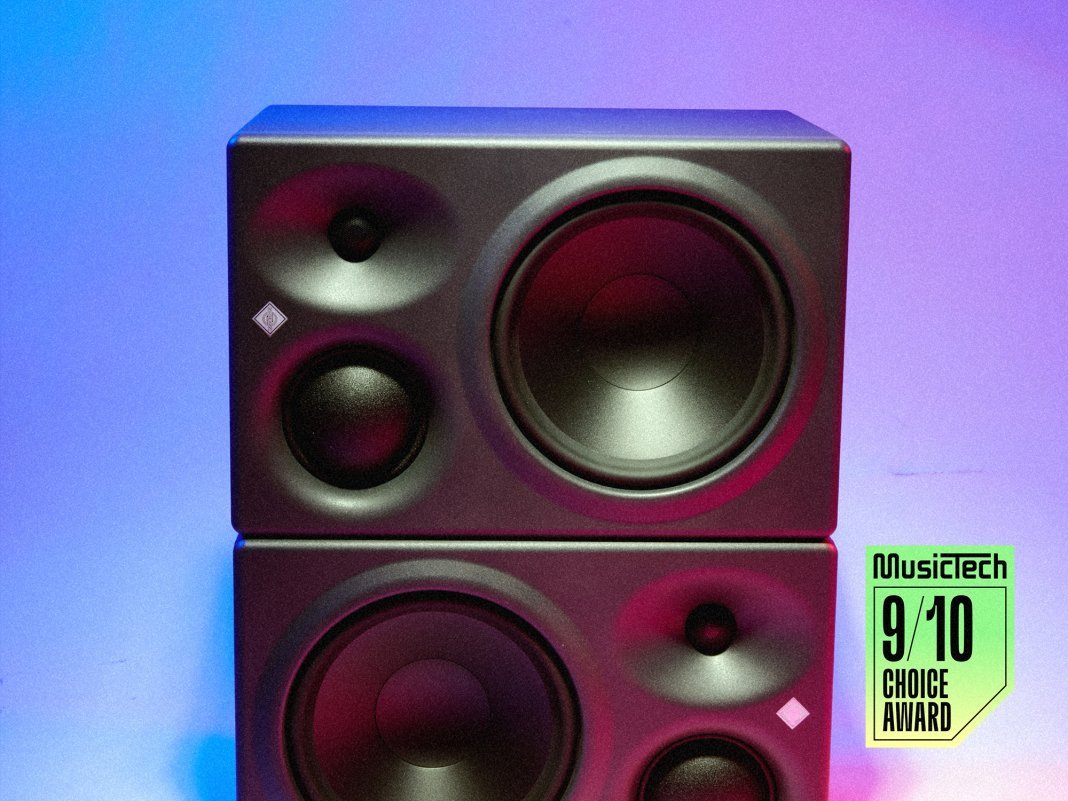
£4,800 per pair (street)
£279 MA1 room measurement mic kit
neumann.com
I’ve been on the hunt for the perfect sub-£5,000 pair of three-way monitors for a few years now.
I’m looking for low levels of distortion, decent bass extension, expansive mids, highs that aren’t too harsh, and a not-so-hefty physical footprint. And room correction is also important in my studio space, which is most effective and convenient when EQ profiles can be hosted on the monitors’ DSP for set-and-forget, low-latency operation.
I’ve tested various other three-way monitors in my quest. Adam’s A8H (£2,500 a pair, street) impress with their keen pricing, integrated Sonarworks, big woofers and ribbon tweeters. HEDD’s Type 20 mk II are a step up in price—and also sound quality— at £3,400 per pair, offering open and closed port options and phase linearisation DSP, but there’s no room correction, and the DSP introduces a sizable latency. A more recent release, Palmer’s (£1,500 per pair) coaxial-driven Orbit 11s are great-sounding, affordable and compact, with a convenient cardioid response but lacking poise in the treble.
All these monitors are really compelling, but they don’t quite tick all my boxes.
Enter Neumann’s new KH 310 II, and now we’re talking. Plenty of headroom, deep yet controlled bass, and sublime sound throughout the frequency range. These stand out as the most impressive monitors in their price range.

What’s new in mark 2?
The woofer is a new design, but otherwise the KH 310 II driver spec is very similar to before: an 8 1.4-inch woofer combined with a dedicated three-inch domed mid driver and one-inch tweeter. There are now more powerful amps, giving increased level before the onset of distortion; always welcome when undertaking critical listening.
The stand-out tweak is to digital signal processing. In the previous iteration, KH310 owners had to pair them with one of Neumann’s pricey DSP-based subwoofers in order to use the brand’s MA1 alignment and correction processes. KH310 II however has DSP on board, which means you control the monitors over a network and store room EQ profiles directly to the monitors. This is a big deal. Another benefit is having a digital (AES-3id) input as well as the usual XLR analogue in, which allows a noise-free connection to the monitors and daisy-chaining to avoid clutter in the studio.
Get aligned with Neumann MA1
If you’re so inclined, you could just plug into the analogue inputs, tweaking the on-board filter switches according to taste and placement within your room.
I want more control than this and don’t want to be constantly disappearing behind my busy desk to adjust filter switches, so I decide to embrace the digital world. I download a copy of Neumann’s MA1 software and cobble together a small network by connecting the two monitors and my computer to a cheap switch with ethernet cables. Although MA1 works with either input, I choose the digital in to free-up two additional analogue outs on my interface for routing to outboard gear. I also grab a 75-Ohm RCA to BNC cable to connect to the S/PDIF out on my audio interface, and then chain the two monitors with a further BNC cable to access the digital input on the second one. This all sounds complex and expensive, but in reality it’s less than £20 extra spend and no networking knowledge is required.
Without paying an extra £279 for a measurement mic kit, which unlocks the room EQ element of MA1, you can still do useful stuff in the software, including updating firmware across the network, customising the logo LED brightness and controlling auto standby, but it’s when MA1 corrects for room deficiencies that you really hear what the monitors can do.
Just like other room correction software, there’s an automated process where you follow instructions to place the mic at various positions and heights in the room. Once measured, you can tweak the target curve (I favour a warmer curve with slightly more bass and less treble) and then load the corrective EQ profile into the monitor’s DSP. From then on, it works independently of the software and you could even disconnect the network.
MA1 works brilliantly to counteract the deficiencies of the listening environment. I compare directly with another well-known brand and the results are night and day. The MA1 profile is natural and tightens up the bass and low-mids in the room so that everything sounds just right. In comparison, the other brand’s correction carves more aggressively at the frequency response. Tight integration between the DSP and the hardware itself really pays off.

What does Neumann’s KH310 II sound like?
Rosé and Bruno Mars’ earworm APT oozes multi-layered detail, from the acoustic depth of the mono drum kit in a rock-solid phantom centre, to the articulate transients of acoustic guitars, whose wide opposite panning is emphasised by the physical tweeter placement. High mids are comfortable yet not recessed. Further down the range, I can differentiate all the layers of stacked synths even when things become really busy, never seeming to reach the limits of clean headroom, while bass elements remain punchy and tight due to the closed design of the monitor. Granted, the bass doesn’t rattle your internal organs—you’d add a subwoofer for that—but there’s no port chuff, and the build-up of low-frequency resonances in the room is less out of control than with ported monitors.
Next is In The Sound of Breathing from Ólafur Arnalds’ Sages project, and I’m immediately floored by the quality of centre placement and tone of the sonorous lead vocals. The gradually-opening low pass filter on the synth riff combined with cinematic orchestra strings and the lyrical vocal is almost too much to bear, because it’s just SO good on the KH 310s. It’s immensely beautiful, chaotic, but always perfectly poised. I’m compelled to listen again, and again.
In K-pop land, Twice’s playful Strategy shows off further the resolution and wideness of stereo imaging and joyful bass articulation. And I love the treble response – most monitors would sound harsh with this bright a mix.
Listening to Raye’s Joy reveals stacked vocals that compete with melodic brass layers without anything becoming blurry or getting masked. And there’s just the right amount of weight to the retro-sounding kick, for a realistic, in-room experience. There’s impressive detail in the multitude of reverb and delay tails.
Despite a considerable price difference, I compare the new KH 310s to the Palmer Orbit 11s I have on loan. The Orbits have dual eight-inch multiple woofers but seem no more subby than the 310s. Bass articulation is similarly impressive for both but it’s the high mids and treble where differences start to show, with the Orbits sounding a touch boxy in the mids and slightly harsh right at the top. Respective room correction algorithms—MA1 on the Neumanns and Sonarworks on the Palmers—only make these differences more apparent. Neumann has done a great job with MA1; the correction simply sounds natural and ‘right’, without any phenomenon of it sounding either thin or brittle once it’s switched on. Both sets of monitors have some self-noise that’s audible with your ear pressed to the tweeter, but not irksome in daily use.
Should I buy a pair of KH 310 II?
The KH 310 II is a consummate all-rounder that has wowed me. It has plenty of power (and bass) to impress clients while tracking, but also supreme accuracy for mixing and mastering jobs without ever sounding flat or boring. Digital inputs and network control are a really worthy improvement to the previous 310 and make life easier.
Contrary to popular wisdom, these monitors work fine in smaller studio spaces while you yearn to upgrade to a bigger space, with the MA1 measurement kit being an essential add-on (unless you’re already using Trinnov or similar). I only wish that there was the option to use the room EQ with a third-party measurement mic at no extra cost, or that the MA1 measurement kit was cheaper or bundled in. It’s annoying that the add-on takes the price past £5,000, and other brands such as IK Multimedia bundle a measurement mic and room correction with their flagship monitors. There doesn’t seem to be a way to apply manual room correction with parametric bands within the DSP, making you more tied into MA1.
There are less expensive alternatives, but the KH 310 IIs are the monitors you’ll wish you’d saved up for in the first place, after buying a cheaper set and encountering limitations. I think I’ve found my perfect pair of sub-£5,000 three-ways.
Key Features
- 3-way closed cabinet active monitors
- 8 1/4 -inch woofer; 3-inch mid driver; 1-inch tweeter
- Frequency response: 29 Hz – 21 kHz (+/- 6 dB)
- Analogue and digital inputs
- On-board filter switching (treble, low-mid and bass bands)
- Network control via MA 1 software (room correction microphone/measurement optional)
- Dimensions: 253 x 383 x 292 mm
- Weight per monitor: 13 kg

Barry has been teaching and writing about music technology for over 25 years. With particular interests in immersive audio, recording with natural reverb, speaker and headphone developments and teaching mixing workflows, the pinnacle of his experience was working as an Audio Associate at the Banff Centre in Canada. When not working on recording and writing projects, he can be found knocking out banging folk tunes on accordion and bouzouki.