


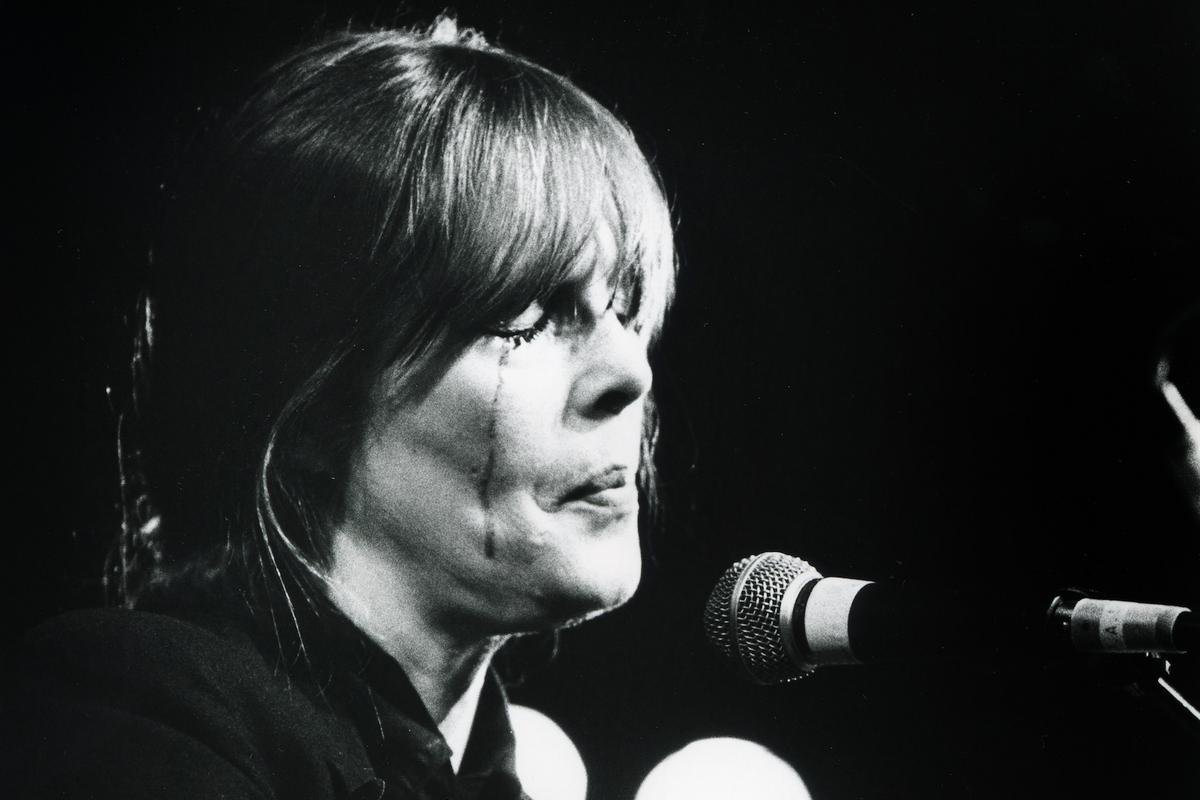
There are many ways to pursue rock ‘n’ roll. Nico, a singer, songwriter, actress, model, muse and more, chose one of the most interesting paths.
Most fans came to know Nico through her work with the Velvet Underground. It was Andy Warhol who insisted she join the group. Lou Reed resisted, then wound up writing songs for her and, briefly, became her lover.
Nico’s career after her time with the Velvets wasn’t necessarily designed for the mainstream. Her solo albums went largely unnoticed, and she preferred the live aspect of music more than anything else. “I would live on a stage if I could,” she said in a 1986 interview.
Nico’s fellow Velvet Underground bandmate John Cale worked with her on a number of said solo albums, including 1985’s Camera Obscura, which would ultimately become the final studio album Nico released before her death. At that time, she and Cale had not collaborated on an album since 1974, but it felt as though no time had passed.
“Oh, it’s like it’s always been, nothing has changed at all,” she said in 1986. “Yes, [the songs] might not be perfect, but John likes the feeling that a song should be like being performed on stage. That it shouldn’t be perfect. He never liked that for some reason. Not for himself, but for me.”
READ MORE: Lou Reed and the Velvet Underground Albums Ranked Worst to Best
Camera Obscura was met with mixed reviews, but it coincided with an arguably more important milestone in Nico’s life: She finally began to conquer a decades-long battle with substances.
“Everyone organizes their life the way they can. She organized hers around a drug,” Cale reflected in 2010. “There was always this moment [in the studio] when there would be tears. She’d go away, you’d do your adorning of the tracks, you’d play back the finished product, then there would be tears of happiness: ‘Ohhh, eet ees beautiful!'”
After 15 years as a heroin addict, Nico reportedly quit and began methadone treatment, leaning into exercise as a way of combating cravings and building structure in her life.
The tragic irony: It was this new, wholesome habit that caused Nico’s death.
The Ibiza Incident
“In the late morning of July 17, 1988, my mother told me she needed to go downtown to buy marijuana,” Nico’s son, Christian Aaron Boulogne, said for Please Kill Me: The Uncensored Oral History of Punk. The pair was vacationing in Ibiza. “She sat down in front of the mirror and wrapped a black scarf around her head. My mother stared at the mirror and took great care to wrap the scarf appropriately. Down the hill on her bike: ‘I’ll be back soon.’ She left in the early afternoon on the hottest day of the year.”
At some point along the journey, 49-year-old Nico fell from her bicycle and hit her head. After an indeterminate amount of time out in the heat, she was found unconscious by a passing taxi driver, taken to a local hospital and eventually pronounced dead from a severe cerebral hemorrhage. Her official death date was July 18, 1988.
“Her manager, Alan Wise, said she died in a hospital on the island a few hours after the accident,” The New York Times reported at the time. “A coroner’s report said she had suffered a cerebral hemorrhage, Mr. Wise said.”
Many years later, Cale recalled his late friend fondly, including a track called “Moonstruck (Nico’s Song)” on his 2023 album Mercy, something he described to Billboard at the time as written with “a lot of affection.”
“Her lyricism, you had to dig for it,” he explained to The Guardian. “You’re always wondering, what did she mean with this? And I never really wanted to question it, I just accepted it for what it was. … What’s happened over time is that her songs appear to be getting better and better.”
Nico, for her part, was never all that concerned with how successful her work was, at least in the traditional sense.
“It’s not very — how do you say — commercial,” she said in a 1985 interview while on tour in New Zealand. “But it will be recognized as I move on, whatever, to descent or ascent.”
Rock’s Greatest Frontwomen
Gallery Credit: Corey Irwin