

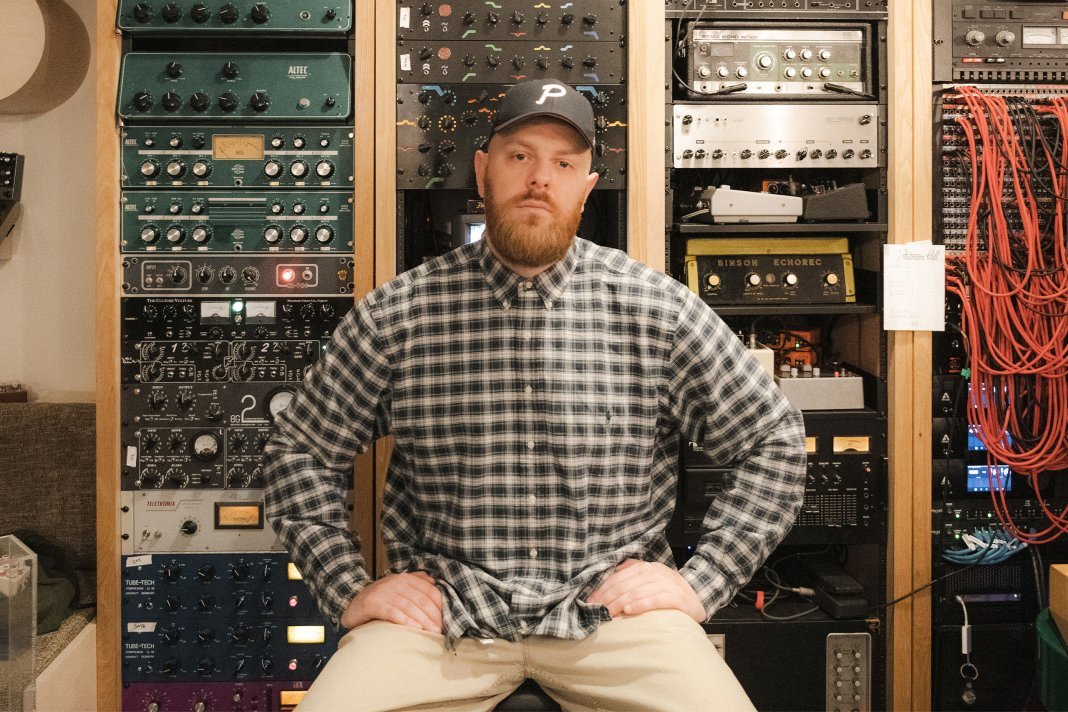
Kenneth Blume would like everyone to stop worrying about what to call him. Since the producer began using his given name professionally about a year ago, people have developed a habit of addressing him as Kenny, then immediately apologising. “I wish that there was a billboard,” he tells MusicTech from an emerald leather kitchen nook at his Putnam Hill studio in Los Angeles. Its message: “It’s okay to still call him Kenny.”
Kenny Beats, after all, is still the prolific producer who made hits with Denzel Curry, Vince Staples, and Freddie Gibbs, then turned his quicksilver studio process into the YouTube series The Cave. His friends still call him Kenny. And despite his evolution from hip-hop producer and internet personality into marquee rock producer, studio founder, and film composer, Blume insists the change was never meant to mark a clean break. “It’s not really a shift in any other way,” he says. “I just want to use my family name.”

The decision began at Sundance 2025, as Blume watched the premiere of Lurker, the Alex Russell-directed music-industry thriller he scored. Seeing “Kenneth Blume,” the name he shares with his father and grandfather, scroll past in the credits stirred something in him that Kenny Beats, an alias coined in middle school for his MySpace output, did not.
Part of that feeling came from everything the pseudonym had accumulated. Kenny Beats no longer referred only to his production work. It was also the on-camera personality trading jokes and improvising viral chart-toppers with Zack Fox on The Cave; the host of beat battles and tutorials on a popular and lucrative Twitch stream; the figure at the centre of the second-largest music community on Discord. Blume says there was “a bit of a difference” between that figure and the person his girlfriend, parents, and closest friends knew. Watching “Kenneth Blume” roll through the credits felt, in some small way, like “just being myself onscreen.”
“My style is just being invisible, making people feel like they’re getting as close as they can to whatever that dream is.”
The change nevertheless coincided with an expansion in his work and the opening of his own studio, some of which is immortalised in a clutch of doodles, notes, and Polaroids pinned to the wall behind us: There are the grinning mugs of Geese, whose zeitgeist-seizing Getting Killed was the first full-length recorded at Putnam Hill; Blume pouting in a long wig, flanked by Rico Nasty, whose RX dropped in July, and Shanny Wise of electronic duo Fcukers, who tapped Blume to helm their debut Ö; a hand-scrawled “=w=” from Weezer’s Gold Album sessions. All the while, Blume has continued to produce rappers, record more live instrumentation, and rely less on software. “Somehow the two, the name and what’s going on with the music, kind of lined up,” he says. “They’re both a little bit more organic than when I was younger.”
Even he can see the symmetry. “I guess using your real name and taking everything off, there’s kind of some through line,” he says. “But it wasn’t intentional.”

The internet conspiracy theory that Blume is distancing himself from hip-hop does not survive his credits. Before The Cave went viral, he worked with IDLES, hardcore band Trash Talk, and Rico Nasty, whose 2019 Anger Management mixtape folded punk and metal into rap.
“I do a metal song now, and they’re like, ‘When did you start doing this?’ And they forget about Rico Nasty, you know?” Blume laughs. “There were guitars there too!”
If there is a constant across those projects, it’s the method Blume brings to the room. “I never propose a genre, a sound, a reference, as far as where you should go with it or what I could hear you doing,” he says. Instead, he studies collaborators to a “nerdy, scary point”, combing old interviews, fan forums, and Discord servers for clues about what the artist might be reaching toward. By the time they enter the studio, he wants to understand not just the music they have made, but the music they may not yet know how to articulate.
His position as something of an outsider helps. “I’m not really authentic to any subgenre I work in,” says the Connecticut-raised Blume. “I’m so impure to everything.” That impurity is perhaps his fingerprint — less a recurring sound than a way of listening. Like the Dust Brothers and Dan The Automator, Blume has a knack for decontextualising sound and technique from genre, treating them as tools that migrate according to what a song or performance needs. But the impulse must come from the artist. “If they wanna cross genres or they wanna pull something from a complete other world, I, as a rule, think that can work,” he says. His role is to recognise the destination and clear a path toward it. “My style is being invisible,” he says, “making people feel like they’re getting as close as they can to whatever that dream is.”

One of Blume’s most lasting lessons from hip-hop is how to preserve spontaneity. He came up on stories of rappers arriving with fully written and rehearsed verses. But as artists such as Young Thug and Future pushed Atlanta to the centre of rap, he watched punch-in recording become the norm: record a line, pause to consider what comes next, maybe take a sip or a hit, then build the track bar by bar. “The first thing off the top of your head and the first time you say it becomes the prized thing on the record,” he says.
The first time he asked IDLES frontman Joe Talbot to write and record at the microphone, Blume recalls, Talbot was confused. He was accustomed to writing with the band or taking a demo away and returning with a completed vocal. Punching in introduced a different kind of risk, and ultimately became part of how they made multiple albums together. Rehearsal serves a band, Blume says, but “you need these records to have something that’s off the cuff.”
With Geese, Blume didn’t have to manufacture that instability. The Brooklyn quartet — “a real, real, real, real band,” he says — had spent months writing, demoing, and testing songs on the road, sometimes playing new material the night it was written. Some songs that would appear on Getting Killed had already been recorded in full, but the band still had not found what it wanted.
“You’ll see a lot more broken amps than shiny new ones. Geese’s Getting Killed broke a lot of my gear.”
Blume is wary of taking credit for the record’s vertiginous momentum. If Getting Killed sounds as though the band is holding on for dear life, he says, that is how it felt making it. “More so than some kind of crazy production technique or some insane gear manifesto, what made that record was capturing what was happening with them at that time authentically and not adding anything to it.”
He compares the approach to Steve Albini’s recordings, where drums sound less like an ideal assembled from studio wisdom than like drums heard by someone in the room. With Geese, the choices of the players remained paramount.
“There wasn’t any music tech involved that anybody couldn’t find and use themselves,” he says. “It was a performance-based thing.” Or, more simply: “That record’s kind of anti-production.”

The evidence remains scattered around Putnam Hill. “You’ll see a lot more broken amps than shiny new ones,” Blume says as we descend from the kitchen to the control and live rooms. “That record broke a lot of my gear” – including three of his guitars, to be exact, just to nail the solo in Bow Down.
Putnam Hill was designed to get out of the way of performances like those. He rounds a corner to a narrow hallway, whose chief function appears to be storing instruments, and points to an audio panel built into the wall. “There’s a shit ton of hallway on that album,” he says of Getting Killed. Everything from the passageways to the emerald couch upstairs is wired for recording. In the live room, a whiteboard proffers the operating ethos in blue marker: “Doubt kills more dreams than failure ever will.”
Blume built Putnam Hill in a former live-work space near USC after working from home began dictating what he could make. Recording more musicians and instruments simultaneously required more space. “I really just need a bigger room,” he remembers deciding. “I don’t need fancy gear.”

No single studio team understood his vision, so he hired the electricians, builders, and designer separately. Daniel McNeill, the engineer who still works beside him on every record, ran wiring beneath the floor and helped pack sand beneath the speakers. “Our blood, sweat, and tears is literally in the damn walls,” Blume says.
The finished studio does, in fact, contain plenty of fancy gear, much of it custom-built in Putnam Hill’s signature green. But every detail is designed to make the technology recede. Its 96 inputs and outputs keep hardware permanently connected and labelled inside the computer. A QR code supplies templates for Ableton, Logic, and FL Studio, so a laptop producer can use the analogue equipment without operating a patch bay. “A laptop producer and a tape producer should be equally as comfortable here,” Blume says.
Even its most bespoke instrument was created for immediacy. Blume and inventor Leon Dewan built the analogue Wandertone synthesizer around favourite synth sounds from SOPHIE, Gesaffelstein, Yeezus, Quincy Jones, and more. Every circuit and symbol was custom-designed; there is no text or LED readout. A “chaos circuit” sends a released note drifting unpredictably toward another. Blume has already put it to work on albums by Fcukers and Show Me the Body.

For all that engineering, Blume says nine consecutive albums made at Putnam Hill were recorded without a click, fixed tempo, or grid.
“I wanted this place to not ever feel like you can’t do anything,” he says. “‘Cause I know how that felt.”
The credits accumulating under the name Kenneth Blume bear out that sense of limitlessness: new albums by Denzel Curry and Show Me The Body, creative direction for jazz collective FATHERS, new singles with Wednesday and Chris Lake and Chris Lorenzo, and something new from IDLES, whose members are unpacking instruments and poring over the day’s tracking list as we head back upstairs.
“Okay, let’s begin!” Blume says.
“So it begins…” Talbot growls as the two clap hands and embrace.

Those expanding credits, however, have yet to settle the question of what Kenneth Blume sounds like. Another album made at Putnam Hill may complicate the answer further: the follow-up to his 2022 solo debut Louie, which is completed and due out in 2027. It came together at Blume’s “lowest point” and is “really sad, and really live”. It is about healing, he says, and not what anyone expects from him. But “I didn’t really have a choice.”
Creating it placed Blume on the other side of his own philosophy. After a career spent helping artists discover what they could not yet articulate, he relied on collaborators to do the same for him. “It’s definitely the first time I feel like I’ve truly been produced,” he says. “They pulled something out of me that I didn’t pull out of myself.”
Words: Andrea Domanick / @calamity.dre
Photography: Evan Tetreault
Location: Putnam Hill / @theputnamhill