


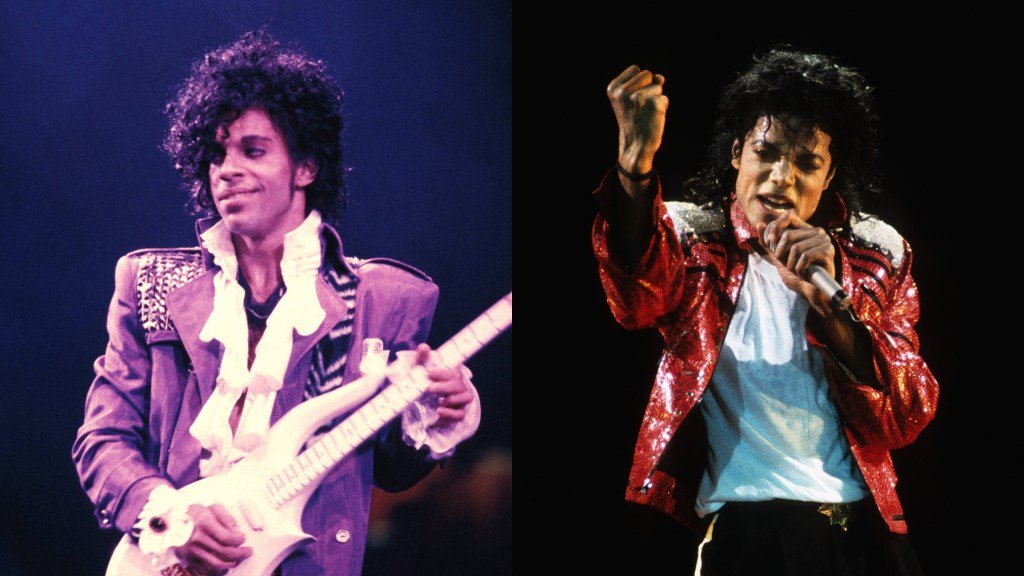
In an illuminating scene from Michael, the record-breaking, debate-igniting music biopic, the future King of Pop and his brothers are relaxing at the pool inside the Jackson family’s lavish Hayvenhurst Estate in Encino, California. It’s 1982, and Michael Jackson is plotting his Thriller world domination. Nothing… no one can get in his way. That’s when a floating MJ realizes that there is a certain multi-hyphenated, one-man-band talent out of the City of Lakes who poses a serious threat to his goal of global supremacy.
“If I’m not here to receive these ideas, God might give ’em to Prince,” he said with a wry smile. Yet the hilarious quip is no contrived Hollywood punchline. It was a real-life anecdote that Kenny Ortega, director of the posthumous 2009 Michael Jackson documentary This Is It, recalled back in 2010 during an interview for VIBE’s Michael Jackson vs Prince oral history. Longtime followers of both musical titans understood the deep and complex historical and cultural connections between the two Black eccentric, gifted artists who transformed the ‘80s and ‘90s into their own playgrounds. Younger MJ Stans, however, were left scratching their heads on social media: What’s the big deal with Prince?
For Gen Z neophytes and hardcore fans overseas (South Asian and Nigerian Mike zealots apparently have a lot to say on the matter), the idea of MJ/Prince ever being a rivalry is laughable. MJ, the Gary, Indiana song-and-dance, Jackson 5 child prodigy, who ascended to uncharted commercial and cultural heights following the release of his 1982 blockbuster Thriller, would go on to sell over 500 million albums worldwide.
In comparison, Prince, the rule-breaking, musical genius whose synthy, genre-blurring Minneapolis Sound became the audio heartbeat of the eighties, amassed 150 million in global units sold, headlined by his 1984 Oscar-winning statement Purple Rain. Not much of a fair fight, right?
And streams? Fuhgeddaboudit. Mike currently has over 22 billion total streams on Spotify alone, while Prince, who kept his music off on-demand digital platforms over his protest of low royalty payments to artists up until a 2015 deal with Jay-Z’s TIDAL, has racked up over 4.2 billion across his extensive catalog.
Musically, Mike’s wholesome pop confections were worlds apart from Prince’s sexier, more provocative, and at times lascivious (he’s literally one of the reasons why parental advisory album stickers were created) funk-rock-and-everything-in-between output.
So why are these two disparate visionaries forever linked? It’s the classic yin-yang relationship. MJ Vs. Prince has long captured the public’s imagination. And at times their rivalry got downright spicy. Jackson was at times miffed by what he believed to be Prince’s at times aloof behavior towards him. In transcripts of recordings taped in 1988 for MJ’s autobiography, Moonwalker, he called out the Purple One.
“I don’t like to be compared to Prince at all,” Jackson said. “I have proven myself since I was real little. It’s not fair. [Prince] feels like I’m his opponent. I hope he changes because boy, he’s gonna get hurt. He’s the type that might commit suicide or something.”
While Prince never got that dark, he was known to enjoy poking fun at Jackson. After politely turning down MJ’s and all-world producer Quincy Jones’ request to appear on the Gloved One’s 1987 hit single “Bad” and its Martin Scorsese-directed video, Prince reportedly joked to friends that the album was only entitled Bad, “because there wasn’t enough room on the sleeve for Pathetic.”
Their storied connection was even at the centerpiece of the 2024 Drake Vs. Kendrick Lamar battle. “And your best work is a light pack/Nigga, Prince outlived Mike Jack,” Kdot fired back at Drizzy, who has made it a point to compare himself to the KOP even before recently breaking MJ’s record for the most No. 1 singles by a male solo artist on the Billboard 100. [On a personal note, the idea of the feature-inflated Drake even being remotely mentioned in the same sentence as Jackson is laughable.]
Even in death, their rivalry has sustained. As MJ’s big screen vehicle Michael closes in on becoming the first biopic to cross $1 billion, Prince finds himself on top of yet another debate-igniting music list. The latest: after garnering the title as the most Googled guitarist, the greatest Super Bowl Halftime Show by Billboard, Prince’s “Purple Rain” was ranked as the GOAT guitar solo of all-time by Rolling Stone.
Of course, aside from being two Midwestern Black men born in the same year (1958), who reached their respective commercial peaks during the unprecedented eighties crossover era, Michael Jackson’s and Prince Rogers Nelson’s approaches to art could not have been any more different. Prince gave his first comment on the two dynamo’s diametric philosophies during conversations with New Yorker contributor Dan Piepenbring, co-writer of the artist’s unfinished, posthumous 2019 No. 1 New York Times best-selling memoir The Beautiful Ones.
Prince pushed back at critics who attempted to describe his work as “alchemy,” embracing the more regimented philosophy of funk. “Funk is the opposite of magic,” he explained. “Funk is about rules. ‘Magic’ is Michael’s word. That’s what his music was about.”
Indeed, MJ emphatically embraced the now-you-see-me-now allure of his greatest pure entertainer title. He was as obsessed with the art of pitch-perfect production as he was with cinema-level visuals (the transformative MJ is the Vincente Minnelli of the music video, turning the procedural medium into blissful spectacle) and over-the-top promotion. Sony spent more than $30 million on Mike’s HIStory double album, including an infamous floating 32 ft. River Thames MJ statue, an outlandish budget in any era of music.
Prince, meanwhile, brought a lone-wolf work ethic to his artistic pursuits. At times during his bombastic, table-shaking, enigmatic career, the singer, arranger, musician, and producer came off as a restless indie artist masquerading as a multiplatinum megastar.
The running joke was that Prince could play his band members’ instruments just as well, if not better. He gave label executives anxiety-induced night sweats, averaging nearly an album a year (not including projects he wrote and produced for other acts and superstars), making even his productive peers look like sloths. But Prince’s prolific proficiency was both a gift and a curse: no one else but His Royal Badness would step on the momentum of a global behemoth like Purple Rain (1984) or the much-welcomed return-to-form Diamonds and Pearls (1991).
Yet MJ and Prince were a lot more alike than their public images. Mike never really got full-blown credit for being the brilliant songwriter that he was (go push play on 1996’s somber, lyrically layered, criminally underrated “Stranger in Moscow,” largely due to his bigger-is-better showman rep that has fooled some delusional Chris Brown fans into thinking he’s the second coming of Jackson.
And Prince, for all his rage-against-the-machine idiosyncrasies, still wanted to be the biggest name in the room (you don’t re-up for a then record-breaking six-year $100 million record deal in 1992 without being driven by commercial ambition).
Perhaps no one understood the timeless connection between the two musical luminaries better than MJ. In 2001, he pitched a treatment for a potential visual for the Invincible era cut “She Was Loving Me” (eventually retitled “Chicago”), which, over a decade later, appeared on the 2014 posthumous Jackson release Xscape.
“At the end of the video, two limos pull side by side,” the song’s producer Cory Rooney described in a May 20th Variety interview, detailing “Chicago’s” recent turn as a viral hit. “Michael rolls his window down, and then the other limo rolls down its window — and it’s Prince.”
When our oral history was first published more than a decade ago, Prince Rogers Nelson was still with us in physical form. On April 21, 2016, he joined Michael as an ancestor. In celebration of what would have been Prince’s 68th birthday (June 7), VIBE presents MJ Vs. Prince Redux. Along with previous interviews from the likes of Questlove, Cynthia Horner, the late Bruce Swedien, and Tito Jackson as well as Teddy Riley, we have included new and unpublished testimonies from former New Power Generation band members Morris “Mr. Hayes” Hayes and Tony “Tony M.” Mosley, musician, YouTube host, and Michael Jackson and Prince expert Casey Rain and acclaimed author Miles Marshall Lewis.
No white glittery gloves or blouses, included.
—
“I heard you were looking for me,” said a deep voice on the other end of the phone. It was the fall of 1996, and Michael Jackson was holding court in a posh suite at the Four Seasons Hotel in New York. The King of Pop had instructed his handlers to contact his old peer and rival, Prince, for a planned collaboration. The prospect of such a headline-making union was indeed intriguing.
For much of the ’80s, Michael Joseph Jackson and Prince Rogers Nelson took turns ruling the musical landscape. MJ, the gifted Motown child prodigy who made good on his ambition to become the biggest pop star to ever walk the earth with the release of the record-breaking landmark Thriller. Prince, the at times outrageous, androgynous, one-man-band performer and producer, backed up his genius rep by pulling off one of the most unlikely coups in rock history after unleashing the multi-platinum 1984 Purple Rain soundtrack and Oscar-winning film. A rivalry was born.
But more than a decade later, both had found themselves in a battle to save their respective careers. MJ struggled mightily to fight unproven child molestation accusations as the tabloid brigade hounded him relentlessly. Prince declared war against his longtime label, Warner Bros., and changed his name to an unpronounceable symbol as he headed deeper into obscurity. Indeed, a team-up between the two icons would be perceived as a brilliant masterstroke. “I think it would be just great,” MJ told Prince. Yet the collaboration to end all collaborations would never happen.
Both aging legends, however, would achieve comebacks on their own terms. With Jackson’s untimely death on June 25, 2009, and Prince’s tragic passing on April 21, 2016, their connection grows even more profound. The fact that the public is still enamored with MJ and Prince speaks volumes for their cultural impact and influential contributions to music. But what did these two titans really think of one another? Was there a true hatred or deep respect? VIBE presents the Oral History of a King and a Prince.—Keith Murphy
A KING AND A PRINCE (1970-1982)
AHMIR “QUESTLOVE” THOMPSON (Leader, producer, drummer for the Philadelphia hip-hop band The Roots, and Oscar-winning director): I have an actual theory on why we started connecting Michael and Prince together early on. I don’t think it’s a coincidence that both were born in the summer of 1958 in the Midwest and both basically represent different phases of the coming-of-age life of black youth. Michael captured the imagination of post civil-rights America as a youth and he was their guiding light. And Prince captured the same post-civil rights America when they became teenagers and helped them mature into adulthood.
ALAN LEEDS (Former tour manager for Prince, James Brown and D’Angelo; Co-editor of the book The James Brown Reader): I remember seeing Michael’s first big tour with the Jackson 5 in 1970. When I was out with James Brown we crossed paths in Dayton, Ohio. They were playing the O’Hare Arena in Dayton the night before we were scheduled to perform. Onstage he had a charismatic presence that very few people had. I remember we were staying at the same hotel. And before the gig, I happened to be in the hotel lobby when the J5 left to go to sound check. I saw them come through with their security; screaming kids were outside the hotel and I recall seeing Michael and he looked like a little pimp [laughs]. He had that confident walk and he was only 10 years old! He totally understood, “Hey, I’m the star. I’m the reason these kids are out here.
CYNTHIA HORNER (Influential former editor of Right On! Magazine from 1976-2005): I met Michael back in 1976, and he was one of the shyest people that I’ve ever dealt with. It was a little difficult to interview him because, even though as a professional entertainer he realized he needed the press, he wasn’t somebody that knew how to relate to the media in terms of being open with information. He was just super shy unless he was around his family. But he picked up the fact I was shy as well, so he kind of embraced me, and we became friends. He and Prince were quite similar because Prince was shy as well. If you were a journalist, he would give you the same monosyllabic answers that Michael did. But Prince would also speak in riddles a lot of the time; he was very evasive. He would never answer any of my questions [laughs]. He wanted to keep his privacy protected at all costs.
BRUCE SWEDIEN (Michael Jackson’s studio engineer for Off The Wall, Thriller, Bad, and Dangerous): It was very obvious to both me and Quincy [Jones] how great Michael was. He was somebody really special… the ultimate talent. We did a bunch of demos after listening to Rod Temperton’s music for Off The Wall. And Michael, in his typical fashion, went home, stayed up all night, and memorized the lyrics, and we recorded those demos without a piece of paper in front of him. You tell me one other singer that could do that.
CYNTHIA HORNER: The first time I encountered Prince was in 1978. He kept calling me over and over again, and I really wasn’t returning his phone calls because I didn’t know who he was, and I really didn’t care. But he called me so much that I just wanted to get rid of him, so I agreed to meet him down the street from my office in Hollywood, near the recording studio he was at. He wanted me to go to the studio to see a jam session. But what I didn’t realize at the time was that the jam session consisted of just one person: Prince! He played all of these different instruments. Prince was trying to prove to me that he was worthy of coverage and that he was more talented than probably a majority of the people who were appearing in [Right On!]. At that moment, Prince let me know that he was a songwriter that could produce, sing, and play all these different instruments. This was a once-in-a-lifetime talent. Once I saw that, I agreed to interview him.
ALAN LEEDS: Michael wasn’t a musician in the classic sense. He approached his music differently from the way Prince did, although Michael could write a great song as well. But Prince was arguably a musician first. I don’t think there’s any doubt that Prince saw Michael as a symbol of where he wanted to go in terms [of notoriety]. Michael was one of the few artists on the planet that Prince respected in that sense. Once we realized that he was in the process of writing what was the original idea for the film Purple Rain as he was scribbling in notebooks during the 1979 tour, we knew he wanted more. The word was beginning to spread: “Hey, Prince really thinks he’s writing a movie.” I don’t think any of us took it that seriously because it didn’t make sense that somebody who at that point only had a few pop hits was going to be able to get the funding for a film. But it certainly revealed an ambition he had, and to his credit, Prince would go on to pull it off.
CYNTHIA HORNER: I would give Michael copies of the magazines, and he would see certain people in the book and ask me lots of questions about the artists he was interested in. And that’s how he was introduced to Prince. After that, I started to let Michael listen to some of the Prince music I had and he was intrigued. At that point, I realized that there was somewhat of a rivalry developing. Michael had been in the business longer, so naturally, he didn’t want to get replaced by the newcomer.
BATTLE FOR SUPREMACY (1983-1993)
ALAN LEEDS: Prince went to a James Brown gig [in 1983] with Bobby Z, his drummer at the time, Big Chick, who was his security guard, and I think Jill Jones, who was one of his protégés. By now, everybody knows what happened at that gig. I don’t think Prince realized that Michael was going to be there. James looked a little puzzled in that video when Michael whispered in his ear, “Hey, bring Prince up.” And of course, Prince didn’t really know what to do either. He went to the guitar first, but he fumbled with that because it was left-handed. He played a few licks, did some dancing, and knocked over a prop by accident. Now I always wondered if Michael intentionally brought Prince up to put him in that position just to say, “Hey, you think you’re on my ass? Well, follow this, motherfucker [laughs].” Bobby Z called me and said, “Oh boy…he made an ass of himself tonight.” He said Prince didn’t say a word the whole way to the hotel.
TITO JACKSON (founding member and guitarist of the Jackson 5 and the Jacksons): Sure, my brothers and I listened to Prince…“1999,” “Little Red Corvette,” “When Doves Cry.” Thriller and Purple Rain were part of our times. That was a great era, wasn’t it? You had two great artists, both doing incredible music at the same time. And then you had the fact that they both were exceptional live performers. Some people feel as though Prince is the greatest thing since sliced bread, and some people feel like my brother is the greatest. To me, that’s what made that era so special.
ALAN LEEDS: Before we set out on the Purple Rain tour, it was a case of Prince wanting to see what Michael and the Jacksons were doing in terms of production, lighting, staging, and everything with the Victory tour. We charted a jet with a couple of his bodyguards and Jerome Benton from the Time and Leroy Bennett, who was Prince’s lighting and production designer for his tours. We flew to Dallas to the old stadium where the Cowboys played. There was a feeling in our camp that while what they were doing was a very solid stadium production, there was nothing really cutting-edge about the technology. The Varilites, which was a brand name for a type of computerized lighting, was the gold standard in the industry at that time. And we made sure we had all that shit. But the Jackson’s production didn’t. Prince had a lot of respect for Michael, but he was mildly impressed with the show.
QUESTLOVE: Michael attended many of the Purple Rain concerts. I have the four Purple Rain shows that were in Los Angeles in ’84. And now that I realize that Mike was in the audience, I often watch it to see if I can spot him [laughs]. But it makes you think. Why was Mike there four nights in a row? You have already created Thriller, you’ve done the moonwalk, you’ve done the groundbreaking videos, and you’ve sold a million a week. You are officially in the Guinness Book of World Records. For all intents and purposes, Purple Rain sold [25] million units, but it was [not] the [70] million that Thriller went on to sell. So why are you this curious about who is behind you? Then I realized that you can’t be that successful without being competitive. Michael knew Prince was a serious threat.
ALAN LEEDS: Quincy Jones organized a lunch that brought Michael and Prince together. At one point, they asked him to be a part of “We All The World,” but Prince respectfully declined and offered to give them a song [“4 The Tears In Your Eyes”]. All I remember Prince talking about afterward is that he thought Michael was a little bit weird. And this is coming from a guy who wore high heels and pajamas to nightclubs [laughs].
QUESTLOVE: There’s the now-infamous story about a ping-pong match between Mike and Prince in 1986 while Prince was overdubbing Under The Cherry Moon and Mike was working on Captain Eo. And they were both vying for the attentions of Prince’s girl Sherilyn Fenn, who back then was the hot shit. It was a ping-pong game gone bonkers. He said that MJ played like Helen Keller. (Editor’s note: Prince’s drummer Bobby Z has gone on record about MJ’s and Prince’s good-natured showdowns in the Minneapolis Star Tribune. “They’d shoot hoops at [Prince’s] Paisley Park,” Bobby Z said of the unlikely pair. “Prince had a deep-seated competitive nature, so it’s easy to see where he would measure himself against Jackson’s success.”)
BRUCE SWEDIEN: Prince is wonderful…just an incredible talent. Both he and Michael had a cordial relationship. They even hung out a few times. It’s common knowledge that the song “Bad” was written to be a duet between Michael and Prince. But as you know, it never came together. When Prince left the studio after we were working on “Bad,” he decided to pull out of it. He left the control room, and as he turned around to go, he said to us all, “Don’t worry, this record will be a big hit even if I’m not on it.”
ALAN LEEDS: But the thing about Michael coming to Prince and wanting him to do “Bad” that really pissed him off. Prince was like, “Oh, he wants to punk me out on record. Who does he think I am, crazy?” He couldn’t get outside himself enough to realize that it was the kind of thing that probably could have benefited both of them. Still, it would have forever been Michael’s video with Prince as just a guest. So that captured what the relationship couldn’t be. They were like Ali vs. Frazier. And the media couldn’t get enough of pitting these guys against each other.
CYNTHIA HORNER: I take credit for that [laughs]. Right On! was a fan magazine, so I could get away with some of the things that I did. Michael and Prince were not actually battling each other on a serious level. But because I knew that was something the public found fascinating and everybody always talked about it, I wanted to have both of them on the cover together to project that element of Prince vs. Michael.
TEDDY RILEY (Grammy-winning originator of New Jack Swing; Michael Jackson producer): We looked at Michael and Prince as Gods. I still remember getting the first call from Michael to work on the Dangerous album. I was trying to get Q-Tip to let me use his studio in Sound Works on 21st St. I had the whole floor booked out. In one room, I was working on Jane Child’s “Don’t Want To Fall In Love,” the other room was Keith Sweat’s “Make You Sweat,” and the other one was Guy’s “Why You Wanna DOG Me Out.” And I went into the other room and created “Remember The Time.” I brought Michael back to our world—the young, black, New Jack Swing world. That was the moment that people said, “Michael is R&B again.” He wasn’t just the King of Pop. He was the King of R&B. And Prince was the king of funk-rock.
QUESTLOVE: You recall that ill-fated duet Eddie Murphy did with Michael called “Whatzupwitu?” I have five hours of raw footage from filming for that video. Michael and Eddie had a green screen behind them, so somewhere in that second hour, the conversation turns to Prince. And Eddie is like, “Yeah man…Prince is a bad motherfucker. I’m glad I’m working with you, but another dream I have is working with him, too.” And I don’t even think that Mike knew the camera was on him, and he goes, “Yes, he’s a natural genius.” And then four beats later, Michael says, “But I can beat him [laughs].”
TONY “TONY M.” MOSLEY (Rapper, guitarist, dancer, and member of the New Power Generation in the early ‘90s): We actually saw the [infamous yellow “assless” pants outfit that Prince wore at the [1991 MTV Video Music Awards] before we hit the stage. We were in the dressing room getting ready for our prayer when he walked into the room wearing a trench coat. He said, “I’ve got a surprise for them and just opened the front of the coat, we were like, “Oh that’s fly.” Then Prince dropped the coat and turned around to head to the stage. I remember Kirk [Johnson], Damon [Dickson], and I were looking at each other like whoa. Damon’s wheels were spinning because he realized that at the top of “Gett Off,” he was the first man down that had to plank over Prince…[laughs]. It wasn’t just the outfit that Prince kept hidden from the MTV execs; it was the actual sexual choreography that was about to go down…THEY WASN’T READY. He absolutely loved the media firestorm that followed. It worked, as we still talk about to this day.
FALLS & COMEBACKS (1994-2010)
TONY M.: I [saw Michael and Prince embracing rap] as the evolution of hip-hop, which became more relevant and socially conscious at that time. They both gravitated toward the message and were in tune with it. Artists like Prince and MJ were always evolving. Some may say they were jumping on the bandwagon, but I will say that when hip-hop really had something to say besides party, women, clothes, etc., they began listening. That was really evident when [the New Power Generation] performed at Jack The Rapper (the fabled Atlanta record convention that brought together Black music executives, journalists, and artists). I didn’t know how we would be received, but it was crazy, it was all love!
ALAN LEEDS: Michael wanted to be dangerous, but no one ever took that side of him seriously. But Prince was always dangerous because he wasn’t afraid to push the envelope. But then Prince tried to upstage hip-hop by singing into a microphone shaped like a gun. He was trying to relate to the rap audience by having those wack rappers in his band.
MILES MARSHALL LEWIS: (Former VIBE editor; writer and author of There’s a Riot Goin’ On and Promise That You Will Sing About Me: The Power and Poetry of Kendrick Lamar): I was a huge hip-hop fan, so for me hip-hop and Prince were the two dominant cultural forces of my wonder years. An older track like “Irresistible Bitch” had a rap flow, so it seemed like he was trying to say on songs like “Gett Off,” “My Name Is Prince” and “Sexy MF,” “Hey, I’ve done this before…don’t forget.” But at the same time, we were in the Golden Age of hip-hop. Every other album during that period was a classic, practically. He released a rap album by T.C. Ellis on Paisley Park Records. Prince elevated Tony M. in the New Power Generation. He produced that whole Carmen Elektra album, which was just her trying to rap… it was just embarrassing. Michael, however, had a different approach. He got out of the way and let the rappers do what they do. It was kind of exciting at the time to think, “Wow, Biggie is on the new Michael Jackson album…”
TONY M: It was a fight, man. Because Prince’s fans did not want to see him onstage with any rappers. But Prince would tell me that I was doing fine and not to worry about any of the talk. Back in the days, people would say that Prince didn’t like hip-hop, but that’s not exactly true. He loved Public Enemy. We would have conversations about Rakim. When we were on the Diamonds and Pearls tour, we would play Digital Underground’s “The Humpty Dance.” Prince loved that song.
MORRIS “MR. HAYES” HAYES (Keyboardist and former member of Prince’s backing band, the New Power Generation): Prince would tell me about the times when he and Michael would hang out with Lenny Kravitz in the studio. And he told me that Michael liked to wear disguises… he was wearing this fishing hat [laughs]. They had some girls with them in the studio, and Prince and Lenny were talking about Madonna. And Michael was just sitting there, silent. And suddenly he says, “Yeah… that Madonna… yeah, she’s a trip.” Dead silence. And Prince and Lenny just started laughing like, “Bro…” But don’t let Mike fool you. He was talking to the girls on some, “Yeah, so what do you do…?” like he was macking a little bit [laughs]. It was just thrilling to hear Prince talk about him and Mike hanging out. While they were very competitive with one another, there was a real brotherhood there.
CYNTHIA HORNER: Both Michael and Prince had their problems later in the ‘90s. I used to see and talk to Michael a lot, but he started to change. I didn’t have very much contact with him; my contact was with all of his relatives. Michael had all these people that surrounded him that kind of prevented his old friends and business peers from having any contact with him, because they wanted to control what was going on with him. His own family didn’t really have a lot of contact with him. And Prince was dealing with his own issues. He woke up one day and realized that some of his business decisions with Warner Bros. had not worked out in his favor. He began to protest the music industry. Everyone remembers when he wrote the word slave across his face. He didn’t feel like he got his just due financially and artistically. Both Prince and Michael became very inaccessible.
CASEY RAIN (UK Musician, vocalist, YouTuber, performer, and Prince and Michael Jackson expert. His most recent single, “Drown,” was released in 2025): The proposed “Bad” duet is the most well-known, but the closest Michael and Prince came to a collaboration was in the early ‘90s. Sal Greco, who was in charge of logistics at Paisley Park at that time, has recently talked about this in John McKie’s excellent new book Prince: A Sign O’ The Times. The exact year isn’t clear, but it’s likely between 92-94. He remembers phone calls between Prince’s team and Michael’s team about bringing different equipment to Paisley from Michael’s team, and according to his specifications, including a different mix console. He’s said that the trucks from Michael’s team were about to leave when Prince changed his mind about doing the session at that time. It’s not clear why Prince did that, but the conversations continued because Prince went to visit Michael during the HIStory sessions in NYC around late ‘94 or early ‘95, and it’s believed that a collaboration was discussed again at that time. For me, it’s probably the single greatest “what if?” in music history.
MR. HAYES: I recall one time back in ’96, I was with the band, and we had just had a real big blow-up with Prince. He was mad because a couple of the early shows in Japan were kind of rough, and it was mostly Prince’s fault. When he got to Japan, he wanted to jam instead of going over the music. I was getting concerned because we were not going over the show. So I went into the dressing room, and Prince would not speak to us. He was so mad that he didn’t say anything. So I said, “Look, guys. We are done after this. He’s going to fire all of us.”
MICHAEL BEARDEN (Keyboardist for Jackson’s 2001 30th Anniversary Show and music director for This Is It): The idea was to do a 30th anniversary show at Madison Square Garden to celebrate Michael’s years in the business. But once people found out that it was going to be a big deal, everybody wanted to be there! Elizabeth Taylor, Liza Minnelli, and tons of people were coming out. Michael didn’t want to do much on his own. He had just dropped his album Invincible. It wasn’t that people were upset with Michael. They were upset that other artists were onstage with him. They wanted to see more of Michael. People were not too cool with seeing all those other acts…[laughs].
DJ SPINNA (DJ, producer, musicologist, and co-founder of Soul Slam’s MJ vs. Prince parties): We started the MJ vs. Prince parties in 2002. The whole idea came about after the success of doing Stevie Wonder tribute parties, which we started in 1999. And we thought, who were the other two iconic music figures in the pop world, but also made a major impact on black culture? And that was Michael and Prince. I remember we did the first party at a venue in Lower Manhattan called Peppers, and the crowd was overwhelming. During the parties, I play music from both camps—Michael and Prince catalogs—as well as from artists that they have influenced and worked with. So, you have the whole Minneapolis vibe going on with Prince, Sheila E, The Time, Vanity 6, Alexander O’Neal, and you have Michael with Jermaine Jackson, Janet Jackson, and the Jackson 5. But at the end of the night, it’s really a party that reminds people of the best times of their lives.
WILL.I.AM (Leader of the Black Eye Peas; Has performed live with Prince and produced several tracks for Michael Jackson): I had a show with the Black Eyed Peas in 2008, and then late that night I performed with Prince at the Palms Hotel. I called Michael just before the show, and I was like, “Hey Mike, I’m in Vegas.” I told him about the performance at the Palms with Prince and asked him if he wanted to come. He was a bit apprehensive at first, but I told him, “Let me call Prince to see if everything is OK.” I sat down with Mike after I finished a song with Prince and he comes down off the stage playing his bass and comes right to our table… ripping the bass in half! It was the coolest experience I’ve ever had. I was with both of my heroes. While we were working on new material for his album, MJ asked me why people didn’t think of him in the same way they thought of Prince as a serious songwriter. It was a shock to hear that coming from such an iconic artist.
KENNY ORTEGA (This Is It director): It was less about competing with Prince and more about respect. Michael felt God was going to give ideas to the next deserving artist, whom he felt was Prince. That’s a true respect, true admiration for Prince. He mentioned several times how he loved the song “Purple Rain.”
TRAVIS PAYNE (Choreographer and associate producer of This Is It): The huge success Prince was able to have at London’s O2 [with 2007’s 21 Nights concerts] was important when Michael was putting together This Is It. The desire for Michael’s contemporaries to still be seen by their audiences gave him further confirmation that his ideas were right. It wasn’t about just competing with Prince. It was about him competing with himself. He wanted to hold the Guinness Book of World Record for the most shows. He wanted to show he was the greatest. And he was.
DJ SPINNA: I met Prince February [2009] in L.A. through Rashida who [was] his personal DJ. It was quite surreal, but he couldn’t quite comprehend the concept of “vs.” Both Rashida and myself tried to explain to him that it wasn’t really a battle between MJ and himself. It’s more of a tribute to their music. But Prince had issues about being pitted against Michael like that. You could sense there was a real respect between the two. That was one of the things that made me change the theme of the MJ/Prince parties. And the other reason that made me change it was, of course, Michael’s passing. I felt like he left such a great legacy behind, and it was unfair to label it MJ vs. Prince because Michael is not here anymore. It’s a celebration of Michael’s and Prince’s music.
KENNY ORTEGA: You know how rumors followed Michael… like a bad shadow, and it wasn’t something that he could escape. But the phones started ringing in our pockets the night we were finishing up rehearsals for the London shows. It was so vague that most of us had become so used to the crazy rumors that we wanted to believe the news of Michael’s death as just another story. A short time after, we discovered he died. And to this day it’s still difficult for me to explain what that felt like. I lost my balance. I couldn’t walk. I had to be helped to another room. I remember the place was spinning and feeling that the floor had fallen out. The only thing I could see as I walked around was this level of sorrow. It was a dark day.
MR. HAYES: Terry Lewis (former bassist of the Time and one half of the legendary, multi-Grammy-winning production duo Jimmy Jam and Terry Lewis) had called me. And he said, “Did you hear about this thing about Michael? They are saying he’s gone.” And I’m like, Nah. That’s gotta be a rumor… It’s gotta be. Because you have that moment where you think Michael is too big to die… Michael Jackson can’t die. But as the news started coming around, I started getting more details. So, I’m on the phone with Terry and he tells me he wants to talk to Prince, just to check in on him. He went outside and washed his car. Terry wanted to do something normal so that he could feel like it was all a bad dream.
Now I’m already late for rehearsal. I get there, and I noticed some of the musicians there were walking outside. They had just heard about MJ passing. Everyone was just standing around, so I go in and I saw Prince. He was just starting to audition girls for his 3rd Eye Girl band. Cindy Blackman, who played in Lenny’s band, was there. And Prince said, “Morris, I can’t do any music right now. I can’t do anything right now. I’m sending everybody back home.” Prince was gutted. He told me, “I can’t feel any music.” For Prince to say that that’s a heavy statement. MJ’s death really hit Prince hard.
TRAVIS PAYNE: I told Kenny after Michael died, “We’re not done. We can’t be finished.” Not only would Michael’s message get out there as he wanted it, people would get to see him creating the very show he was going to perform. He actually reached more fans than he would have with l[the concerts with [the This Is It] movie. So that made me very happy. But there’s not a day I don’t think about Michael.
CYNTHIA HORNER: One of the reasons why we still care about Michael and Prince is because we will never know everything we want to know about them. They both understood the power of mystique. They realized that was part of their power they had with their fans. And it’s always going to be that way because there will never be another like those two. When people talk about someone is the next Michael and Prince, I just laugh.
WILL.I.AM: You think the really big people are going to be assholes. And those artists are really not even that big. Then you meet real big artists like Michael and Prince and you are like, “Damn, these guys don’t act like the asshole I just met last week.” The reason why the assholes act like that is because they aren’t really that big. Michael and Prince are as big as you can get.
SOMETIMES IT SNOWS IN APRIL (2011-2016)
MR. HAYES: At this point there were only two things that Prince had not done in his career. One of them was an all-girl band, which he eventually ended up doing, and the other one was a band of clones where it’s just him on every instrument. That way it would always be perfect [laughs]. No mistakes. It’s just all Prince on the bass, on the keys, on the guitar, and the drums. But I was almost right because years later he did the [Piano & a Microphone tour]. It was just Prince alone on the piano all by himself… the same way he began his musical journey.
TONY M.: I had been out to a couple of parties and sessions Prince had at Paisley Park. This was around 2014. We brought the wives and kids out. It was an impromptu party, and everybody came out to the sound stage. Kendrick Lamar performed. That did not shock me because if Prince thought an artist could bring it he would share the stage with you. That was the last time I saw Prince before his passing a few years later.
MILES MARSHALL LEWIS: Prince invited a few journalists to come to Paisley Park. I was working at Ebony [at the time] and they flew me out. I was there to interview Joshua Welton (co-producer of Prince’s 2015 HitnRun Phase One album]. They said Prince might be around during my interview. He showed up and gave me a hug and referenced a piece I had written for Wax Poetics about the birth of his jazz project Madhouse on which he played all the instruments except the saxophone. And Prince said something very early on, like, “That’s where Madhouse came from,” and gave me a wink. That’s when it hit me: Holy shit, this is really Prince!
He held court for about two hours. He was known for not wanting to talk about the past, but he did that night. Prince started talking about the formation of the Time, the Madhouse project, and the origin of certain songs like “Darling Niki” and “Purple Rain.” Alan Light had written something about Bob Seeger being the inspiration for “Purple Rain” because Prince wanted a [Middle America] anthem, but Prince immediately denied that. He was like, “Bob Seeger???” like he was aghast [laughs].” He left, and his assistant took me out front, and Prince swung around in his Cadillac and threw open the door. I got in, and he played me the entire HitnRun Two album, which hadn’t yet even been announced. The man finished an entirely new album. I expected no less from him because he’s Prince. I just shook my head.
MR. HAYES: I was in LA working on a score for a movie. I had been up late, and I had left my phone out on the table in the dining room. I kept hearing it vibrate. Soon as I picked it up a friend said, “Man…turn on CNN. I think Prince is gone.” I turned on the TV, and there were helicopters flying around Paisley Park. And I literally dropped to my knees. I broke down in tears. What was crazy is that prior to Prince’s passing, I kinda felt like something was going on after the whole thing I saw with his plane [having to make an emergency landing] just days before. I’m thinking back to some of the things that Prince had said and posted online. I saw Prince a couple of times, and he didn’t look right. He looked super small. All of it just seemed like it was leading up to something. When I heard that Prince had died, all my worst fears came to a head. It was devastating. I cried as hard as a grown man could cry.
MILES MARSHALL LEWIS: I was taking a nap. I had been up all night, writing, and I woke up and saw the news on Twitter that someone had died at Paisley Park. They weren’t revealing who it was. I just couldn’t fathom that it was Prince, even with the news of his airplane scare that previous week. I just knew it wasn’t Prince. I went back to bed, but when I woke up, I had like 30 text messages. My wife sent me a message in all caps: PRINCE HAS DIED. I couldn’t believe it. I didn’t have time to process what had happened. A world without Prince? I still can’t believe it.
LEGACY: (2017-2026)
MR. HAYES: MJ and Prince were both fierce competitors, but they were actually friends. It’s kind of like that Looney Tunes cartoon with the coyote and the sheepdog. They walk in together to work, punch the clock, and then they fight until it’s 5 o’clock and walk back home together. Once they were on the stage, it was may the best man win. Michael always wanted to be the best, and Prince always wanted to be the best, so it was always going to be this push-pull kind of thing. You are talking about two artists who [are responsible for] the two greatest Super Bowl Halftime shows of all time. So that competition was real. I would even say Prince had the better SB show. Because Prince was not trying to get whupped by nobody. That’s who they were.
CASEY RAIN: I had no doubt the [Michael] film would be huge. Queen never had the global impact of Michael, and their film [Bohemian Rhapsody] did over $900 million in revenue, so that showed what was possible. With Graham King, Antoine Fuqua, and most importantly, an actual Jackson (Jaafar) playing the lead, capturing the almost intangible mannerisms and magic of his uncle, it was always a stellar combination. What it proves is Michael is globally loved. I’ve seen that first-hand as a fan who has also been a touring musician. I’ve seen murals of him in remote parts of India. There are statues of him in China. Nobody’s had that broad an appeal before or since.
MILES MARSHALL LEWIS: Why do we still compare Michal Jackson and Prince after all these years? They have always been polar opposites because Michael was associated with Neverland, Peter Pan sort of fantasy and imagery. And Prince was sort of rebellious and salacious in terms of the sexual content of his earlier work. But such rivalries have happened throughout different generations. Just look at the Beatles and the Rolling Stones. It’s the same Apollonian and Dionysian split. There’s the artist that’s for the kids, who appealed to everyone, and the other that was more grown, more adventurous. It’s pop vs. punk. But the thing about Prince is he had his pop songs, too. Michael tried his version of what was tough, street, and sexy. But I don’t think it was the magazines that started the Michael vs. Prince thing. I think the fans were starting to organically see them that way… the kids were already putting posters on the wall and having debates. That’s always been there.
CASEY RAIN: The Prince Estate has a few different mountains to climb. One is the scale of the work. There’s a stereotype that Prince fans love to complain, and while there is some truth to that. If you ask 20 different Prince fans what the Estate should release next, you’ll likely get 20 different answers, because there’s just so much between vault material, live shows, remastering albums, protege material, licensing IP, films and documentaries, events, and the list goes on.
Balancing the art and the commerce is the old adage, but that’s also true. Nobody should be surprised [that there is so much focus on] Purple Rain, because that’s where the money is, but as fans, we know there’s several dozen more released albums and just as much yet to be released. And there’s a lot of different decision makers and stakeholders involved. I think they’ll find a groove; it’s just taking a little longer than some fans would like.
Everyone who makes Prince content on YouTube knows that the demographic skews heavily above the age of 45, whereas every new generation has discovered Michael one way or another at a young age. To their credit, the Estate is aware of this and has focused on sync deals, like having “When Doves Cry” and “Purple Rain” in the finale of Stranger Things. That did a lot to expose new audiences to his music.
I talked to a teenager recently who discovered Prince via “I Would Die 4 U” being used in the Project Hail Mary movie trailer. Loosening up the reigns a little and getting his music placed in lots of different places is the key. Prince has so music to suit any mood or scene, so as long as they’ve got people intimately familiar with his catalog, there’s no reason why his music shouldn’t be popping up everywhere – video games, TV shows, more movies. And even though the original Netflix deal fell apart, I believe there are new documentaries in the works, which will help, too.
MILES MARSHALL LEWIS: When it comes to Michael and Prince, you are dealing with an American culture that tells you that there is only room for one, right? That’s the syndrome. Even in the ‘90s, Terrence Trent D’Arby (Sananda Maitreya) complained that the ascendence of Lenny Kravitz wasn’t really allowing him to be as dominant as he was with his debut album because the industry only has room for one. So if there was going to be one Black male star, I think Michael and Prince had the sense that the media covered [the rivalry] as if there was only room for one of them. But that’s what drove them. That’s what made them great.