

UVI has just released its first standalone synthesizer. Regular contributor Aphelion’s Orbit takes Rumble for a spin to see how it fares.
Rumble Young Man Rumble!
UVI has now ventured into a very deep uncharted area of music software creation for themselves. That uncharted territory is a standalone instrument; that’s not tethered to UVI workstation and is presented as a bass synth. However, don’t be surprised if UVI doesn’t find a way to integrate Rumble into its workstation ecosystem.
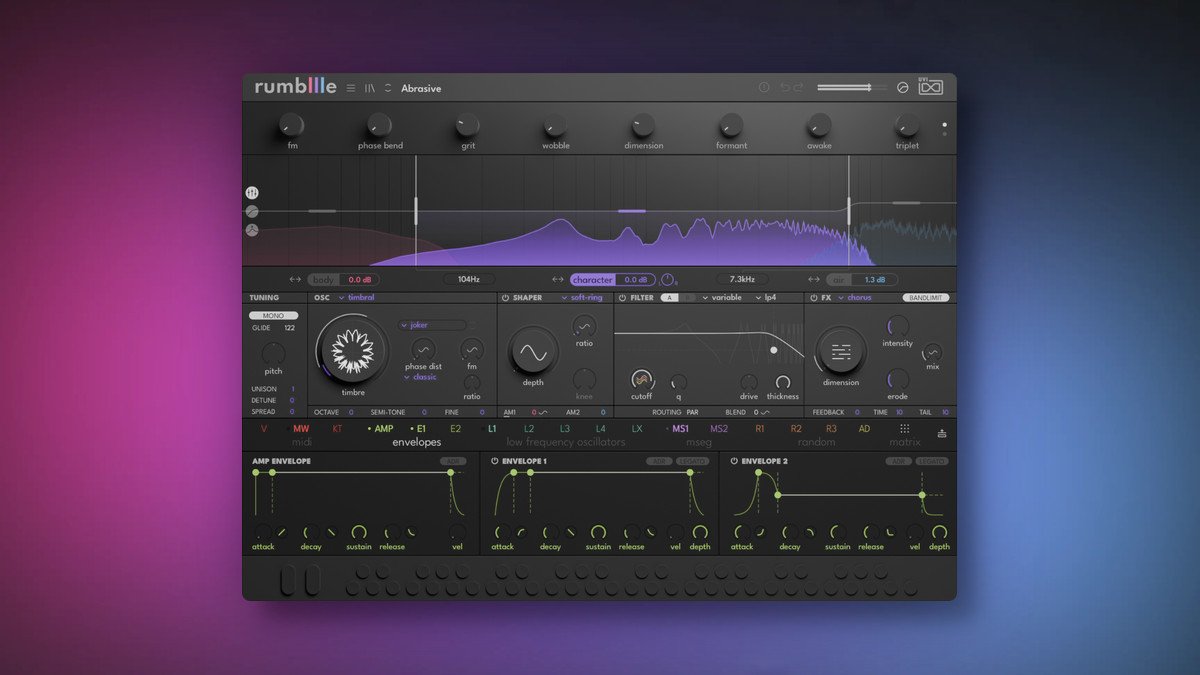
UVI, have built from the ground up a synthesizer that takes 3 voices and separates them into 3 bands with their own oscillators, and a boat load of effects and routing that allows for crazy sound design.
During my last couple of days of testing presets, frequencies, oscillators, macros, sound design and music creation, this multiband synthesizer is so much more.
First Impressions
The first thing that catches you with Rumble is its amazing looking interface available in bright and dark mode. But most of all for me this synth looks and sounds like Native Instruments Massive X.


The interface is logical and has helpful tool tips for key sections and buttons. These can be toggled on and off in the preferences section.
Rumble delivers on the low bass end. Though I wanted to see what else I could do with it. Could it deliver me believable sounds in the mid, and high registers for plucks, leads, or maybe a string type sound. And it surprisingly delivered inspiring and useful sounds.
Some other stand out points from my initial take on this synth are how well the manual is outlined. Macro mapping, drag and drop, and band splitting all made this synth easy to use. This gave me the ability to create some amazing sounds on my first launch.

Input Signal Chain
Rumble splits the sound into three dedicated bands — Body, Character, and Air — and treats each one like a full synth. That decision alone changes how you design low end.
The layout makes the concept obvious: three parallel engines, each with its own oscillator, shaper, and effect slot, all feeding into a shared filter, multiband compressor, and master EQ. It’s a clean, top-down view of the sound. You’re not guessing where weight, grit, or snap are coming from — each band handles its own territory, and nothing fights for space unless you make it.
Band–Signal Splitting
I really love this section. Outside of an EQ which Rumble has, this really adds that cross-sectional sound design that allows you to get deeper with your experimentation. This feature is like Plugin Alliances TRIAD.

Modulation & Macros
Modulation is everywhere on this synth in a good way. You can almost modulate anything. Just click and hold any of the macros and the areas you can modulate will highlight.

Oscillators
The oscillator lineup is surprisingly deep. Nine models cover analog, morphing, formant style phoneme tones, folding, noise, a kick style transient generator, and even a sampler engine tuned for bass hits. They’re not filler oscillators either; most have secondary layers or extra shaping that push them beyond the usual “pick a waveform and move on” workflow. It’s the kind of design that rewards tweaking instead of preset surfing.
Sound
I found Rumbles sound holds up well against some of the favorites out there like Serum, Massive X, Phase Plant. It can sound harsh and digital. But it can also sound phat, analog, and musical. The sounds just scream for you to tweak them.
Presets
The factory library is big and surprisingly varied. Yes, it covers the expected 808s, wobbles, growls, and Reese style patches, but it also dives into drones, cinematic textures, motion sequences, and more abstract sound design. Every preset is built across all three bands, which means even the simpler sounds feel intentionally structured. Nothing collapses into mud or fizz unless you push it there.

Pros
- Does what it says it does and delivers the boom.
- Macros that are fun.
- Automation.
- Modulation.
- 3-day trial.
Cons
- Price after into offer.
- Annoying save window after every tweak when you switch presets.
- CPU hog.
Alternatives
Final Thoughts
Rumble isn’t trying to replace Falcon or compete with massive modular environments. It’s focused, opinionated, and built for a specific job — delivering bass with weight, clarity, and motion. And it does that job extremely well. If your sessions lean on low-end as a primary voice rather than a supporting layer, Rumble gives you a level of control that single path synths just can’t match.
Rumble is available for Windows and macOS as standalone software and in VST3, AU and AAX plugin formats. Regularly priced 199 USD/EUR, the synth is still on sale for the intro price of 99 USD/EUR at the UVI store until June 28th, 2026.
ABOUT THE AUTHOR