

For a plugin to earn a place in my everyday setup, it needs to solve a problem my existing tools don’t, or offer a better way of approaching it. Kreuzberg Audio’s STAFFEL makes an interesting case for itself, although understanding where it fits takes some experimentation.
Its central idea is a staged handover between two filters. Rather than simply crossfading their outputs, STAFFEL transfers processing section by section, creating intermediate responses along the way. As developer Frank explains: “Along the way you get sounds that are neither A nor B, but something of their own.”
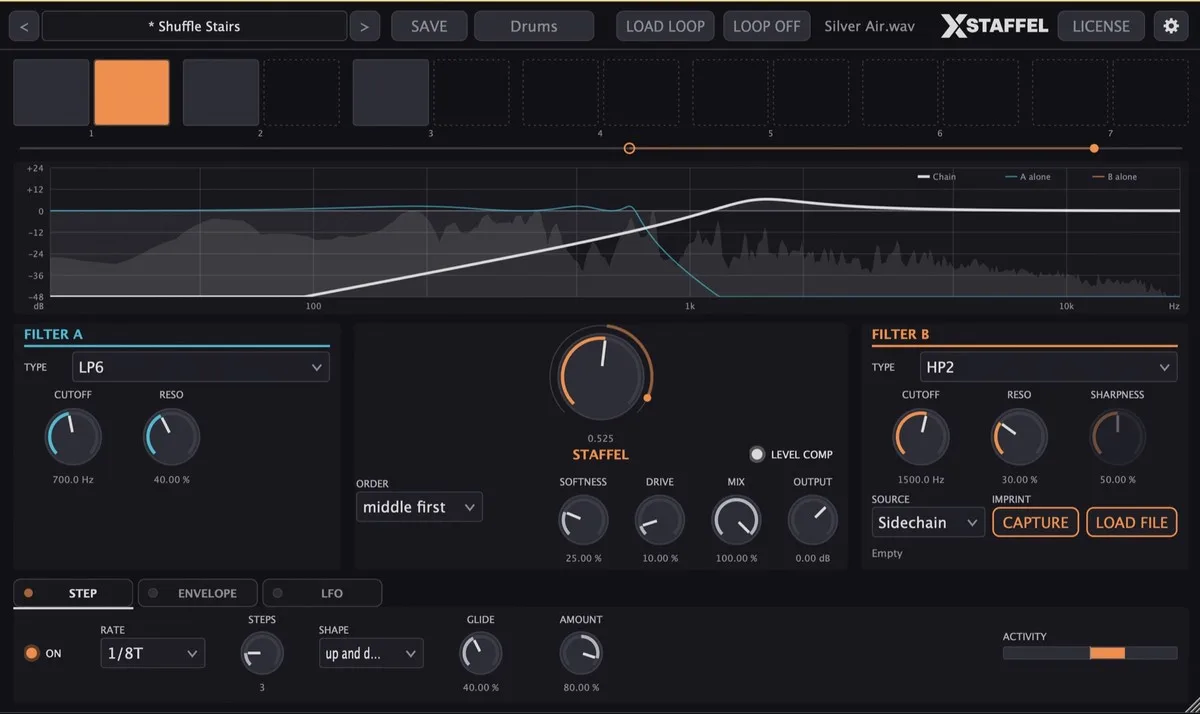
A warm, harmonically rich pad proved a useful starting point. Moving between a four-pole low-pass and a two-pole high-pass produced cycling, phase-like resonances, with the responsive frequency display making the changing peaks and notches easy to follow. Increasing resonance made the movement more pronounced, although fully wet processing could feel too drastic. Blending roughly half the dry signal back in preserved the pad’s body while allowing those shifting colours to come through.
Small cutoff adjustments made surprisingly large differences to the relationship between the filters. Finding a sweet spot required patience, but SOFTNESS was particularly effective at smoothing the handover. DRIVE also brought out appealing overtones and emphasised lower-register resonances. High-resonance settings need careful level monitoring: the drive’s level compensation should not be mistaken for peak protection.
The modulation options extend the idea considerably. STEP offers up to eight steps, with ascending, descending and up/down patterns, while GLIDE smooths the movement between them. Choosing an odd step count suggests interesting rhythmic cycles against a regular arrangement. On a drone, adding a slower LFO alongside STEP introduced longer variations that made the movement feel less obviously repetitive. An envelope follower, optionally driven by a sidechain, adds another way of moving between the filters.
Results depended heavily on the source. I was less convinced by an isolated drum loop, but a full musical passage sampled from a psychedelic record worked much better. With bass, midrange instrumentation and high percussion available, the stepped filtering brought different parts of the arrangement into focus. That suggested a practical application in sample-based production, where movement within an existing loop can be more useful than another obvious effect layered over it.
IMPRINT was less immediately persuasive. It derives a resonant filter from supplied audio, allowing that captured character to become Filter B. I tried isolated vowels and vocal phrases, hearing slightly different resonant colours rather than a clearly recognisable connection to each source. Those variations may reward further exploration, but I didn’t find an obvious application during testing. Processing a vocal directly also produced some uncomfortable resonances when sweeping the cutoff.
The factory presets span Bass, Drums, Acid, Voice and Chaos, although a dedicated pad bank feels like an omission. More fundamentally, such source-dependent processing made me prefer starting from a basic setup. Learning how the filters respond to the material felt more productive than auditioning complex modulation presets whose suitability changed with the input.
STAFFEL has merit. Recreating this particular combination of staged filtering and modulation with Ableton’s existing tools would, I suspect, involve a fairly elaborate setup. At €49, it offers an accessible route into that territory. For me, though, it is a tool to explore, learn and remember for a suitable moment. Spend time discovering what it does well with your own material, and it could become a useful option when a track needs precisely this kind of evolving spectral movement.
Find out more here
Related
Discover more from Decoded Magazine
Subscribe to get the latest posts sent to your email.