


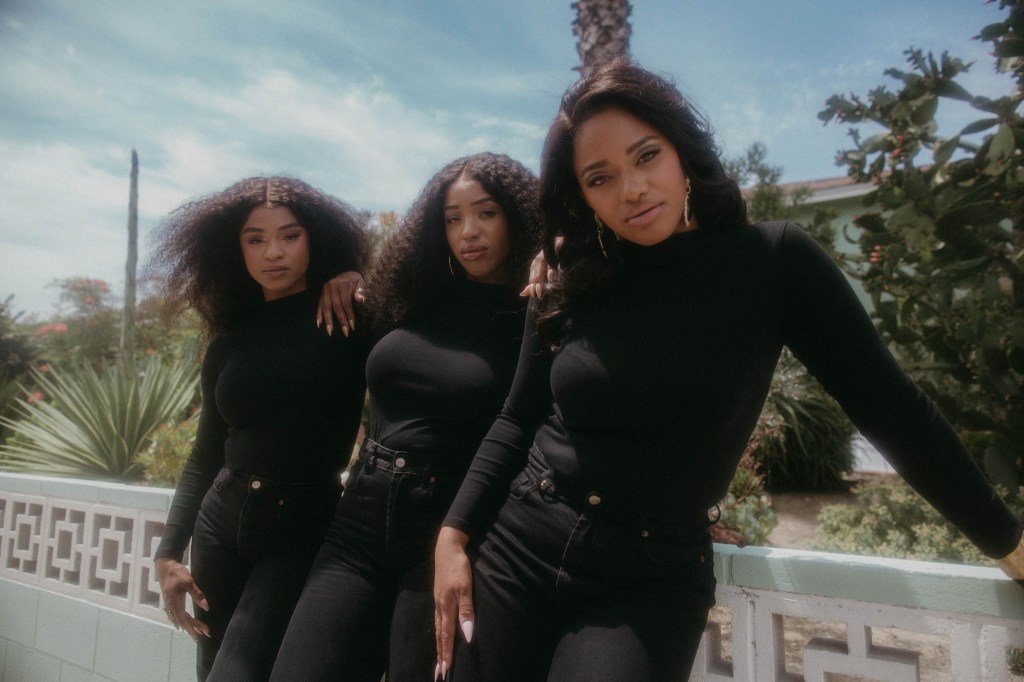
Black music trios — from the post-millennium pop precision of Destiny’s Child to the mid-2010s craze of The Migos — offer us an undeniable feeling of harmonic completion. In a space crowded by solo acts, The Womack Sisters represent the power of three in rare, uncompromising modern soul. Listening is like stepping into a time capsule of 1960s acts: The Supremes (whose “Stop! In the Name of Love” remains a pop culture staple), The Shirelles (whose No. 1 hit “Will You Still Love Me Tomorrow” was famously covered by Amy Winehouse), and The Marvelettes (who sang Motown’s first No. 1, “Please Mr. Postman”).
Their official debut, The Womack Sisters, brings analog warmth, tight three-part harmonies anchored by guitar and deep, rubbery basslines. Working with Daptone’s Bosco Mann and Wayne Gordon alongside a “family full of musicians,” they favor performances in which players organically bounce notes off each other, rather than calculated digital production. Emotionally, the record moves from sunny, summery joy (“If I Let You”) to bluesy heartbreak (“Monster”) to family devotion (“My Sisters and Me”), always grounded in soul music’s ultimate purpose for them: truth-telling and healing.
This project’s arrival begs two big questions: What does it take to keep traditional soul at the forefront in 2026, when soul is scattered across subgenres and Black women singing retro styles are no longer prominent on pop charts and the radio? How will acts that descend from soul greatness carve out their own path for a new generation?
Until now, casual observers may have seen The Womack Sisters as the ladies with big hair and matching retro fits, fingers snapping, and singing in effortless unity across social media timelines, while commenters quickly identified them as Sam Cooke’s granddaughters, Womack & Womack’s daughters, and Bobby’s nieces. Just as Donny Hathaway’s legacy continues through Lalah Hathaway, the Isley Brothers through Alex Isley, and Jaafar Jackson carrying his uncle’s torch, being a bloodline music bearer evokes creative pride and comparisons, ones the sisters fully embrace.

Rosie Cohe
“We think of the Womack family as one, we think of the Cooke family as one, and we represent each other wherever we go,” shares BG, the eldest sister. On a video chat from their North Hollywood home on an early September afternoon, between tour dates with labelmate Thee Sacred Souls, the trio makes it clear they are representing their lineage while forging a distinct path. “We feel like our legacy is not necessarily about separating ourselves from them, but continuing the greatness and exposing next generations to the fact that they were here,” she continues.
On stage and across their self-titled album, released this past August, you hear their lifelong discipline. Raised across the globe in South Africa, England, France, Tanzania, and Thailand with their touring parents, Cecil and Linda, the sisters were brought straight to the studio from birth.
Music was the household baseline: their mother sang daily, and their dad played guitar every morning, running through verse ideas, testing harmonies, and asking for their input on lyrics. “He was very big on keeping a melody strong, sticking to it, and also knowing that all music, when you take the genre away, it’s the same 12 notes,” BG recalls. “If you start there and not stray too far, you can listen to any song, and it can be anything.”
Their father named them Ejyptsian Queen. But as they matured, they chose The Womack Sisters to honor their father and uncles, The Womack Brothers. Over our chat, the individual personalities that make up their tight-knit unit become clear, and in true sisterly fashion, they complete each other’s sentences.
Kucha, the youngest member, is the organized backbone, anchoring the group with a “jazzy, fluty” register the sisters liken to a female Curtis Mayfield. BG delivers gospel-steeped belts meant to send you “right up to God,” while holding down the title of most eclectic sister (her latest proposal: launching an avocado farm). Rounding out the trio is Zeimani, the middle sibling and resident comedian, whose raspy vocal grit carries the DNA of her late uncle, Bobby Womack.
Together, charming, sharp, and self-determined, they offer a new perspective on vintage soul.
The Womack Sisters’ music echoes an era when Black female artists faced blatant sexism and racism, a time when women couldn’t legally hold a credit card, own studio time, or protect their families from systemic discrimination. Their grandfather’s “A Change Is Gonna Come” was born after a segregated Shreveport, Louisiana hotel turned him away in 1963. Back then, Black American music served as a unifying sanctuary of resistance, a tradition pioneered by the blues.
“I think our people wouldn’t have made it through a lot of the things that we have gone through if we weren’t able to express music that’s speaking straight from the spirit,” says Zeimani. “It’s authentic. It’s real pain, real joy. There’s no intention for anything but truth and healing. It’s to make you stronger, to give you that hand that you need to walk you through life.”
Today, more independent Black women in soul, from future-R&B to old souls like The Womack Sisters, embody what Black artists of yesteryear fought for: total creative autonomy.
The sisters are living that dream, releasing the exact music they want to make through independent funk and soul label Daptone, though the journey was a marathon. While they had what many musicians don’t (iconic parents who taught them the game, from international touring logistics to legal counsel references), lineage alone didn’t pay the bills when they stepped out on their own.
They bootstrapped by investing their own money and leveraged social media. “It was really good to help us build [an] audience and people that are genuinely interested in us [and] slowly trying to turn them into real fans where they buy things,” shares Kucha.
One project that gained traction was their retro-1960s single “Darling” in 2017. After friend Jimmy heard “Darling,” he passed along their info to producer Bosco Mann, co-founder of Daptone Records. At the time, Daptone was grieving their star vocalist Sharon Jones and wasn’t officially working with new acts, while the sisters got tangled in a bad deal with another manager. To keep music out in the world, The Womack Sisters released Legacy EP (2022), featuring remixes of earlier records.
When they reconnected with Daptone, they pulled out tracks cut with Bosco and songwriter Wayne Gordon during initial meetings: “I Just Don’t Want You” and “If You Want Me.” Kucha says, “Listening back, we were like, ‘Wow… those are some good songs…’ We knew that that was it. That was the sound.” After finalizing backgrounds and adding instrumentation, these songs anchored their 11-track debut.
“We were sitting talking about life, and that’s how we put these songs together with Gabe (Bosco Mann) and Wayne,” explains Zeimani. “He brings the guitar in, and we go from there.”
During the recording process, they poured their real lives into the microphone: BG recently navigated a painful breakup, Zeimani endured the loss of her husband during the pandemic, and they juggled side hustles to fund their careers. It was worth it. By summer 2026, their lead single “If I Let You” took off on social media, bringing them new fans. It carries the breezy warmth of the season, but underneath lies a crucial boundary: vet potential lovers before they enter your house or bed. “Ensure they are bringing joy,” says Zeimani.
On “Monster,” the emotional pendulum swings to reflection. “You want to give yourself a big hug after hearing ‘Monster,’” says Zeimani. When relationships end sourly, they can leave a person feeling unworthy of love and form an “icebox” heart, says BG. The track reminds listeners they deserve good things after heartbreak.

Rosie Cohe
Meanwhile, “Chauffeur” was born from conversations about driving Ubers to make ends meet. “When you’re out there for hours trying to make enough to pay a bill…and you don’t make what you would have liked to make, but you get back out there and do it again,” says Zeimani.
They explore unconditional love on “I Am Your Season,” capturing the purity of early romance, while “My Sisters and Me” is about how they saved each other’s lives. “We’ve been each other’s best friends…as long as we could speak,” says Zeimani. Their unbreakable bond is why they’ve made it this far: “Whether it’s relationships, life, death, we’ve really been there for each other.”
Looking ahead, they name-drop heavyweights they’d love to collaborate with, including Ari Lennox, Jazmine Sullivan, Nas, Kendrick Lamar, The Roots, Harry Styles (whom they open for on tour soon), and Baby Rose, who the sisters note “is like our DNA.”
Though new vintage soul feels much harder to discover through mainstream channels, The Womack Sisters prove the genre still draws excitement when people find it. Weeks before our call, in the warm glow of a Lower Manhattan vinyl listening theater, a DJ dropped the needle on classic soul records for a room full of attentive young listeners who weren’t alive for their release. A few weeks later, “If I Let You” arrived on my TikTok “For You” page. I texted it to my friend (who I brought along): This song gives me the same vibes. Comments under the clip ranged from “Please bring this genre back” to “Please please please don’t be AI.”
The full-circle moment showed me that soul music, whether spun in an analog setting or served up by social media algorithms, will always find its way back to us.